
Half-Days
Souvenirs from a shitty season.
―
Snow gun hissing still
Bluebird sky dries the county
Kindling for June.
November.
Our new locker room occupies a hastily built-out corner of the Grand Colorado’s garage. There are no windows, so it smells of exhaust and feet. Returning pros squabble about where to put the computers and the vending machines, but everyone agrees there are not enough benches or places to put the skis.
A construction site behind the Magic Carpet swallowed our old home over the summer. Broken ground leaks diesel plumes into the learning area. When the wind turns north, they carry all the way up to Trygve's Platter, which isn’t running yet anyway. Through peepholes in the construction fence we glimpse bones being laid for the resort’s first five-star hotel: The Imperial Hotel and Alpine Chalet Residences. Embedded in its 70,000 foot sprawl will be the “Sky Domes,” glass geodesic houses where high-net worth individuals can dine and stargaze. For now, though, it’s just a big dirty hole.
Blue jackets swing on hooks. Boot dryers hum, filling the air with their familiar musk. The pros trickle in but the snow does not. A week is all it takes to shred the “White Ribbon of Death” to a shoelace. It feels more like April than November.
I return from another lower-mountain lesson, sixth toe burning, wearing only a thin base layer beneath my uniform, unsure what the uniform is for.
December.
Thirty-seven of 193 trails open. An 18” base. Daytime temperatures squat above freezing at base elevation, refreezing weakly at night, if at all. Snowmaking fills narrow wet-bulb windows, laying down dense, artificial ribbons that abrade quickly under holiday traffic. Natural snowfall hasn’t built depth; it sublimates, melts, or compacts back into dirt.
The hollow statue of the Norse god Ullr stands motionless at the base of Peak 8. His bow drawn, his arrow aims at a widening patch of dirt beneath the Colorado SuperChair. Kids slither around sharks—rocks hidden like prizes between moguls—and micro-forests that push up defiantly through the white stuff we’ve paid dearly to make.
Exasperated instructors confiscate skis and send groups of advanced kids one-footed down the greens. The sups laud such creative pedagogy, but the parents are not impressed. Lesson prices have gone up. A full-day private now starts at around $1300. A half day at $900.
“We’re in a donut,” lament the locals in bars. “The snow is hitting everywhere all around us. East, West, they’re all getting pounded. But not us.”
In Broomfield, the corporate wizards reach for euphemism: variable, packed powder, early-season conditions. But it isn’t early season. It’s Christmas week—the first rush of what’s supposed to be winter.
A persistent ridge of high pressure has diverted more storm tracks north. On Christmas Day, rain falls on Main Street.“Variable” isn’t just a euphemism for bad snow. It’s overworked bodies. Dwindling work. And rent that won’t quit.
January.
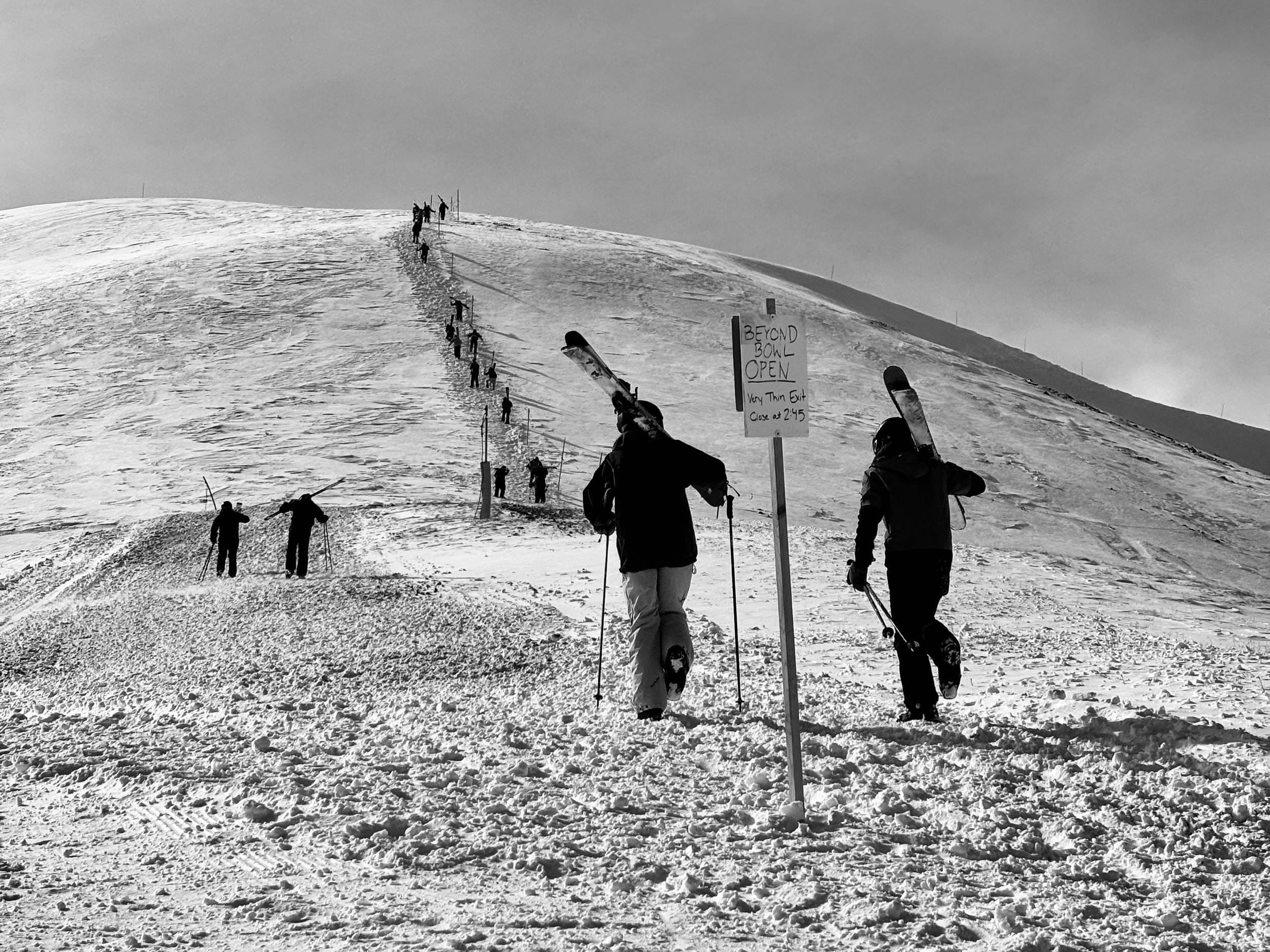
The donut shows no signs of abating. The apps show a 30” base at Breck, 70” at Hunter. Let’s not even mention what’s occurring at Jay Peak or in Vermont. The resort’s social media team burns overtime. As the weeks slip, they go from posting white rooms money shots taken last season (presumably to entice March bookings) to addressing the blight directly.
Look! We are so authentic! Come and have fun with us despite the shit conditions! Skiing’s not about quality or quantity! It’s all about who you slide with. Look! Here’s an adorable avy dog in training! Aren’t the views, like, so pretty?
In a week, the resort will have used all its state allocated water for snowmaking. While the local news quietly covers the debate about opening a thirsty new data center on the Western Slope, passholders are told not to worry about the snowmaking. The resort will buy reserves from the town. And where (everyone thinks but dares not ask), when that runs out, will the town buy its reserves from?
One Thursday, I ride the gondola down with a Boomer instructor after another day of no lessons. His beard is the color of refrozen snow and his Carhartts have holes in them; he wears the uniform of the veteran ski bum well. He smiles correctively at me when he asks how my season is going and I respond honestly.
“Don’t be so dower, dear. It’s great to have all this time to free ski! I took the day off to telly.”
He grins at me like a guy who bought real estate here in the 80s.
“You know,” he continues, “there was a winter like this once. Back in the early ’80s, before snowmaking. Breck shut down for a month. Then it dumped. Absolutely nuked. And when it did, we had the biggest spring I can remember.”
(Of all the words skiers use to talk about snow, that one— nuke—is the one I hate most).
One by one, my regulars cancel.
“So sorry,” they apologize, “but we’ve decided to go to Mexico this year. Hope you get some snow soon!”
Beginners take their place. My schedule fills up with the half-day privates that are all the rage these days. Value is squeezed like blood from stone in a sport synonymous with money. The culture around skiing seems to have shifted with the climate but here both subjects are mostly verboten. There is only Stoke, Send, and Slut Strands.
The Magic Carpet churns while prayers for inches resound through the county at night. The bars fill up and the restaurants report a boost in earnings. Across Vail Pass, in Eagle County, the southern facing aspects soak up so much sun they’ve stayed completely bald. Squirrels and chipmunks chatter on the treed fringes of blue groomers, and confused moose stumble out onto the runs at Peak 9. Birdsong, not normally heard til closing week, trills in the air.
February.
The Olympic torch burns through Cortina. And just like that, the world is enamored with winter sports again. Lindsey nearly loses a leg and Mikaela reclaims the glory that eluded her in Beijing. Everywhere but here, it seems, the skiing skies on.
Suddenly, the water for snowmaking is all gone. The sun gnaws what’s left into afternoon slush, which promptly congeals overnight. Patrol shuts down runs previously opened. Collisions after collision make local headlines. One bro at Keystone rushes a tree so hard that he loses an eyeball, then promptly sues the goggle company.
Prayers for powder dissolve into hushed chatter about summer. The experts say the threshold has already been passed to generate enough snowpack to see us safely through fire season. The runoff will limp along. Whatever does slip into the river beds will disappear quick. Lake Dillon, which hydrates the Denver metro area and didn’t freeze until this month, sleeps fitfully under her thin cover. She tosses beneath her thin sheets of ice like a child with a fever. It is announced that Frisco will close the marina’s dock and public boat ramps for the summer.
Just in time for President’s Day, patrol drops rope on T-Bar. There’s dirt in the track on the way up, and crowns of rock complicating all entrances to the bowl.
“Can we go ski up there?” the kids ask.
I shake my head. “Not today.”
Even the old timer isn’t taking days off to telly anymore.
Turn Phases Are Places
I went to cert 3 clinics.
—
On Thursdays after a day of watching skiers ski around the mountain, Cert III candidates watched videos of more skiers.
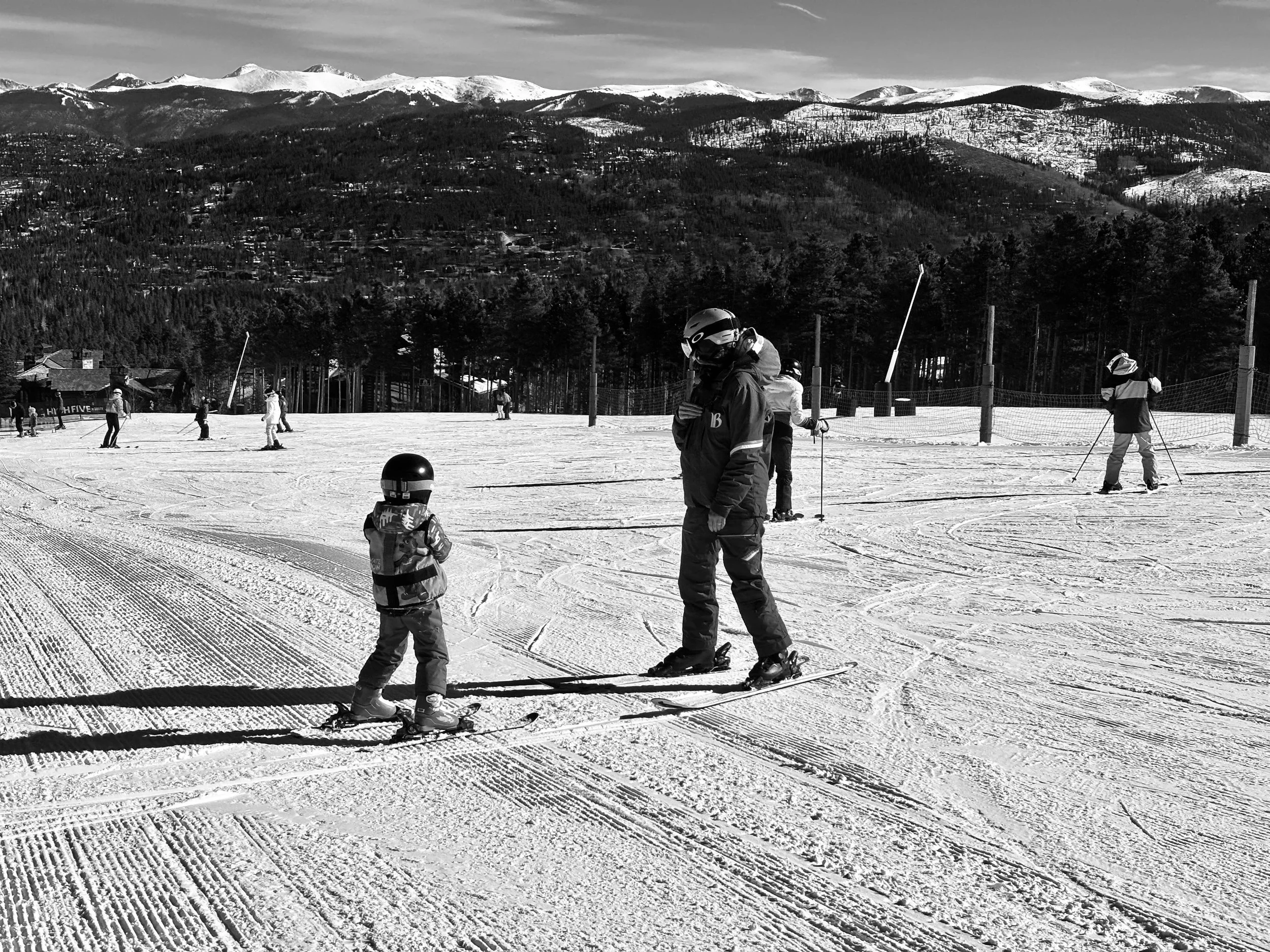
It was the particular late of ski towns, when the lifts have stopped spinning but the day hasn’t quite let go. In the Village kids’ center, we folded ourselves onto chairs meant for children—too small for most of us, knees up, backs rounding, no one comfortable but no one admitting it. Someone filled bowls with Goldfish and passed them around like rations.
The trainer fussed with the projector like a substitute math teacher. Then, under fluorescent light, we began.
Movement analysis at the Cert III level has a way of clarifying things by muddying them. The lexicon of how bodies and skis perform their official ballet is mechanical, not moral.
“The skis tell the truth,” the writers of manuals and rubrics of the Professional Ski Instructors of America insist. What they really mean is, it is your bodies that try to lie.
Out on the hill, with real students, the language always feels simpler than the dense codex of sagittal planes mitigating centripetal forces. A student’s edges either hold or they don’t. You can hear the clean, high hiss of a ski set on edge, or the loud loose grate when it isn’t.
“Pizza!” you scream for dear life as the body locks and careens toward the fence. “Piiiiiiiiiiizza!!”
No parsing required. Just the peeling of Gore-Tex from fencing and the occasional wiping of tears.
Inside, though, the words always get in the way.
This week, the Irish national team performed dynamic short-radius turns. The video looped at half-speed. The trainer played it until someone emerged bold enough to speak.
It was a young instructor from Peak 9. He’d gone for the exam a few weeks back and found himself unsuccessful. He leaned against the cubbies stacked at the back of the room, still wearing his backpack, like a veteran returned to basic training after seeing combat.
“Um, the skier initiates his turns in the backseat. He’s aft in all three phases.”
All eyeballs rolled toward him like snowballs down the bunny hill. Uh-oh.
Movement analysis is the banality of precision. The dialect is exacting and faintly absurd. One does not say, “the skier is aft.” One says: at initiation, the center of mass moves aft of the base of support, limiting the ability to direct pressure along the length of the ski.
“Let me stop you right there, son.” The trainer—who’d been listening with the patience of someone accustomed to coaching three-year-olds—interrupted.“I fail a candidate as soon as I hear them speak about turn phases as verbs.”
The room imploded in silence. The projector whirred and some laughter drifted in from the ice rink nearby. Someone shifted; a boot sole squeaked faintly against linoleum. It was so white-out quiet you could hear a snowflake fizzle in hell.
“You don’t initiate the turn. It’s at initiation.”
It was, on its face, a small correction. But it carried the weight of a larger ideology. The minutiae, the semantics, in PSIA, they are precisely the point.
To speak of initiation as a verb is to imply control, authorship—an act a skier imposes on the mountain.
To speak of it as a place is to acknowledge something more existential: the turn unfolds in spite of you. The turn is ideal. It’s a Platonic Form that exists in a perfect arc apropos of nothing. But not you, the skier. You, with your bum knee and tight hips, are all too real. Real means fallible. As in, likely to fall—over your words, your crisscrossed tips, your boots on the frozen puddles laced throughout the parking lot at the gondola’s end.
Movement analysis’ purpose is to make you understand how you suck in relation to the turn, not the other way around.
At initiation.
In shaping.
Through finish.
“Ski–snow interaction” is best understood in prepositions, not commands.
On a warm January day, a training in Vail begins with a warning: rotary inaccuracies can cause fore/aft issues. It is delivered without emphasis, but once heard, it is everywhere. A slight twist at the top of the turn, a subtle pivot of the feet, and the skier is displaced. The skis scrape instead of carve. When pressure arrives late, the pelvis is usually the culprit.
“Not square,” the trainer, a different one from the one who loves prepositions, says. “Separation, not symmetry. Now, let’s try and task ourselves into good skiing.”
At the finish of the turn, she has us sideslip all the way down Pickeroon. Not as a rest, but as a reference. The skis flatten, the edges release, and there’s that familiar, dry whisper of bases against snow. Alignment of the center of mass to the outside ski is the goal. Lead it with the inside knee. The skis slide where they had once gripped. The toe of the downhill boot seeks the middle of the uphill arch. Micromanaging tip lead feels small, almost trivial, until it doesn’t. The sound changes, the sensation changes, and the whole system reorganizes around that point.
The body resists; the task insists.
There are images, occasionally. The ski is the bow, the snow the string, the outside leg the arm drawing the arrow back. You feel the tension build—not metaphorically, but physically, in the muscles, in the contact with the snow—and then you release. The turn snaps cleanly through. Less an action than a location you can pinpoint with an arrow.
Indoors again, this time at home on Zoom, the tone sharpens. The task is performance mediums. A mise en abyme: your spoken performance of the ski’s performance of your body’s performance.
“I’d like to see the skier continue flexing their outside leg through finish.” I say. “And develop more counter all the way through shaping to unlock more ski performance.”
The structure is simple, and unforgiving: I see this, and this is causing this. What I would rather see is…
“Yes,” the trainer agrees in a way I know I missed the mark. “But now connect the outcome to the ski performance and body performance. This skier’s tendency in movement pattern is to move from the hip. She gets a high edge angle early and cuts off rotation. Try again.”
I try again. And again. Over time, halting shifts closer to fluency. Initiation becomes a place whose boundary to shaping is as porous as shaping is to finish. They each last an infinity and are inextricably linked. I arm myself with PSIA words, none of them mine.
Your eyes memorize what you ski. And then, almost without noticing—
the verbs disappear.
Fundamentalism
According to PSIA.
—
According to PSIA, the Five Fundamentals of alpine skiing are:
1. Fore–Aft Pressure
Mass moves over base
Directs pressure fore and aft
Along the ski length
2. Ski-to-ski / Outside Ski
Pressure foot to foot
Directed to outside ski
Arcing tip to tail
3. Edging
Edge angles controlled
Incline and angulate more
Tip from lower leg
4. Rotation
Skis rotate with legs
Separate from upper body
Steering with the feet
5. Pressure Magnitude
Regulate pressure
Ski to snow interaction
Flexion, extension
28 hr (1,874 mi) via I-80 W
Poems composed on the drive from New York to Colorado.
―
Poems composed on the drive from New York to Colorado:
Ohio
Ski bro at the pump—
Jersey plates, puffy jacket,
knowing nod ensues.
Presidential
Birthplace of Lincoln—
green signs lecture as we drive.
Birthplace of Reagan.
Work Zones
Chevrons flash orange.
Arteries of asphalt squeeze;
neon hazards glow.
Iowa
Turbines rake grey sky.
Billboards preach roadside gospel—
America shrugs.
Accident
Semi on its side,
tipped like a child’s toy truck—
steel guts glint in sun.
Ovid, CO
Metamorphosis:
state lines shift, the earth stays flat—
Nebraska, but not.
The Whites
Poems written in a New Hampshire diner.
―
1.
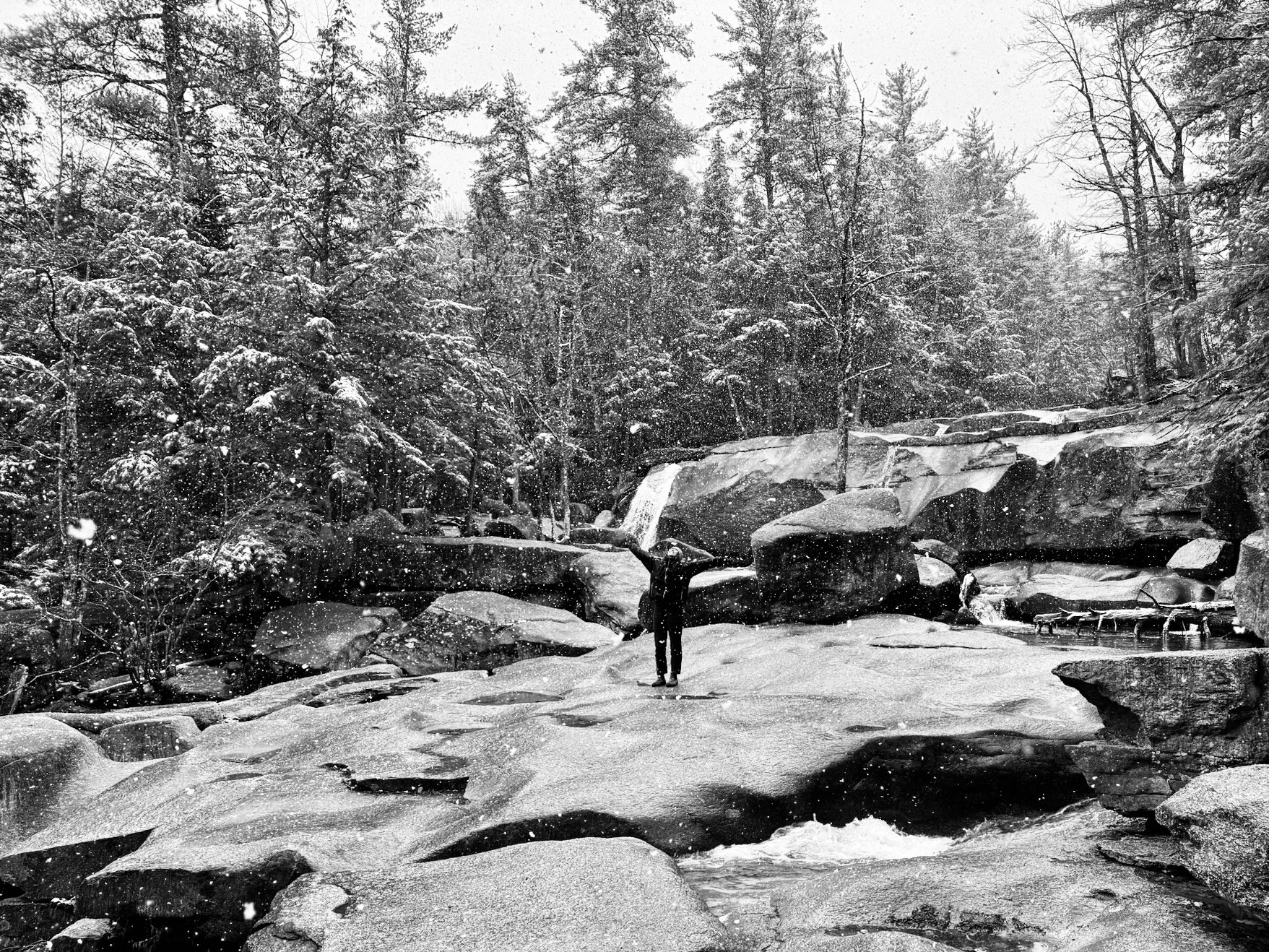
North Conway woods—
sideways November light slips
between bare branches.
2.
Fall loosens its grip,
or maybe I’m the one who
cannot hold it still.
3.
The old man’s stone face
gave way to weather and time—
souvenirs remain.
4.
First snow on the Kanc—
the White Mountains disappear
to become themselves
MOI
“CPR does not work in the woods.”
―
My knees chilled from kneeling in wet November leaves. Someone was playing an unconscious victim with unnerving conviction, half buried in duff. I palpated her limbs the way you check a jacket pocket you’re almost certain you haven’t lost your keys in—half hopeful, half afraid of what you’ll find.
“Just remember,” our instructor called out, hands tucked into his vest pockets, tone dry as tinder, “CPR doesn’t work in the woods. Hurry up and figure out what’s wrong with your patient.”
He wandered over to inspect my technique, which at that moment consisted mostly of wrestling my patient onto a sleeping pad and rooting, somewhat desperately, for a carotid pulse.
“Don’t reach over your patient like that,” he said. “Take the pulse on your side. Otherwise you’ll strangle her.”
Killing my first patient felt like a reasonable beginning to Wilderness First Responder—known, with varying degrees of affection, as “Woofer.”
For ten days, our group of twenty-one strangers revived plastic infants with stiff limbs, treated imaginary drunk campers, and staged the mass-casualty aftermath of a downed gondola in the pines of New Hampshire. Mornings meant rolling out of bunk beds, submitting gratefully to Nancy’s enormous breakfasts—Nancy being the campus cook and, by consensus, the only person keeping the entire operation emotionally solvent—and marching into the cold for scenarios. We memorized the necessary acronyms: AVPU, ABCs, SOAP. But the one that rooted itself most insistently—lodged, really, the way an impaled branch might—was MOI.
Mechanism of injury.
The origin story of pain.
The plot twist that gets you here, cosplaying catastrophe in the woods.
Outdoor professions attract a familiar cohort: the recent graduate not quite ready for a desk, and the retiree who spent twenty years at one and finally suffered the sort of existential rupture that results in a backpack purchase. Because of finances, there is very little in the middle. The twenty-two-year-olds are perfectly content to live under tarps in a state of communal, provisional bliss. The retirees, meanwhile, can afford to resurrect the happiest memories of their youth with the zeal of someone performing chest compressions on nostalgia. The metronome remains the same, but the song used to keep rhythm has shifted—from the Bee Gees to Chappell Roan—leaving those of us with aging but still functional knees and long Zillow wishlists in a kind of generational no-man’s-land.
Around me sat human clippings from a vintage REI catalog: rookie ski patrollers; a seventy-year-old scientist who surveyed remote Alaska; a retired teacher moonlighting with search-and-rescue; a twenty-something backcountry ski guide; a young “brown bear” guide fresh off his summer in the Kenai Peninsula; an eighteen-year-old New Yorker whose motives remained inscrutable; a nature therapist in her sixties. Only two people were in my age bracket. We spotted one another immediately, exchanging the quiet recognition of travelers who’ve missed the last ferry and now occupy the same dimly lit dock.
23 YOF.
70 YOM.
40 YOF.
Even stripped to the barest patient identifiers, we were an earnest, slightly improbable cast—twenty-one strangers who had, in various ways, accepted that the wilderness is where one eventually meets the hard limits of the human body.
“What’s our favorite word?” the instructor asked one morning, tapping the smart board with a digital pen that seemed to please him disproportionately.
“Continuum!” the class replied, as though it were a moral directive.
And in a way, it was. Everything, we learned, exists on a continuum: shock, infection, heat injury, hypothermia, traumatic brain injury—which the instructor colorfully described as “the brain trying to leave the skull through the big hole.” Careers, relationships, and taxes share the same sliding-scale inevitability. Talking nicely and sugar water, we were assured, help with most things.
“At the end of the day,” our instructor announced, “we’re all fucking hummingbirds.”
By then we had practiced impalements, strokes, heart attacks, broken ribs, tourniquets, and death notifications. We stabbed training EpiPens into our thighs and splinted one another’s intact bones with sticks and sleeping pads. Underneath the theatrics pulsed a quieter question: Will I ever need this? And: Will that ever be me?
Last year, it was. I had been a real patient. There is no moulage for c-word things. Nothing in the textbook—despite its generous enthusiasm for diagrams—prepares you for the way a medical event can rearrange your sense of chronology. My MOI was internal, discreet, the sort of plot point you can’t point to on a map.
Pema Chödrön writes that “nothing ever goes away until it has taught us what we need to know.” If that isn’t a continuum, I don’t know what is.
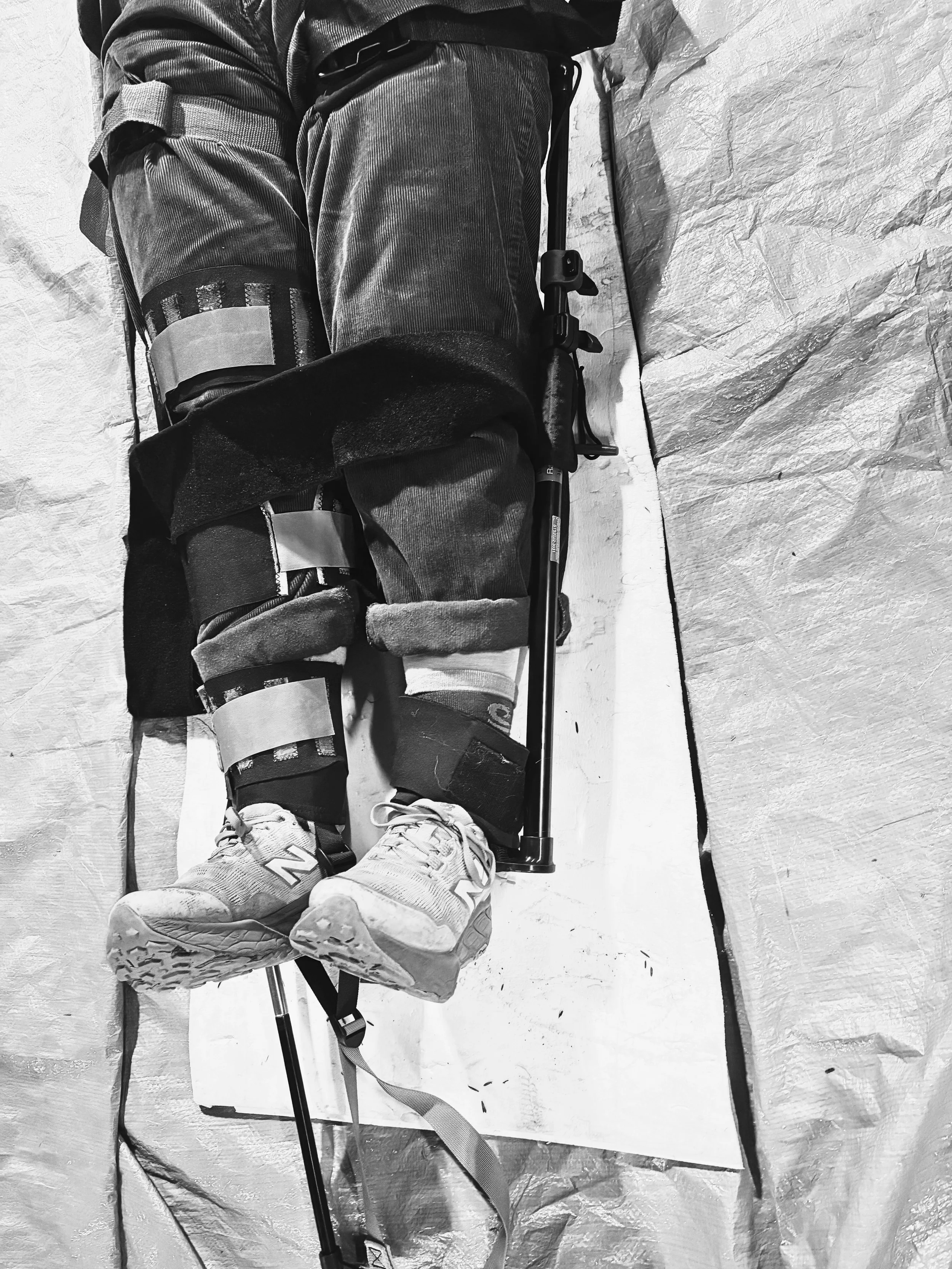
By week’s end, EMT Sensei—his own MOI wrapped neatly in a knee brace—led us to a ridge where five classmates and two mannequins lay strewn in dramatic disarray, moulaged with almost theatrical verve. Moving toward emergency always feels like approaching a mirror: the mountains we climb, the waters we cross, the people we love; the moments when things go wrong and you kneel beside a body, hoping your hands remember their choreography.
“So, what did we learn this week?” he asked on the final day.
“CPR doesn’t work in the woods!” we shouted.
But the unspoken second half had become obvious: But that doesn’t mean we don’t try.
I tucked my badge away and climbed back into the Subaru, pointing myself west. At my cushy resort mountain, is ski patrol. Helicopters on call. An army of elite orthopedic surgeons.
But first responder training isn’t about conquering chaos or even saving lives; it’s about cultivating a kind of interior ballast. The ability to arrive—at accidents, at relationships, at your own life—with a little more steadiness than the day before. To assess scene safety first, then decide whether you have a duty to act. And if you don’t, whether you will act anyway. It’s about widening, however minimally, the fragile circle in which you may be able to make something a little better. Including, it turns out, the slow, awkward business of getting older—especially when you find yourself wedged between the sendy, twenty-year-old hopefuls and the sixty-something wilderness sages. It is, like everything else, a continuum.
In the end, MOI feels less like a mechanism of injury than a mechanism of insight: why we are drawn to these places, why we return, why some of us build our odd little lives at the edge of weather and chance.
And why, in a hexagonal building in New Hampshire, twenty-one strangers worked so intently—earnestly, imperfectly—to learn the simplest and hardest thing: how to keep one another alive.
Used To Be August
Waiting for the seasons to change.
―
After the first frost:
Hoar
Yard sighs, mother-gray;
brittle blades wake silver-spined—
the forest shudders.
Mr. B. B. Says
“Used to be August,”
he sighs of October rime—
“frost’s gone by lunch now.”
Layers
Fog, river’s cashmere;
Hudson layers for the cold—
winter waves hello.
Dry Suit Season
Neoprene to wool—
paddle will soon be ski pole;
make sure zippers close.
Denning
Bears nose through the duff;
out back, a tarp snaps in wind—
snow hums in the pines.
On HABs
The Hudson falls ill.
―
The Wolf’s had a birthday since I last saw him at the Seattle airport fussing over his boarding pass, not quite thawed from our Inside Passage trip. Seventy-seven Augusts and counting, he now boasts a gold hoop in his left ear and a turkey feather tucked in his hatband. “Talismans,” he calls ‘em, to sanctify his new status as a sea kayak guide.
We met unloading boats at Kingston Point, and have paddled together ever since. From Rhode Island to Alaska, the Wolf’s hand-of-godded and towed me out of trouble more times than I care to admit.
This summer, while I’ve been away in Maine, he’s been leading trips Bannerman Castle, the eccentric ruin on Pollepel Island. I sign up to see him in action my first weekend back. The wolf wades into the shallows and shoves the Pungos off the beach. Their sturdy, almond-shaped hulls rock in the barge wake as Maine’s erratic lobstermen and postcard beaches give way to New York’s working waterway.
Here, city etiquette seeps upstream—sidewalk habits translate to current and channel. Boats of all sizes and kinds dodge, shift, merge. The tour crowd changes, too—New Yorkers, kin to New Englanders, but tempered: grittier, somehow sleeker. A Women’s History professor from Albany tells me why she drove her family three hours downriver to kayak today: “History,” she says. “What else?”
We cross on slackening flood and scramble over the rocky landing, slick with periphyton. The Hudson doesn’t swing ten feet like Maine waters, but its three-foot tide still breathes diurnally through this ancient fjorded valley.
A volunteer guide in a BANNERMAN’S CASTLE shirt with a Long Island lilt greets us at the island and gathers us by Mrs. Bannerman’s pie garden. The Wolf hangs back, chewing the inside of his cheek. He stands by and listens with the seasoned stoicism of one who’s spent the whole summer silently judging another guide’s schpeal. He knows her script by heart.
“He was the country’s original arms dealer,” the Wolf whispers to me. “Ran the biggest military surplus operation that became the Army Navy Surplus Store. This place is an adult game of hide-and-seek.”
After the Spanish–American War, Bannerman bought 90% of the US military’s unused weapons, uniforms, and black powder—so much that Brooklyn officials blanched at the thought of his munitions next door to the naval yard. The baron desired storage and spectacle, so he doodled himself a castle—part Scottish baronial, part billboard—its crenellations spelling BANNERMAN’S ISLAND ARSENAL for every passing steamboat to read. Poured quick and cheap, the concrete fairy-tale went up quick. For a time, it advertised a fast-tracked empire.
Then came the classic Gilded Age plotline: the warehouse exploded in 1920, Bannerman followed soon after, and the slow unspooling began. In 1969, fire set the period at the end of the sentence. What’s left is a buttressed rib cage open to weather, a shell that now stages local theater and a ruin Metro-North commuters know by heart—a concrete pastiche of The Great Gatsby’s closing line: “So we beat on, boats against the current, borne back ceaselessly into the past.”
Neon dots of algae whorl off my paddle like confetti. They are HABs—harmful algal blooms. A spotted lanternfly touches down on my hat —cryptic gray forewings, sudden aposematic red beneath.
“Kill it,” the Wolf says, soft but absolute. “Slowly, if you can, to send a message to the others. They’re very invasive.”
HABs on the Hudson.
The worst outbreak of blooms in 40 years inscribe the present tense in a scientist’s lexicon. Cyanobacteria and other phytoplankton—neither fish nor tree—are photosynthesizers catalogued by color and clade: green, red, brown; diatoms, dinoflagellates, blue-greens. In balance, they underwrite primary productivity, turning light into living carbon. But increase nutrient loading—sewage, lawn runoff, manure; warm the water; slow the flushing—and eutrophication takes hold. Pigments slick the surface like spilled paint.
Some blooms merely shade; some produce toxins. All are a message in dissolved oxygen and turbidity: choke the light, starve the gills, tilt the river toward hypoxia. Longer heat stretches stratification; drought reduces turnover; nutrients light the fuse.
Contamination isn’t dramatic. It’s steady—like sedimentation, a floodplain filling grain by grain. To get rid of the HABs, as the Columbia Riverkeeper says, the task is none other than tackling climate change itself.
While small efforts from individuals can always help, like picking up pet waste, the true remedy is for it all just to stop. Then wait for as long as it takes for the water to clean itself. But once the bloom is here, there’s little that can be done. Don’t swim in the waters, keep the dog away, and, in time, maybe it’ll dissipate.
“For time is the essential ingredient,” writes Rachel Carson in Silent Spring; “but in the modern world there is no time.”
The day after the paddle, the Hudson Valley Garlic Festival sprawls in a field to the west of Saugerties.
The mosaic of garlic hats, witches, vampires, and soil-rich hands throngs in the late September heat. “Eighty degrees,” sighs a vendor, wiping sweat from her brow with her forearm.
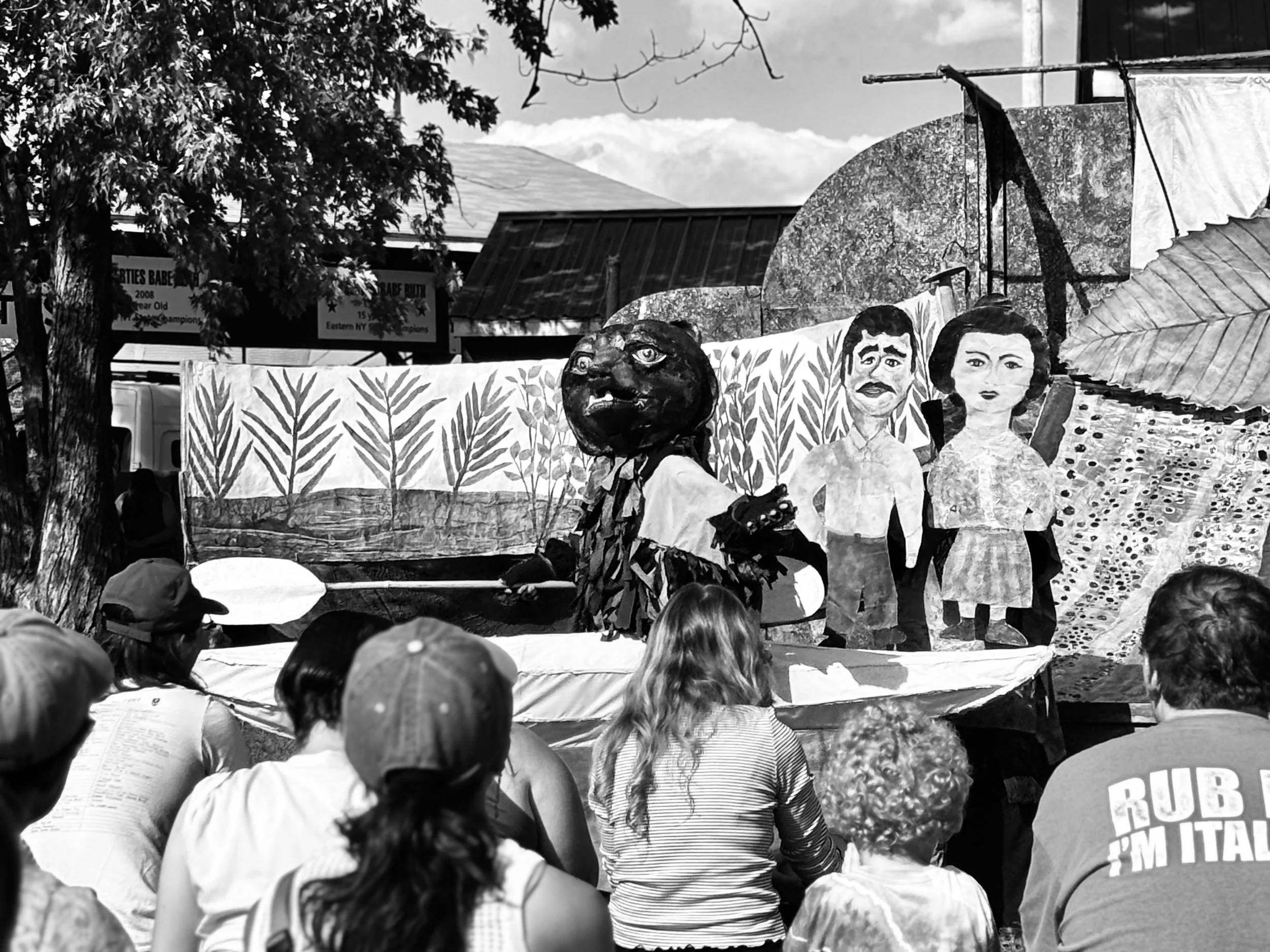
In the hay-bale commons, the Arm-of-the-Sea Theater unfurls a puppet river in cerulean silks and sings a song about photosynthesis to a chorus of equally delighted adults and kids. The troupe’s mission—“handmade theater as an antidote to ubiquitous electronic media and consumer culture”—ripples through the crowd as boos meet the colonial realtor and cheers rise for hemlock, oak, and pine.
Some of us are locals; some are not. Everyone is listening. For the finale, a black bear waddles onstage with a kayak cinched around his belly, paddle in paw. He dips the blades into imagined current, singing of environmental resilience to papier-mâché trout and city transplants alike.
Tucked in the generous allium bounty of small farms, the play reminds me that this place where I’ve made my home holds more than ruin and warning.
Sea kayak guides lead people into many waters. In Maine, we sell clarity—porpoises and ledge ecology, tidal respiration you can feel in your bones. We point to eiders surfing swell, pull out lobster gauges, and say, look how well the world keeps working.
It’s easy to forget that Rachel Carson spent her summers on Southport Island, just across the bridge from Boothbay Harbor where I lived this summer—and that her time there shaped the work that helped end DDT’s reign. Without her, the islands where I taught kids to Leave No Trace and delight in shorebird abundance might have read differently.
The Wolf threads us through the arteries of an overbuilt New York watershed to a Gilded-Age folly between interstate bridges. The Hudson’s riparian speaks in closures and neon veils, but also in the older key of resilience and succession: flood-pulse, leaf-drop, Forever Wild. On the banks, a countercurrent slowly gathers—garlic-festival crowds, hay-bale audiences, a bear in a cardboard kayak. Creativity is the Hudson Valley’s unique civic hydrology: it braids strangers, slows the current of despair, and makes room for oxygen.
The river remembers how to heal. We must remember how to belong.
The Spectacles
Somewhere on the Sheepscot.
―
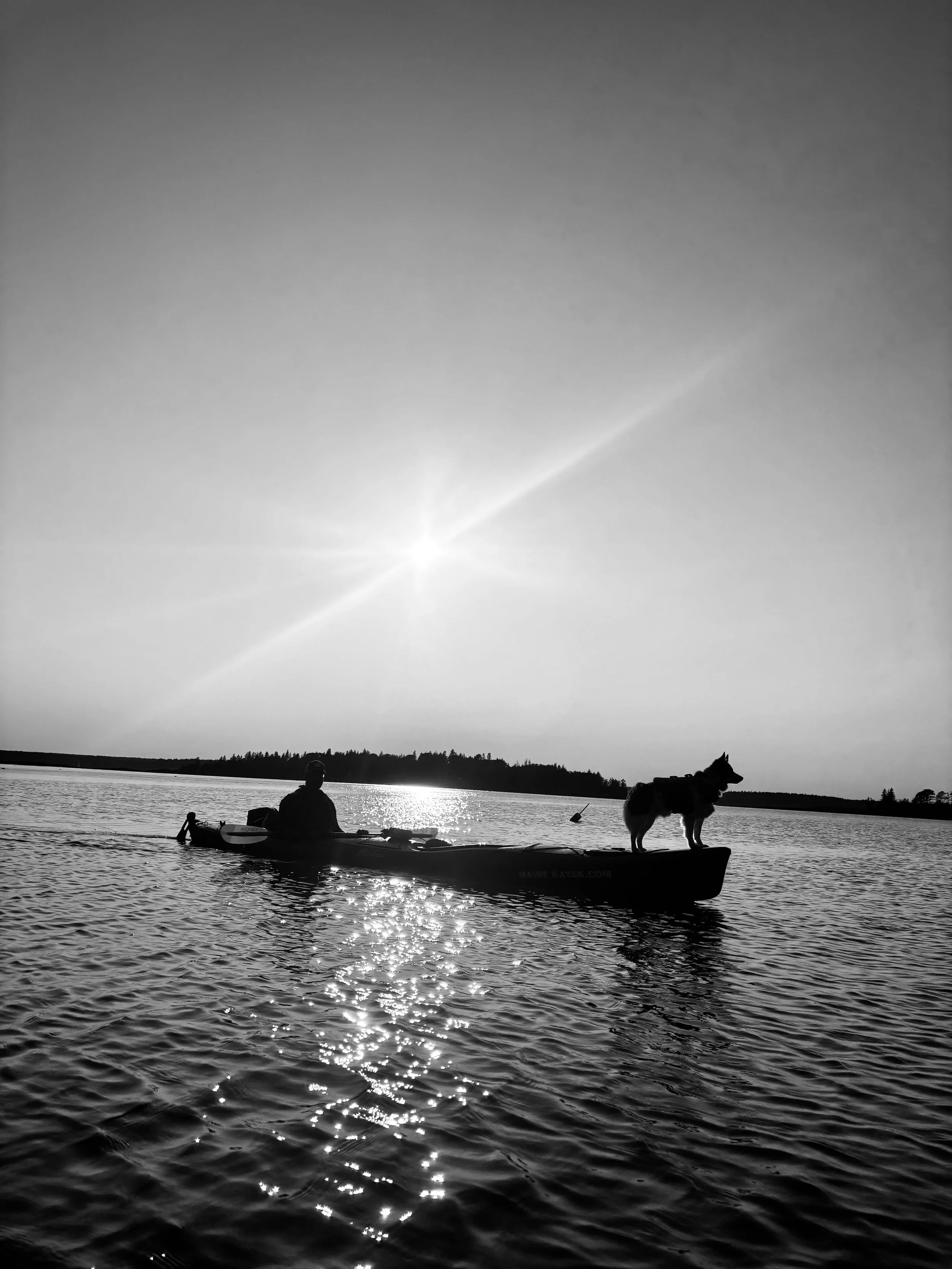
The corn moon lifts over the Sheepscot. Somewhere upstream near Alna sleep the descendants of pines cut for the spars of the USS Constitution, the country’s oldest surviving warship. Downstream, the nearly extinct native Atlantic salmon inch home against the current. Between them, us—two kayakers bookmarked for the night on the edge of the estuary, our REI Penates—stove, sleeping bags, thermoses—set up on an islet known as the Spectacles.
J. and I pass the dromedary of rosé and watch the pale apricot sphere climb beyond the river’s mouth as the tide slides toward its night low. Nine feet of water pull off the ledges like a cloth whisked from an altar. Low water bares the rocky bar that joins the two small islets, the feature that gave this place its name. It’s classic glacial work: granite shoulders rounded by ice, boulder till suturing the halves, cobble glued by crushed shell. Spruces hold the higher ground, wind-flagged by years of nor’easters. Down near the wash, bayberry and sheep laurel dome the edges, and a belt of eelgrass lets go and combs the beach in long green hair.
Our kayaks lie bow-to-bow above the high-tide line. The tent faces east at the northern end; a spruce limb serves as a rack for PFDs, spray skirts, and tow belts. Someone has carved TWO FEATHERS into a dead branch and cinched on a pair of cormorant plumes. Off the eastern shore a sloop anchors for the night. Its mast light and watery reflection shine like two ancient coins suspended in a museum case.
Back on the mainland, long-throated geese arrow south; a rim of crimson edges the maple outside the Boothbay library—living messengers of fall. Breckenridge saw its first dusting yesterday. My hours in this northern latitude stretch toward their end. The click of seasons drives a compulsion to distill the last months into a cohesive narrative. For a skier and paddler, the impulse to arc arises as natural as the geese.
Unable to relax into the moonrise, I break the silence with someone else’s wisdom: “You know, J., kayaking in Maine is special because it gives you intimacy with islands.”
A friend offered this insight earlier this summer. I pass forward as if it were my own.
“Intimacy?” J.’s headlamp confronts me like a cyclops.
“Yep. Spending the night on an uninhabited island isn’t like normal camping. They’re all different, the MITA islands. Their energy, what they give you…it’s a form of intimacy.”
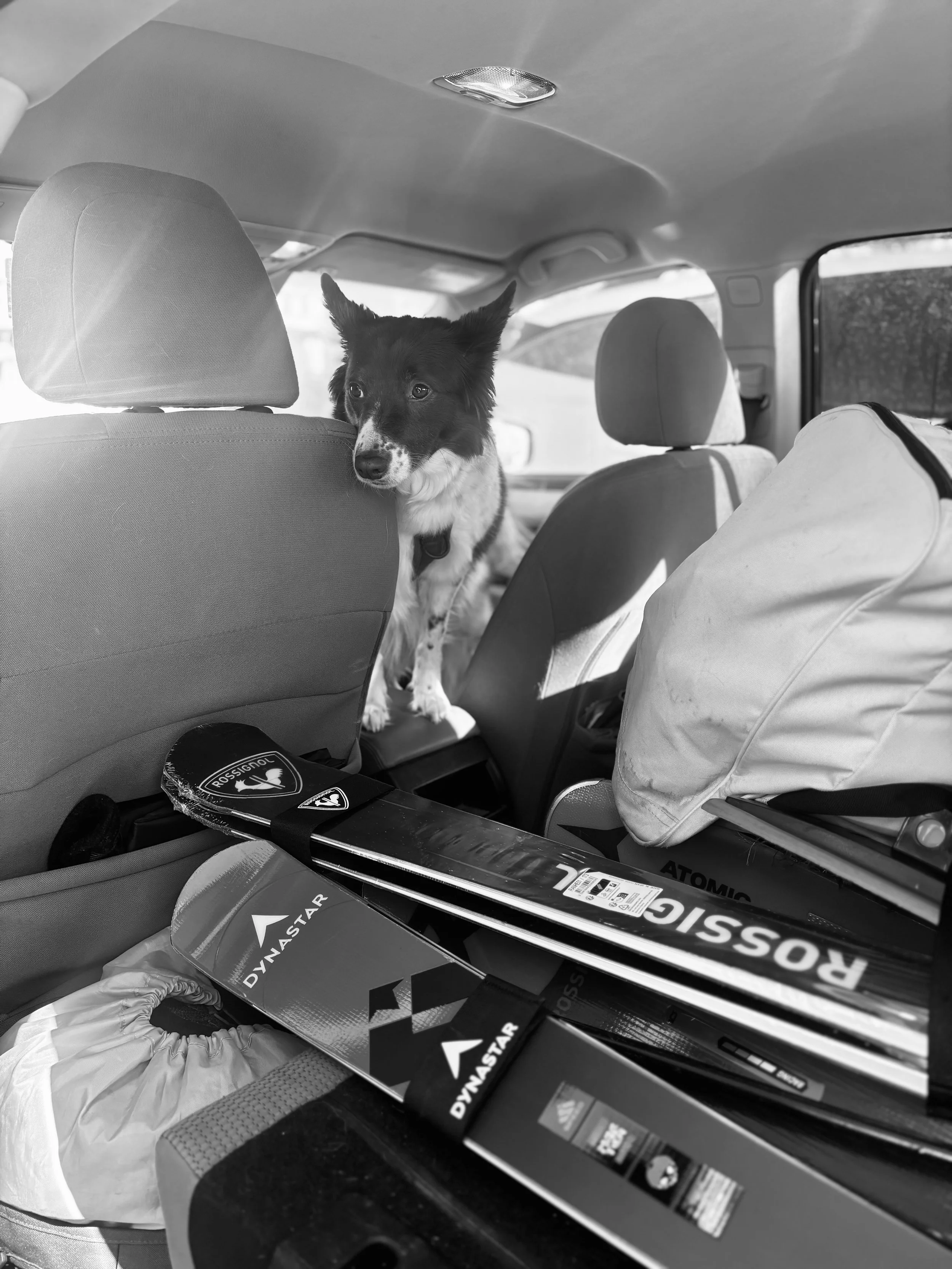
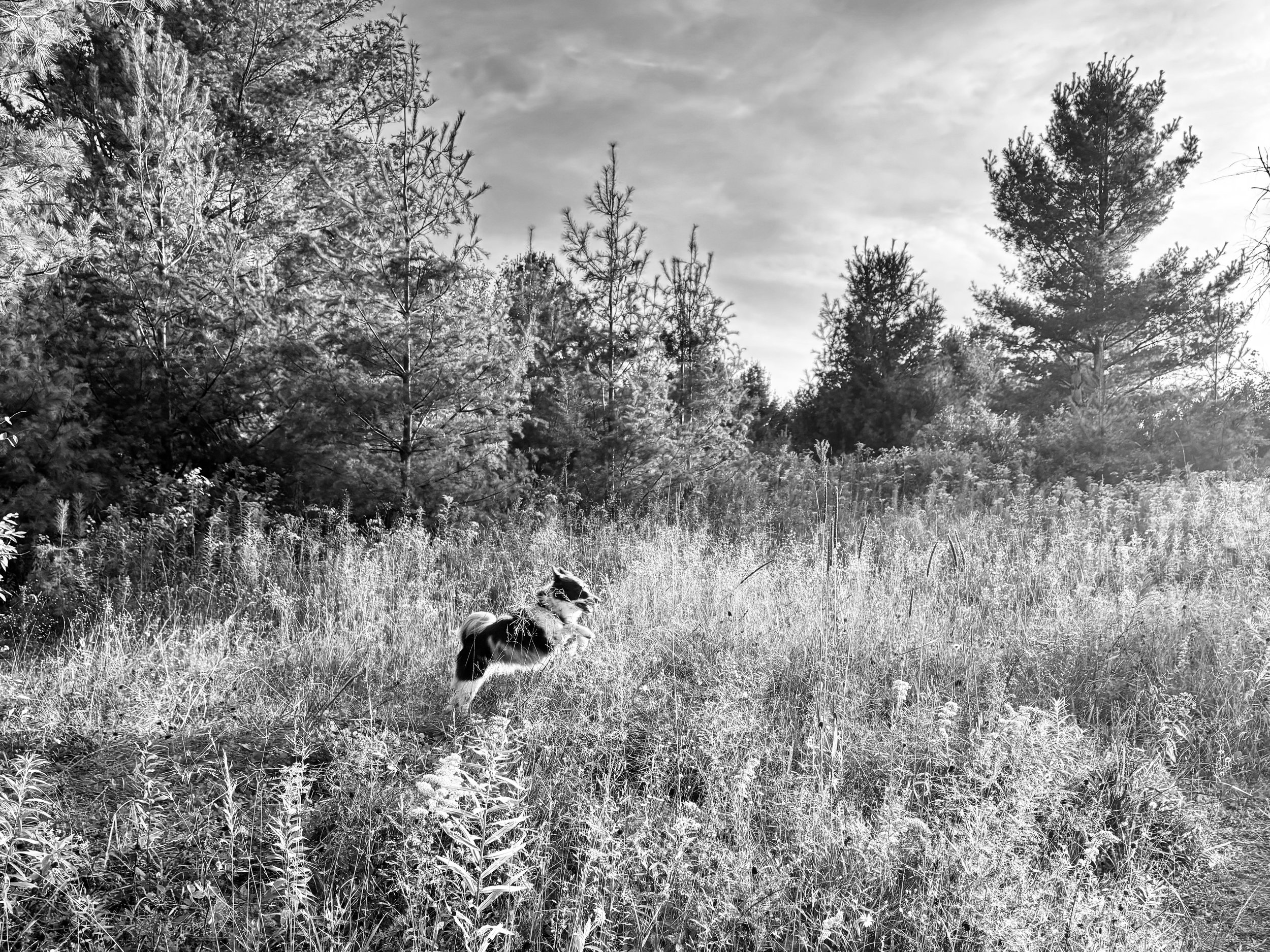
On the rocks below, our border collie noses the periwinkles working the weed lines and the barnacles flexing in the last of the ebb. She returns muddy-pawed and full of tidal-river smells: iodine and sweet rot. She, too, is restless. Comma-splicing at our feet, she scans for seals, who write their script where the moon lays its verse across the watery velum. A gray, blunt-muzzled and big as a buoy, surfaces like a macron, a sight like a long flat sound over the vowel of a small wave. Our collie whines and a loon answers from the black cove. Its one-to-three-note wail—the tremolo—resounds like a dactyl across the scroll of liquid glass.
“So what’s intimacy look like on the Spectacles?” J. grins.
I leave the bait.
“Never mind,” I groan. “Forget I mentioned it.”
I step off our perch, circle to the tent, and shrug into the puffy—the first time since May. I linger with the dark. The thought I dropped finds me again: intimacy. On the Spectacles, it unsettles the eye—apparition or perception, mirror or twin? My own twin answers from a peak 10,000 feet high, calling across corn-flat miles: Snow’s here. When are you coming back? Can it already be time to turn west for winter and slip into my other life? The weather in Maine remains kind; its myriad islands aren’t finished with me yet. I want to stay here. On the Atlantic’s margin, where the tide writes a path and unwrites it, twice a day.
In Book 3 of Virgil’s Aeneid, Aeneas recounts his long apprenticeship by islands—the Odyssey-esque counterpoint to the mini-Iliad of Book 2. Epics within epics, retold by the losing side: Aeneas is a Trojan, Rome’s mythic ancestor; Homer’s heroes are mostly Greek.
After Troy falls, Aeneas puts to sea in search of a sanctuary: first Thrace (where he cuts down trees for new ships and Polydorus bleeds from the soil), then Delos, sacred to Apollo. The hero misreads the god’s oracle—“seek your ancient mother”—and sets a course for Crete. There, he claims ancestral heritage and the island answers with plague until, in a dream, the Penates correct his course and nameItaly as his fated destination. The archipelago continues its syllabus: the Strophades, where the Harpies foul the table and Celaeno curses them to hunger; Actium, where they invent games to discipline fear; Buthrotum, where Aeneas finds Andromache, raw with grief.
For Aeneas, the sea becomes a page and omens his pen. Island by island—punctuated by waves, bound by current—he rewrites his story. It takes seven long years of wandering.
In August, I dreamed a katabasis. I visited the River Styx the way tourists visit Rome: gift shops, a ferry terminal, the buzzy public rush of famous monuments—and, most memorable, waking with the sensation of a cold hand in mine.
Morning rationalized. I led a group of six to Burnt Island Lighthouse and back, pointing out osprey nests and cormorants drying their wings.
A few days later, over Labor Day weekend, I took J.’s family kayak camping. We launched late to evade the rain. Stars lifted on the orange-blazed horizon by the time we were ready for dinner. Kneeling on a granite slab to thread a canister onto the stove line, I felt the phone hum in my back pocket. A message from Japan.
“I am sorry to write with sad news,” my cousin said through Google Translate. “My father, your uncle, has died. We cremated him last week.”
The next morning, there was no more news from Japan. I slipped from the tent before the others and boiled water for tea and oatmeal—a small, solemn meal offered to the dead. Light spilled from the east, and the tears came. For a moment grief caught, then passed.
We slid our keels into the flood and hopped island to island along the outer edge of the bay. We ate lunch on Black, where a yellow-and-blue lobster buoy had washed ashore, Sharpied with a blunt oracle: REAP WHAT YOU SOW.
J.’s father’s partner asked if she could keep the buoy, wanting to take it home as a coastal keepsake.
“I’m afraid not,” I said, thinking of karma and Tokyo. “Technically you’re supposed to turn them in.”
“Hey, can we go to that island next?” J. asked, changing the subject.
He pointed to a dark sickle on the horizon, Wreck Island. The name is literal: a late-summer storm in the 1500s, a ship on the ledge, cries the locals heard and—by law’s perverse permission—ignored. Salvage only if no survivors. Winter smothered the cries until spring’s silence licensed the pillage. Not all place-names instruct; some indict. Locals say you can still hear the ghosts howl in the throat of a gale.
What do you reap if you sow nothing?
Leave No Trace ethics are as anti-Roman as can be. Try to be good guests, not founders. Land and launch toward invisibility. Pitch above the wrack on durable ground; keep off the lichens. Cook on a stove, skip fires unless allowed—and then keep them small and erased. Pack out everything: food scraps, dog waste, tea leaves, and on thin-soiled islands, human waste too. Keep voices low after dark. Give wildlife room; birds and seals own the shore before we do.
Conquest and conservation cannot coexist. And yet, Virgil’s epic, like Homer’s, endures as a work of western literary genius precisely because, somehow, through writing, it overlaps them anyway.
The two feathers are someone else’s marginalia in Spectacle island’s manuscript. Or are they quills—reminders that there are multiple ways of writing and reading, of leaving something behind for others to interpret? A carving is not a colony, but it also not nothing. What about a poem? A cousin grieving half a world away?
We did not take the buoy. Nor did we make for Wreck. We turned around. Part of island literacy is knowing when silence isn’t yours to enter. I felt the pull—the old heroic shape, the easy narrative of confronting the unknown and coming home with a lesson pinned to the mast—but the learning here was different: not everything wants or requires pilgrimage. Turning back is often just as good a reading.
As we pivoted, three gray seals rose around us, big and deliberate. One rolled a shoulder and showed a pale map of scars. Another clapped the surface—a sound like an oar slap. The third thrashed after a mackerel with a great splash. I thought of my dream and my cousin’s message. My mother was the youngest of three. With the passing of my uncle, the middle brother, the postwar generation of siblings is gone.
If Virgil were writing this, my kayak would capsize and I’d meet a sea god riding a seal’s back who’d speak in a voice thick with grief and command. This Maine Sea Lord would address me the way Apollo spoke to Aeneas at Delos, with the confidence only deities can muster: “Seek out your ancient mother,” remember? That oracle is so Freudian it can only invite mistakes. Nothing good comes of chasing an absent mother. For Aeneas, that meant setting a course for Crete, and the island rewarded his misreading with a plague.
But Virgil’s not writing this essay. I am. And even though I studied Classics in graduate school, I am not an ancient Roman. I do not get gods—maybe, now and then, a little bit of kami. If I’m lucky, I get cold hands, constellated skies, no cell service for a few days, and animals that watch closely and need nothing from me. Like memories, they surface long enough to be recognized, then left well alone.
Why do people paddle out to islands?
We give these islands our time, sweat, salt, love, attention. They give us a living grammar. A windline becomes an audience; a fogbank, an argument you shouldn’t force; a name like Wreck, not a dare but a boundary to be respected. Prophecy, closure, visitation, omen—it’s all the quiet feeling of being very close to the world in a vernacular only you can understand.
We are not Trojans exiled from a demolished city, goaded by inklings of destiny. And yet, we are goaded by something. Two feathers. An oracular buoy. A good story.
You are not yet done with the sea, explains my mountain twin to me. You come for the small, accruing knowings: which mossy flat cushions a root; that an onshore breeze will snuff the stove unless you turn its mouth a few degrees leeward and shield with a pot lid. For the field-marks that make a place become itself: the late-season tern that should have already gone, the single monarch angling south over salt, the way eelgrass stains your hands sweet-green.
As 21st-century island-farers, we strive to be better guests. To leave no trace, but maybe take home a learning. An essay. A story. The deeper flow of this narrative is still Virgil’s, translated across millennia to a humbler register for a less heroic age. For that is what good epic poetry does. It conveys the legacy of human saga, great and small, allowing it to be repurposed and contextualized, long after the empire has fallen. The ruins of Aeneas’ heirs attract millions as they decay. The trees of Thrace and Alna—felled for the ships that carry the stories—meanwhile have grown and grown.
Whether the Mediterranean or the Gulf of Maine, seafaring adventures teach human beings to read the world as a text, but caution of arriving at any fixed point of interpretation and anchoring there too long. Scylla and Charbydis remain hazards as real today’s sea kayakers as they were to antiquity’s sailors. The hydraulics of minds and river confluences will always hold the power to swallow a boat whole. Ancient epic’s register can still give us a vocabulary for charting modern meaning. An uncle dies in Japan; a sea kayaking niece on an island in Maine mourns. A seal is not a mother, but also not not her, for the feeling this sighting conveys. Aeneas misreads Delos; Crete corrects him. At Strophades the Harpies make a lesson out of hunger: you will mistake want for destiny until you know the difference in your bones. At Actium, courage becomes ritual. In Buthrotum, grief becomes a craft Andromache lives. The archipelago teaches the threshold—sandbars that appear and vanish with the tides, doubles that are mirror and not twin, moons that look like prophecy but also simply illumine the life that is already there.
Back on the Spectacles, the September morning arrives diluted, the color of milk left in a cereal bowl. The corn moon loosens into it and disappears. Lobstermen work the channel in tight circles, haulers clacking, diesel thrum low in the chest. A gull drops a quahog on a rock and misses; on the second try it scores; the shell shatters clean and neat, a violence that is purely practical. On the sloop, two figures in sweaters step out with mugs and give us the small nod of morning boats. We answer with our spoons, lifted from the oatmeal pot.
We break camp without speaking much. Drybags slot into their hatches; our collie leaps like Palinurus to the bow, and the tow belt clicks back around my waist. J. walks down to the boat, carrying a stick. The dog’s tail immediately begins to swoosh. She leaps off the boat and re-muddies her paws. She’s ready to stay here and play fetch in the intertidal zone forever.
“Hey,” he says. Let’s take just this one, for her. We’ll start a stick library. She loves it here so much…she’s explored every inch of this place. I get it now. Intimacy with the island.”
The bar is already taking water; the path becomes a darker seam and then only memory. One island becomes two again—tidy, divisible. I dip a blade. We slip past the last granite shoulder into the channel, where the river’s cold meets the bay’s salt and stitches a line you can feel with your knees. Behind us, the Spectacles regard us the way a good poet does when you read their work not by luck but by practice: not praise exactly, but recognition.
Virgil. The Aeneid. Translated by Scott McGill and Susannah Wright, introduction by Emily Wilson, W. W. Norton & Company, 2025.
Marine Forecast
I love weather.
―
Checking the forecast:
Weather
Gale warning offshore;
complex low keeps on turning
somewhere off Greenland.
Wind
South wind to ten knots—
rain with gusts up to thirty;
seas six to ten feet.
Small Craft Advisory
Another cold front
tightens over the waters—
small craft have been warned.
Fog
Southerlies rising;
patch fog after midnight—
showers at daybreak.
Pressure
High pressure building
behind the pushing cold front—
seas around two feet.
Fetch / Swell
Fetch laid to the east;
swell wraps around Monhegan,
the storm still speaking.