
A Few Interior Landscapes
I keep going to the Yukon.
―
33 Mile
The roadhouse just seven miles shy of the Canadian border up the Haines Highway flies both flags—US and Canadian. A brown bear stumbles in a ditch just down the road, skinny and dazed. He or she is likely looking for dandelions, but all they are already gone.
It’s Fourth of July Eve, and a pig carcass lolls unattended on the lawn. I don’t want to know how they got it. 33 Mile’s Fourth celebration is a local favorite because, well, the pork roast. Besides, the Haines police don’t bother coming this far up the road to shut down the fireworks.
The place is hewn from large timbers. They’re playing 50s tunes on what could be an invisible jukebox. The condiments on linoleum tables look almost as old, and the portions are bigger than anything you’d see in Haines proper. Everyone says 33 Mile has the best burgers this side of Juneau, our closest McDonalds.
A skinny girl (who hasn’t bathed longer than I have) strolls in right past me in Xtratufs. A long knife swings on her belt. She orders soup, and the server seems to know her. She repeatedly calls the girl “honey” as they chitchat. Weather. Bears. Fireworks. More bears. That one in the ditch has been looking at folks funny, like he’s about to charge. They reckon he won’t last the month.
Finally, I catch a side-eye. Honey goes and takes a seat, and I step forward to order. The server sighs when I ask about veggie burgers.
“Yes, we have them, if that’s what you mean.”
Whitehorse
“You sure go to the Yukon a lot.”
My new friends say this to me like it’s a character judgement. Like it’s a referendum on what I think about Haines, and how it’s going here. Maybe it is.
Why do I keep spending so much gas money driving up and out of the fjord at the back of the Lynn Canal after I traveled so far to get to Alaska? It’s not just for Real Canadian Superstore in Whitehorse, or the bakery in Haines Junction, or even the sustainable shop downtown, with its endless shelves of delightful soaps and laundry powders. Is it?
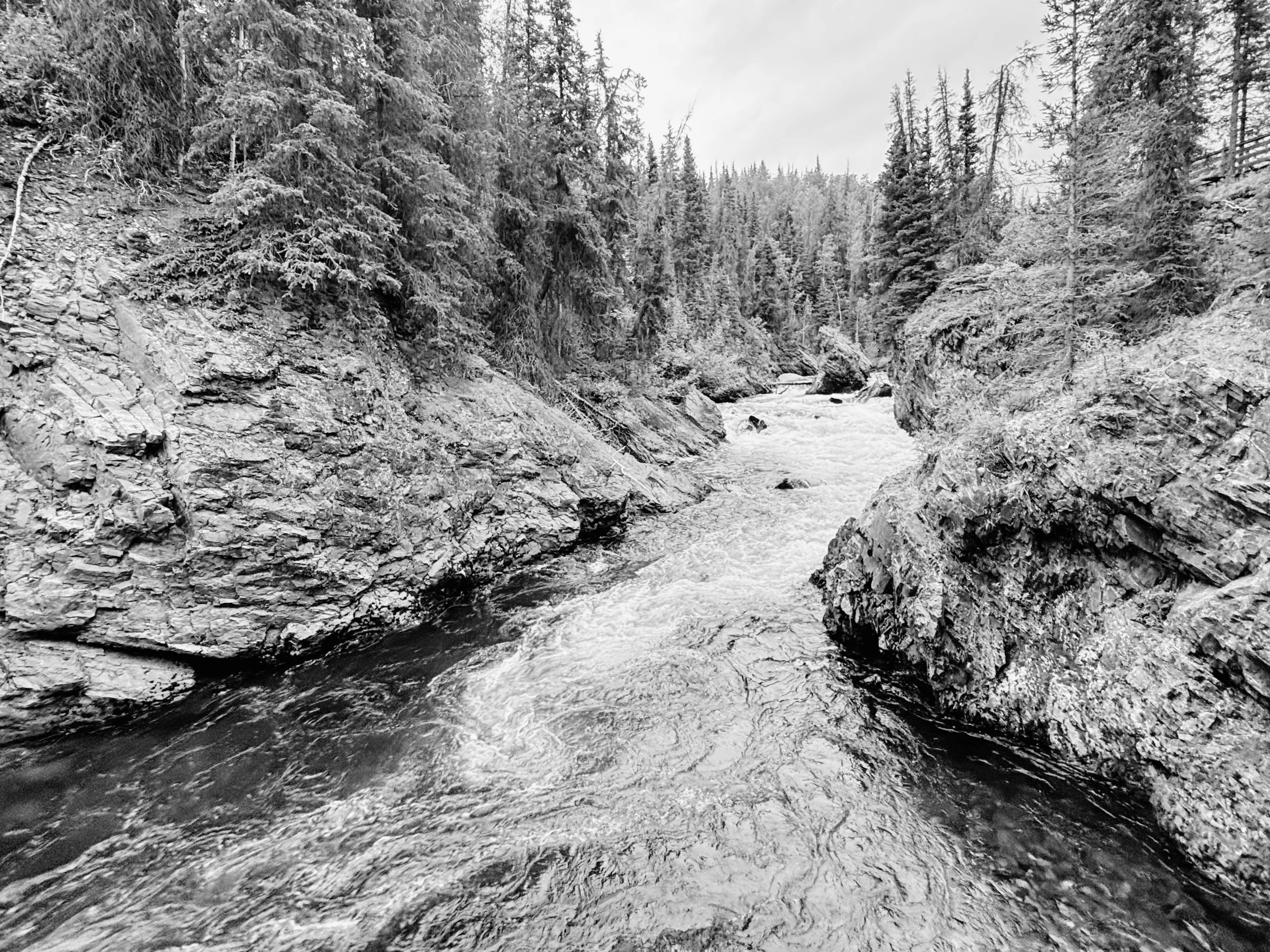
One does not have to go very far up the Haines Highway for the mistiness of the fjord to drift off on the tides. How fast the sea becomes a postcard swallowed by Yukon’s vast network of mountains and rivers.
The other side of the pass, the Yukon Territory (after a kiss of BC), just feels more like Colorado than Southeast. Soaring cathedrals of hard rock, but with more greens, blues, and violets. Skies are bluer here. The silvery-gray shimmer of the coastal rainforest dispelled. Fireweed soars triumphant along the roadways, magenta arrows pointing the way to Kluane, to autumn, even though summer has just begun.
Like home, too, the rock here is strong: giant bones that can contain the enormity of the world they hold up. Caves rattle with eons and mammoth bones. But unlike home, the sponginess of the permafrost gives way to bogginess that swallows your Tufs with a sigh of Labrador tea. Back in Colorado, there is no sponginess: only the arid grind of stone and bone, occasionally veiled with a resolute crunch of dried-out pine needles.
I camp near the hot springs—another reason to come to Whitehorse. The people in Haines complain that’s it’s boujee since the remodel, but I appreciate the polished floors, multiple saunas, and vegan smoothies.
There are five more hours of daylight to go and it’s already bedtime. This too, is different. There is even more light here than in Haines. Yukon's southernmost border starts at the 60th parallel north, which is nearly 19 degrees farther north than Colorado's absolute northernmost point. Home, but norther.
I sleep deeply for four hours. The sun wakes me like a parent telling me I’ve overslept, ogling at the foot of the bed, its tangerine glow through the black spruce boughs, prying open my eyes at 2 AM.
Million Dollar Falls
And then there it was, the sound of the river.
Neither the Chilkoot, which trickles its pewter around the weir with its as yet unrealized promise of salmon. Nor the Chilkat, big and braided while it milks its way down to the inlet. This is the Takhanne boring in my ears. It’s an earnest rush of a big snowmelt, bounding into the earth beneath me. Below the sixty-foot drop, wave trains crash and seethe before giving way on the dark brown banks blanketed by pine.
I light the fire starter I made from torn up shards of a Starlink box and the melted wax from a saint’s votive excavated from one of Haines’ endless free piles. The wax snatches the flame like Sasha snatches a snack, and bursts into righteousness.
I feed the baby fire with the kindling I stole from the ski hut in Haines Pass. Colorful crotchet oven mitts dangle above its door like Tibetan prayer flags. The hut is swept and stocked with dry food and firewood. Its plywood walls and door are tattooed in notes and drawings from people who’d stayed there before: Yukoners, Alaskans, hikers, skiers.
“Keep on birding in the free world.”
“Haines Pass Baby!”
Since I drove up here from home in April, Haines Pass has all gone green and gray with rain: the white a memory. Come again in six months and those words left by those skiers will be another bridge: winter’s long recoil. Bear spray at my hip, Sasha and I wander. But we are very much alone.
Now the water. And the waterfall. Insisting on erasing the sounds of my pasts—one in each ear. Sasha circles our site with joy. She knows what a campground is now. This sheepdog who requires routine to regulate her hypervigilance takes comfort in this newly forming idea of mutable home. The sound of the truckbed camper rising. The clank of kibble striking metal dinner bowl. I delight in spending the night away from our little dry cabin back in Haines, already crowded like a sunny patch of forest floor with new community.
The rain comes in hard before the darkness. My little fire persists, which leaves me feeling triumphant, like a guide capable of keeping a flame alive in a hurricane. Even Sasha radiates in the satisfaction of being warm and dry while the world around us absorbs the cold deflected by our heat.
The rain here is not Haines rain. It is not feathery rainforest rain. This is the rain that blows in on the wind and will pass shortly, returning the sun, mountain rain. It falls in fat drops that go splat on the rocks. Each splat leaves a wet thumbprint. Wet plopping to the earth with purpose.
This rain is familiar.
“You sure go to the Yukon a lot.”
The Yukon, the interior’s beginning at the end of the Inside Passage, is like homecoming without being anywhere near home.
Tagish Lake
I cannot see either end of Tagish Lake, whose unusual wishbone shape spans the border of the Yukon Territory and northern BC. While Alaskans speak of their oceanways as lower bodies, here, in the nearby interior, laconic nomenclature lives above the waist. Tagish’s long, blue branches are called arms, and they wrap around either side of the Canadians’ borders, 74 miles long.
I camp on the Yukon side. Sasha offleash sniffs the bones of what the signs tell me are what’s left of the Venus Silver Mine. The abandoned machinery of a long-dead era now rots like a caribous carcass on the grey rock beach. The story, to a Coloradan, is a familiar one. Claims staked early at the turn of the last century by men from elsewhere who came in hard, purged other peoples’ money, and established a boomtown—named after themselves.
In elementary school, while delicately skirting the stories of what happened to the Buffalo by choosing to focus instead on the mystery of the Anasazi, all Coloradan children are taught the history of our “Silver State.” Silver was our gold rush before skiing. But when the Panic of 1893 crashed silver prices, mines across our mountains instantly shut, and their villages and camps dissolved into ghost towns.
A Canadian with a mutt comes down. She’s new to Whitehorse, recently relocated there from Toronto after a divorce. The dogs play as she squats on the beach squinting through binoculars for mountain goats after rinsing her frying pan in the emerald and aquamarine lake. Snow patches still cling on the hills ringing the shores. The woman spots two mountain goats cleaving to a rib of ridge, and hands me the binoculars.
“See them? There’s two!” she exclaims.
I find them quick, like motes in the eye: just barely visible to the right of a tear-shaped patch of winter. But I didn’t come all this way to the world of whales and brown bears to see alpine animals who clog the side of our highways back home.
“Yeah, wow,” I reply. “There they are.”
Kluane Lake
Kluane Lake nestles in between mountains of brown and green and grey that rise from the vastness and settle beneath clouds. Fireweed borders the roads with its striking magenta. The one burst of color striking out to say I AM HERE TOO. Notice me! Yukon grandeur made even grander by the smallest flower: a border to the borderlands beauty.
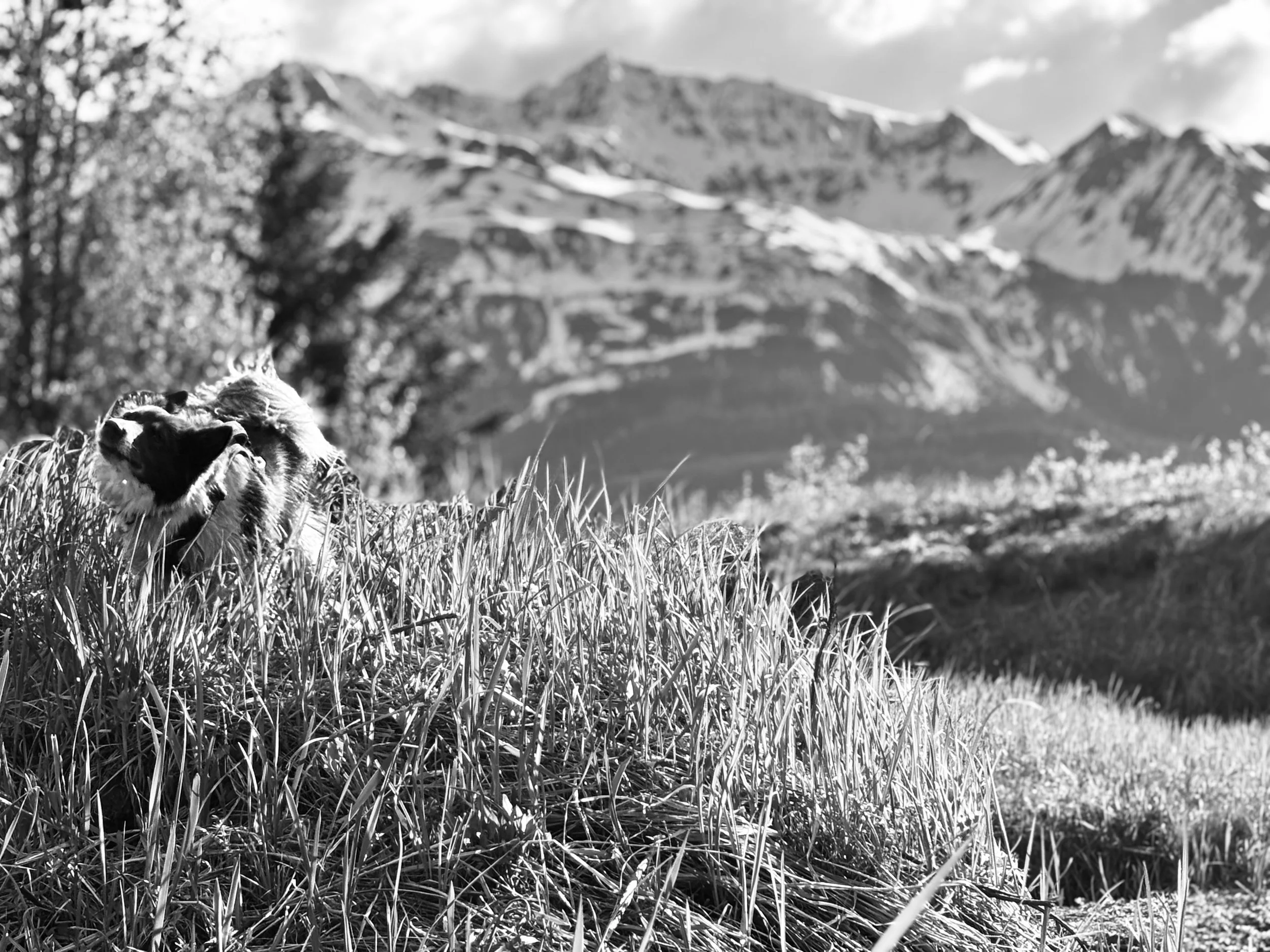
The woman who minds the campground has blue veins that run down her neck like river lines on a topo map. She tells me, “a mama and her two cubs have been coming through. Once a day, but they cause no trouble. It’s the black bears that you have to watch out for—they’re curious. The grizzlies mind their own.”
The lake stretches like a secret. Not the U-shaped wishbone of Tagish so much as a liquid mirror in whose reflection are buried the secrets of northern places that bring people like me here. The Aurora. The caribou migrating in such numbers that “the mountain appeared to be moving.” Kluane has been wishing well to it all.
So much of the Yukon feels this way. Even as RVs cut through, cruise ships of two, usually retirees, that cut the land. They are swallowed by the landscape, which they then try right back to swallow up in turn. The cruise ships that dock in the fjords are less subtle. They lash out at the Coast and Chilkat mountains, floating mountains that block our view of the town. But if they did not come, neither would I. Interior and coastal, tourists and seasonal worker. Local and stranger. Lovers and ex. Brown bears and blacks; everybody has a point of comparison, of contrast, means of expressing curiosity or minding your own.
Why do you keep coming to the Yukon?
Because the air here is cleaner than Haines because it’s not heavy with the water. The air back home is not even the air back home right now. After our terrible drought of a winter, home, Colorado, is on fire.
I cry over my morning coffee as I finish The Sun Is A Compass, and the book ends with the author giving birth. Must all female adventure stories end this way? Epic hikes and treks or paddles whose terminuses are husbands and handmade cabins and babies who go on helicopter rides for their first backcountry trips?
Where are these women? I want to know. I think of the RV retirees and the woman with the river lines on her cheeks and want to scream. The majority of women I meet in this line of work—the guides and scientists and park rangers—are mostly in permafrost relationships. Spongey inbetweens. Melting. Fragile. Glacial remnants.
No one writes about that, though. The stories that get printed and sold in the smalltown Alaskan bookshops sell the narrative of the adventuring couple. It’s a new have it all fantasy for the outdoorsy millennial or gen z’er. Men, of course, have been doing this since the Odyssey. Since the Old Testament, or whatever.
They go out into the big scary nature alone, have revelations and write books, and get shit named after them. Peak baggers. Ocean crossers. Mythmakers. They go alone and come home to a new understand of self and a woman waiting whom they would have treated like shit before they left and probably will again once the sheen of glorious return has worn off.
But women must trek across the mountains or paddle around a continent into the arms of a man and birth a child. Then, she must take them with her back to the woods to truly be wild, free, complete. Bless these Madonnas of the Forest, for I am not one of them.
So far, none of the women I’ve encountered out here are. I’ve met all these women out in the Yukon, camping alone. I do not see men solo camping. Or groups of male friends. Couples, yes. Families, yes. But women—we venture out here on our won in droves. For so long, we’ve been told this tale of men leading women into the wilderness to keep them safe. But maybe, it’s the other way around. Most men won’t go anywhere alone. Not truly alone. Alone with the world watching them break a record or do a badass thing, yes. But that’s not the same thing as a woman who goes just to go, or maybe even get away from these men.
The aloneness as vast as this lake hiding between mountains seduces woman away from man quois man, even if we don’t or won’t speak of it. Mama bears roam without fathers. The trope is always mamas and her cubs. It’s evoked to remind us to be fierce in protecting our own. Do the big adventure with or without the mate, but don’t forget to take care of everyone when it’s all said and done.
Take care to mind your own. Eventually the yearlings go. Mama remains. Out there, fishing and scavenging for berries all on her own again.
Dyea
Tomorrow I will close the Golden Triangle and board the Hubbard, which will take me back to home for now, or Haines.
Four enormous cruise ships are docked in Skagway today: 12,800 souls. A gold rush for modern times. Concentrated human activity that breeds commerce. A dirt road out of the t-shirt shops winds down, down, down and away to the head of a trail that killed the cruise ship people’s ancestors. A graveyard for those who failed to get anything named after them except a cemetery that’s actually named for the thing that killed them. Slide Cemetery houses the bones of 19th century prospectors trying to get up the White Pass when the locals, natives, told them don’t go. Even most skiers know that avalanches are the mountain’s way of wiping the slate clean.
In the shops, they keep asking if I am local. I don’t even know what that means anymore. I don’t know where I live or where most of my mail is ending up right now. I’m unwashed, so I must look like a guide—is that what she meant? Or just that I’m not like a cruise ship person, so I must serve them. Black bear or brown.
Why do I keep coming to the Yukon?
Because, here, the dandelion aren’t quite done. Because there are women who roam free as bears who delight in an abundance of daylight and fish. Because wild iris bloom in the flats. Exquisite, tiny purple fingers reaching for the sun.
The Greenness of Green
Summer comes to Southeast.
―
And then, Southeast Alaska was green beyond all green.
Tennis-ball green. Green like the glow of bioluminescence trailing a kayak blade in the Florida Keys. Honeydew highlighter green. The kind of green Pantone announces as “color of the year.” To a girl with eyes grown in the rocky palette Colorado’s interiors, it is an extraterrestrial green, an impossible, invisible color only seen by multi-eyed insects.
After weeks of grizzle skies flocked with mist and rain, summer's sudden saturation startles. The sun crowns the fjord in Klondike gold and, with it, comes a regional heat advisory, though the temperature barely tops 65. Locals rake the beaches for ingredients for "beach green burritos." Along the Chilkat, they're harvesting spruce tips for beer. The neon-green shoots grow heavy as they ripen, pulling the boughs downward.
A young couple plays with their infant in the intertidal zone. The mud shimmers and ravens circle for fish the tide forgot. The boy sheds his clothes, throws back his head, and screams.
"He was born in winter," they explain, almost sheepishly. "Today's the first time he's ever seen the sun."
A woman with snow-streaked hair follows her elated dog along the beach, pants rolled to expose calves the color of cod. Here, comments about the weather carry the weight of intimate conversation rather than pleasantries. Last summer, they say, there were only three days without rain. So much sun, so early in the season, feels almost overwhelming.
"The ache that always lives in my bones," she tells me, "it's finally gone."
Life in Alaska has a short window in which to get everything done: be born, grow fat, find a mate, raise young, and prepare for winter. It is a meticulously choreographed performance in which all who hurry to the stage know their roles. Nothing hesitates.
The green acts as a scrim to the grand reveals: the brown bears, who I learn are serial monogamists. The oldest female bear recorded in Alaska lived to 39; the oldest male, 38. If I were a brown bear, I'd already be dead.
The only bear we've seen on our lake tours so far is a small black one, romping through the Jurassic skunk cabbage that soars its yellow between plunging cascades. Each day, the sun siphons more snow from the mountaintops, and the water rushes thicker, louder.
On the lake's east side, enormous beaver chips confetti the shoreline. They punctuate the green creeping up the mountainside like ivy. The beavers are turning poplars into toothpicks to enlarge and enliven their lodges.
One afternoon, we return from a tour to find a dozen tourists spilled from a bus, telescopic lenses trained on the far bank of the river. A cow moose is shepherding her calf through the shallows. The calf's spindly legs wobble as it picks its way around the eddies while its mother pauses, alert and watchful.
Everyone is watching them: the tourists, the guides, the river itself. Eagles peer down from the Sitka spruce. The forest is like a restless audience, holding its breath.
A few days later, I'm tying up kayaks when a veteran guide comes down to the boat ramp. Unlike the green twenty-somethings, who post up for the season in their beater cars with bandanas tied around their foreheads, he’s year-round and all brown. This soft-spoken Oberon has eyes like a bear in the forest and dons a weathered khaki jacket. He asks if we've been seeing any bears.
I tell him about the little black rambler on the eastern shore.
"Well," Oberon says, glancing toward the river, "they found that baby moose right there on the rocks by the boat ramp yesterday. I reckon that black bear got it. Lots of scat on the road, too. That's a bad sign. Means they're hungry and coming into town."
He pauses.
"But they got the weir in. Sockeye should be here any day now."
No sign of the mother. They cut back the brush to better see the bears coming.
A group of twenty-something guides—the boys shirtless and the girls in bikinis, all of them in Xtratufs—smoke old-fashioned cigarettes on the dock on a sun-spilled day when, for now, no cruise ship is anchored in Haines harbor.
"Smoking is actually good for you because it teaches your lungs to clean themselves," I hear one girl say.
They load cases of beer where they normally load overstimulated tourists into their fourteen-person voyager canoe. The motor roars to life and they bounce toward the back of the lake, slicing through a glassy reflection of mountains collapsed into sky. Their laughter is soon swallowed by the waterfalls.
Like the bears, the otters, the skunk cabbage, and the moose, they are part of summer's great performance. They emerge from the green like the mechanicals in A Midsummer Night's Dream: overconfident Nick Bottom turning the color of a boiled Dungeness crab while refusing sunscreen; Peter Quince directing traffic on the dock; would-be Thisbes in tie-dye overalls; Robin Starveling, the mushrooms already kicking in, convinced she's Moonshine.
Merrily they stumble onward, performing their play within a play. There is something beautiful about it—the recklessness, the costumes, the certainty that summer will last forever. On one of nature's grandest stages, far from the critics of the cities, a riot of green.
Every week, a few Coloradans step off a cruise ship and into the kayaks I lead. The first thing we talk about is the rain.
Back home, it's all brown, they tell me. They look up at the Coastal Mountains layered in spruce and hemlock, their peaks disappearing into low clouds swollen with rain, and say, almost wistfully, "A week of this would solve all our problems."
Fire restrictions are already in place. Reservoirs shrink. The winter snowpack is devoured weeks before it should be, and whole counties hold their breath through another summer.
The moose calf had been born like a prop presented to an audience. Dozens of cruise ship tourists stood along the riverbank photographing its uncertain first steps. By now those images are scattered across phones and social media accounts, tiny souvenirs of a life that lasted less than a week.
Most of those people will never think of it again.
But I find myself wondering about the mother. Do moose mourn? Is she still searching the riverbanks? Or has the forest already folded her loss back into itself?
The salmon are coming, Alaskan Oberon had said.
Summer is short.
Someone Who’s Been There Before
Getting schooled in guiding.
―
Beyond the windows, the Lynn Canal wrinkles beneath a cold southerly wind. White flashes appear between waves the color of jade. A gull. A whitecap. A whale.
It is April. Humpbacks are moving north with their calves, leaving Hawaiian breeding grounds for the nutrient-rich waters of Southeast Alaska. Soon the herring will spawn, turning sheltered coves silver. Eagles, sea lions, bears, and whales will gather for the first of the annual feasts.
Winter, meanwhile, seems unconvinced it is over. Snow from a record-breaking year remains heaped around town. A damp chill drifts off the fjord. Tomorrow I will spend hours immersed in that water.
For now, there is coffee.
The clubhouse offers the comforts of shore life: showers, Wi-Fi, washing machines. A whiteboard blocks the view. Scrawled across it is an ambitious syllabus: incident management, expedition skills, sea survival.
There are four of us in the Grey Heron’s coastal sea kayak guide course. It is scheduled for sixteen days. It will eventually stretch to nineteen.
The Grey Heron is already in the room. Among sea kayakers, he is known as an expedition paddler, coach, and guide. Decades on the water have carried him along remote coastlines from Japan to Norway. He has spent much of his career teaching paddlers how to become guides and guides how to become mariners.
Tall and long-limbed, the sixty-something Brit moves with the economy of someone who has spent much of his life outdoors. He has a habit of pausing before speaking, as if checking conditions. Weather, tide, wildlife, group dynamics—it all appears to occupy the same mental shelf.
In the absence of bears and rough seas, we become the object of observation: a seasoned outfitter from Sitka, a young NOLS graduate already guiding in Alaska, the Wolf whose enthusiasm arrives several seconds before the rest of him, and me, knees still aching from a winter of teaching skiing.
When the Grey Heron paces before the whiteboard, the room takes on the feel of a vessel underway.
"As kayakers, each individual is captain of their own ship," he says. "Through your leadership, they're going to follow you. Seamanship is about knowing what's coming up."
Long before maps, roads, and GPS satellites, traders crossed deserts, pilgrims crossed mountains, and sailors traversed unfamiliar seas by following someone who had already done it. Today’s recreational guiding remains essentially the same arrangement, albeit with lighter equipment and more expensive gear.
A tourist paddles a kayak along a stretch of coastline.
A sea kayak guide reads the same coastline the way a philologist combs a manuscript.
The lessons move quickly from theory to practice.
"Stop! Capsize! Swimmer!"
One by one we tumble from our kayaks and feign hypothermia until the real thing begins to creep in. We tow one another through confused seas, rescue swimmers beneath rain-slick cliffs, descend rock faces in improvised harnesses, and build fires with whatever will burn. The line between exercise and reality proves surprisingly thin.
The Grey Heron's preferred teaching method is disruption. Whenever the group settles into a comfortable rhythm, disaster arrives. A flooded hatch. A shoulder injury. Cold shock. A cardiac arrest. One moment he is paddling quietly among us. The next he is upside down, a sea anchor holding his breath while someone struggles through a rescue.
Every module points toward the same conclusion: weather deteriorates, equipment breaks, people become tired, and assumptions fail. Rarely all at once, but often enough that some scale of catastrophe should be expected as the guide’s constant companion.
Just because people follow you doesn't mean you always lead them well.
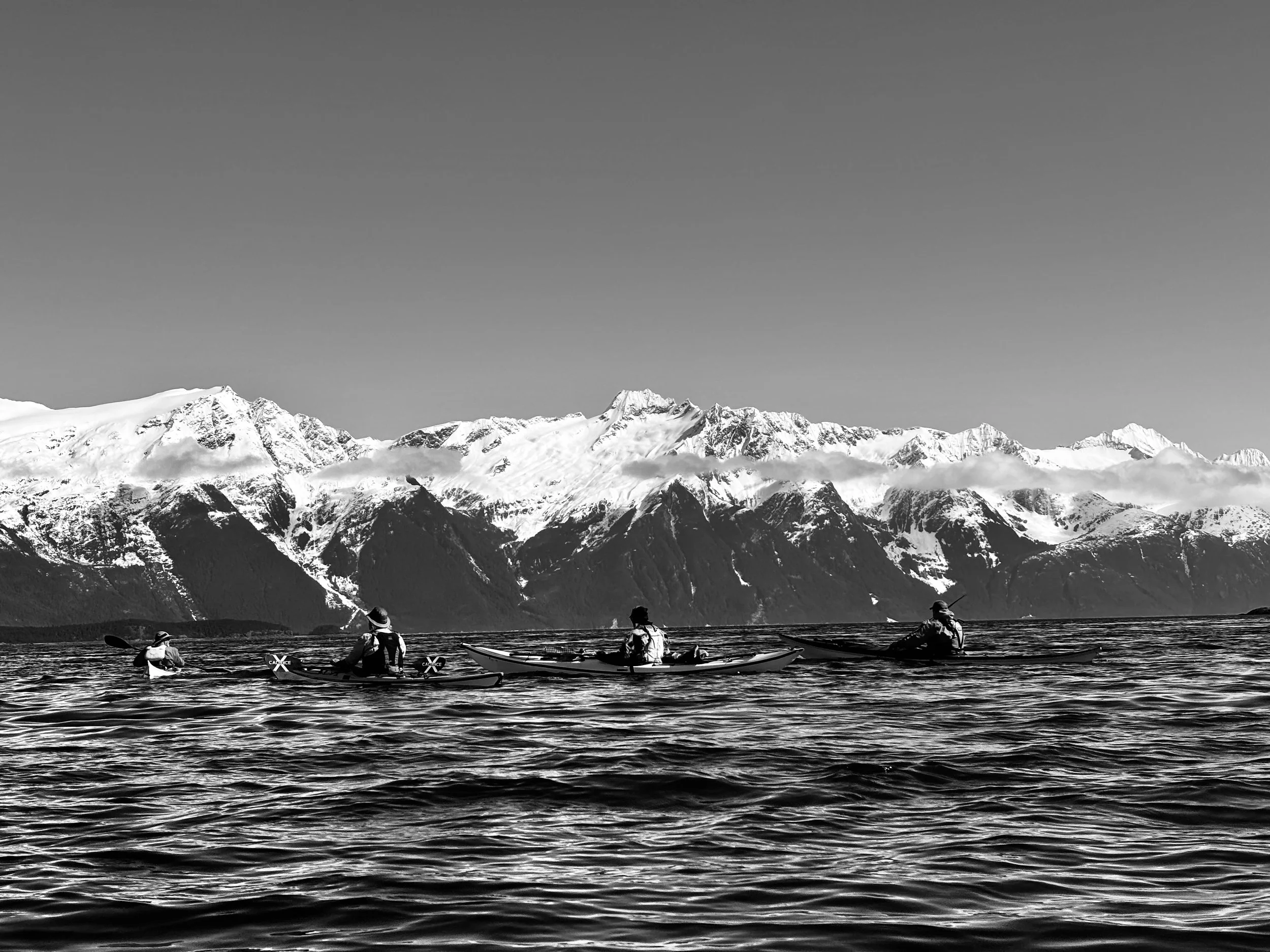
A month later, I find myself leading a group of six experienced river kayakers from Letnikof Cove. Their goal is ambitious: paddle the entire Inside Passage from Seattle to Skagway the following summer. This trip is their forerunner. Our just is to show them tides, crossings, and the practical realities of traveling through bear country.
The strongest paddlers quickly pull ahead. A high-school teacher drops behind.
"My arms are screaming at me right now," he says.
"Push with your feet."
Later, around camp, he recounts my advice.
"'Push with your feet,' she told me. STFU."
The group laughs.
The guests show little interest in rescue scenarios. What concerns them is weather, mileage, and wildlife. They care about making camp on a beach with a short carry and a foreshore of small rocks. They care about the porpoises surfing a ferry wake and the river otter snacking on a fish until an eagle arrives and attempts to steal it.
They care about seeing Alaska.
The previous summer I had traveled this same route under the watchful eye of a local guide. Waterfalls poured from hanging valleys carved by ice. Evening light moved across the Chilkat Range. Humpbacks blew along the deep cliffs before flashing their tails and disappearing beneath our hulls. The place seemed less like Alaska than a rough draft of the planet.
Now I was returning with a pencil. The landscape itself unchanged, but I had begun to read it differently. Freshwater here, lunch beach there, porpoises off this point, bears on that one. My rough draft was acquiring footnotes.
When we reach Juneau, rain falls in sheets. Everything is soaked.
We emerge from the water like seals flushed from a haul-out and gather beside a stranger's fire. Steam rises from wet fleece. Around us, the guests swap stories from our last crossing as though it happened years ago instead of hours.
I smile. Before he left, the Grey Heron offered perhaps the simplest definition of a guide: someone who's been there before.
A Visit To Lost Winter
Detour to Banff.
―
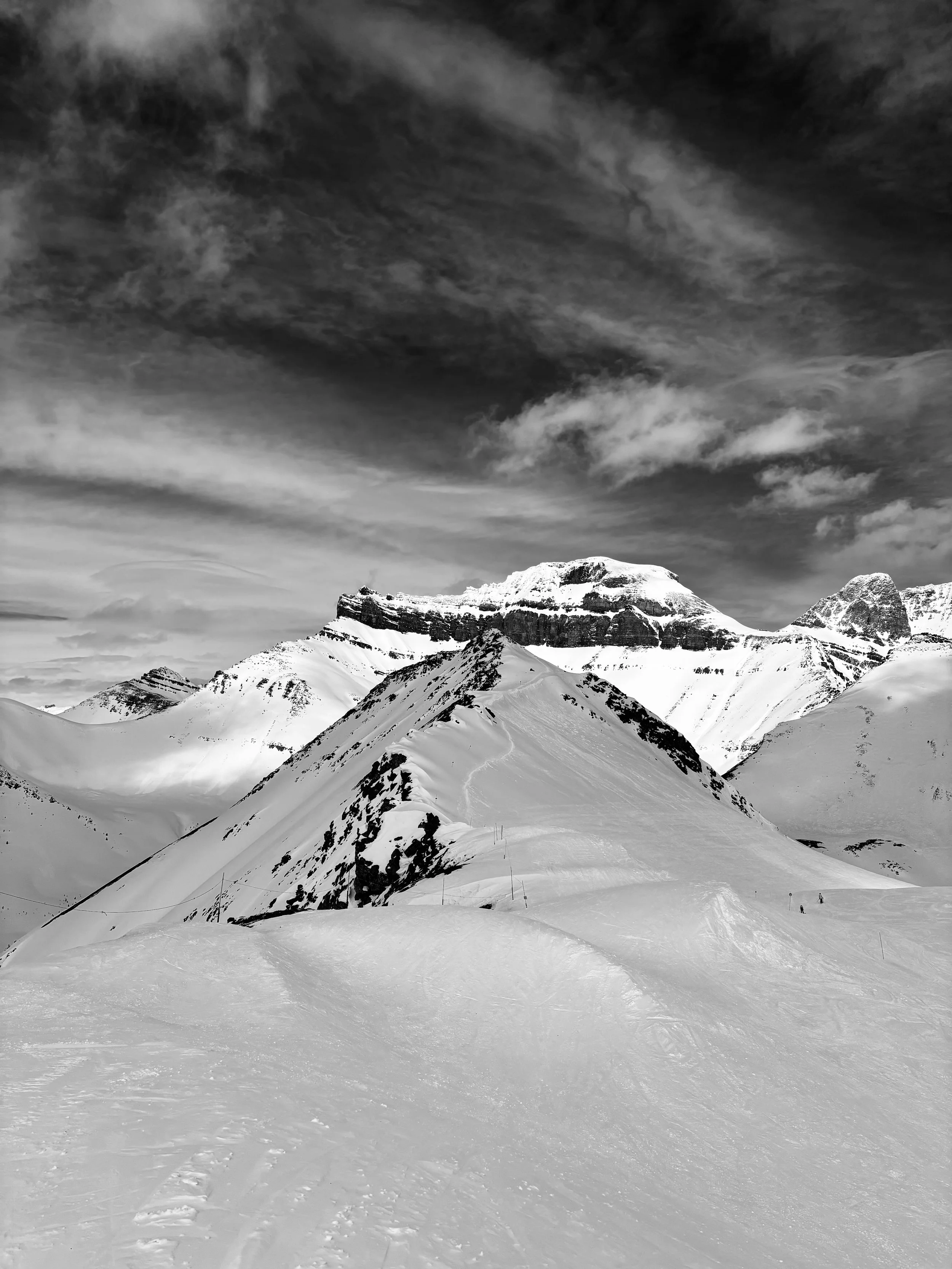
In Banff, the mountains are so big they could swallow Colorado.
Canada is winter’s prodigal daughter.
The pass narrows into twilight. Winter’s deep roots never died, they were just north of the border, buried on the other side of the Omega Block.
Alive snow shifts on the strange, humongous faces. Wind cries with the wolves, stiffening the pack. Sky-splitting peaks with their unfamiliar aspects pierce my heart and make me weep tears of snow.
We check into an AirBnB in Cranmore. The old cabin layered of lacquered logs sits 45 degrees to the road. The woodstove is big as a gondola but there’s no need to use it because forced air blows like a tropical wind through the house.
I find a ramen place for dinner and slot into the booths beneath murals of ski-themed manga. The broth slides steamy down my throat. A group of twenty-something ski bros crowds the booth beside us. Their hair is helmet tussled, cheeks still flush from hiking the steeps, as they breathlessly rehash the day’s lines.
Boots sink into snow
ptarmigan fading from sight—
a winter whisper .
Lake Louise has bowls that hold all of you. Bigger than your biggest Super-G turns; they make our Horseshoe Bowl look like a snack. It’s midweek, but the sun’s out and the parking’s free, so the mountain buzzes with enough energy to make it feel like February.
100% terrain open. There’s the boomerang, a groomer that rings the upper mountain and twists up along out-of-bound ribs before swooshing down toward the ridgeline’s hips.
I follow a duo of local twelve-year-olds who dart like sparrows into unmarked trees. They fly me to a rock garden where little boulders offer endless lips to launch off.
Top of the World chair whisks to a realm of rock and snow. Steeps that bind the throat are accessed by Paradise, an old triple fixed grip dangling high over a vast bowl. There’s no footrest, and the lowered bar offers a gap wide enough for a human torso to slip through.
By the third lap, I get used to the feeling of almost-falling.
At 3:25, I ride up with a guy from lift ops. The chair stops over the belly of the bowl. A tendon of rope below wriggles in the wind that wings its way into my belly. This mountain is not part of the mega corporation I belong to, but he’s dressed in black, just like our guys do.
I tell him where I come from and how shitty our season was. The chairlift ninja grins, and replies:
“We all have bad years
winter shits the bed sometimes—
it was just your turn.”
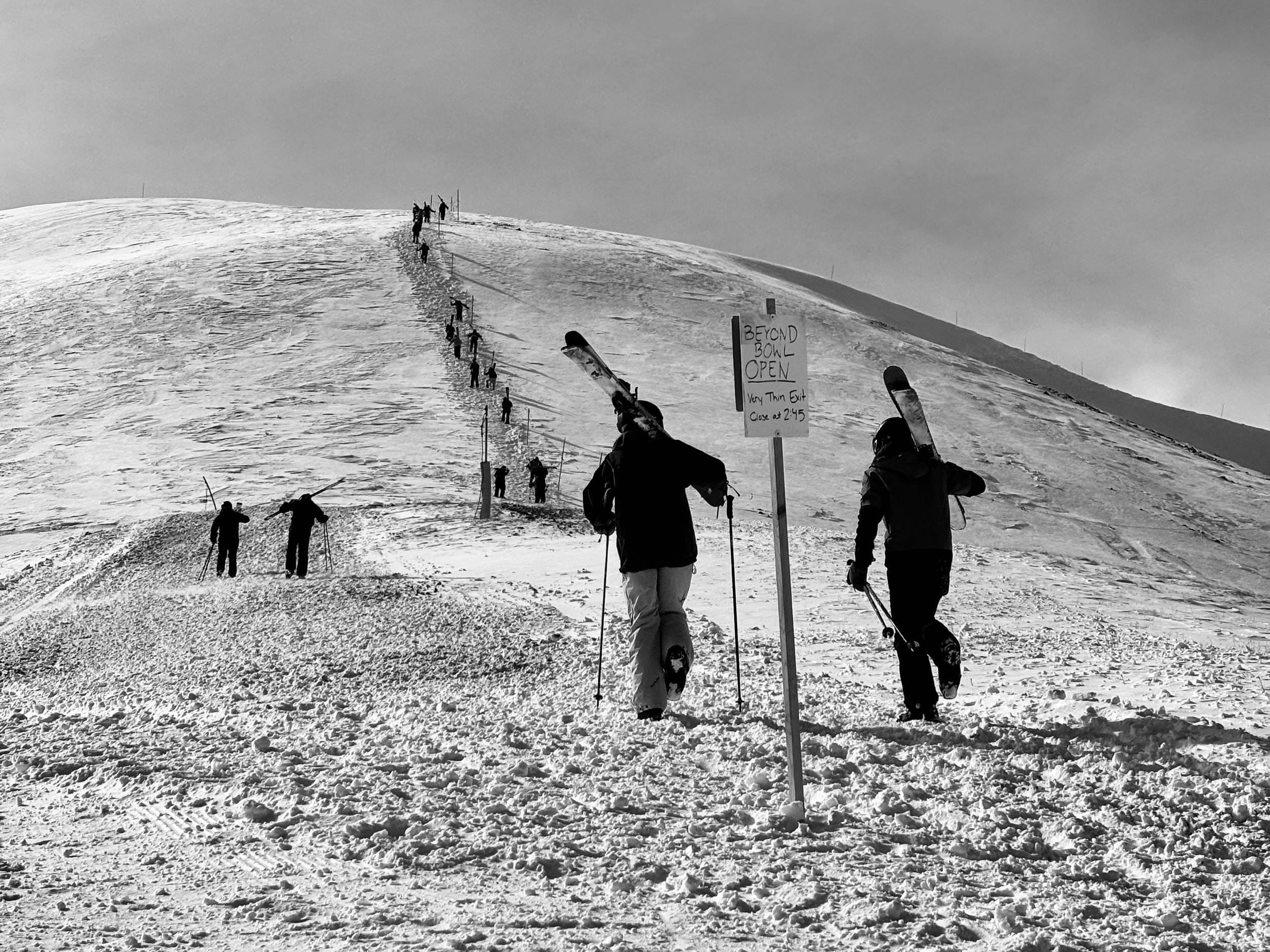
Half-Days
Souvenirs from a shitty season.
―
Snow gun hissing still
Bluebird sky dries the county
Kindling for June.
November.
Our new locker room occupies a hastily built-out corner of the Grand Colorado’s garage. There are no windows, so it smells of exhaust and feet. Returning pros squabble about where to put the computers and the vending machines, but everyone agrees there are not enough benches or places to put the skis.
A construction site behind the Magic Carpet swallowed our old home over the summer. Broken ground leaks diesel plumes into the learning area. When the wind turns north, they carry all the way up to Trygve's Platter, which isn’t running yet anyway. Through peepholes in the construction fence we glimpse bones being laid for the resort’s first five-star hotel: The Imperial Hotel and Alpine Chalet Residences. Embedded in its 70,000 foot sprawl will be the “Sky Domes,” glass geodesic houses where high-net worth individuals can dine and stargaze. For now, though, it’s just a big dirty hole.
Blue jackets swing on hooks. Boot dryers hum, filling the air with their familiar musk. The pros trickle in but the snow does not. A week is all it takes to shred the “White Ribbon of Death” to a shoelace. It feels more like April than November.
I return from another lower-mountain lesson, sixth toe burning, wearing only a thin base layer beneath my uniform, unsure what the uniform is for.
December.
Thirty-seven of 193 trails open. An 18” base. Daytime temperatures squat above freezing at base elevation, refreezing weakly at night, if at all. Snowmaking fills narrow wet-bulb windows, laying down dense, artificial ribbons that abrade quickly under holiday traffic. Natural snowfall hasn’t built depth; it sublimates, melts, or compacts back into dirt.
The hollow statue of the Norse god Ullr stands motionless at the base of Peak 8. His bow drawn, his arrow aims at a widening patch of dirt beneath the Colorado SuperChair. Kids slither around sharks—rocks hidden like prizes between moguls—and micro-forests that push up defiantly through the white stuff we’ve paid dearly to make.
Exasperated instructors confiscate skis and send groups of advanced kids one-footed down the greens. The sups laud such creative pedagogy, but the parents are not impressed. Lesson prices have gone up. A full-day private now starts at around $1300. A half day at $900.
“We’re in a donut,” lament the locals in bars. “The snow is hitting everywhere all around us. East, West, they’re all getting pounded. But not us.”
In Broomfield, the corporate wizards reach for euphemism: variable, packed powder, early-season conditions. But it isn’t early season. It’s Christmas week—the first rush of what’s supposed to be winter.
A persistent ridge of high pressure has diverted more storm tracks north. On Christmas Day, rain falls on Main Street.“Variable” isn’t just a euphemism for bad snow. It’s overworked bodies. Dwindling work. And rent that won’t quit.
January.
The donut shows no signs of abating. The apps show a 30” base at Breck, 70” at Hunter. Let’s not even mention what’s occurring at Jay Peak or in Vermont. The resort’s social media team burns overtime. As the weeks slip, they go from posting white rooms money shots taken last season (presumably to entice March bookings) to addressing the blight directly.
Look! We are so authentic! Come and have fun with us despite the shit conditions! Skiing’s not about quality or quantity! It’s all about who you slide with. Look! Here’s an adorable avy dog in training! Aren’t the views, like, so pretty?
In a week, the resort will have used all its state allocated water for snowmaking. While the local news quietly covers the debate about opening a thirsty new data center on the Western Slope, passholders are told not to worry about the snowmaking. The resort will buy reserves from the town. And where (everyone thinks but dares not ask), when that runs out, will the town buy its reserves from?
One Thursday, I ride the gondola down with a Boomer instructor after another day of no lessons. His beard is the color of refrozen snow and his Carhartts have holes in them; he wears the uniform of the veteran ski bum well. He smiles correctively at me when he asks how my season is going and I respond honestly.
“Don’t be so dower, dear. It’s great to have all this time to free ski! I took the day off to telly.”
He grins at me like a guy who bought real estate here in the 80s.
“You know,” he continues, “there was a winter like this once. Back in the early ’80s, before snowmaking. Breck shut down for a month. Then it dumped. Absolutely nuked. And when it did, we had the biggest spring I can remember.”
(Of all the words skiers use to talk about snow, that one— nuke—is the one I hate most).
One by one, my regulars cancel.
“So sorry,” they apologize, “but we’ve decided to go to Mexico this year. Hope you get some snow soon!”
Beginners take their place. My schedule fills up with the half-day privates that are all the rage these days. Value is squeezed like blood from stone in a sport synonymous with money. The culture around skiing seems to have shifted with the climate but here both subjects are mostly verboten. There is only Stoke, Send, and Slut Strands.
The Magic Carpet churns while prayers for inches resound through the county at night. The bars fill up and the restaurants report a boost in earnings. Across Vail Pass, in Eagle County, the southern facing aspects soak up so much sun they’ve stayed completely bald. Squirrels and chipmunks chatter on the treed fringes of blue groomers, and confused moose stumble out onto the runs at Peak 9. Birdsong, not normally heard til closing week, trills in the air.
February.
The Olympic torch burns through Cortina. And just like that, the world is enamored with winter sports again. Lindsey nearly loses a leg and Mikaela reclaims the glory that eluded her in Beijing. Everywhere but here, it seems, the skiing skies on.
Suddenly, the water for snowmaking is all gone. The sun gnaws what’s left into afternoon slush, which promptly congeals overnight. Patrol shuts down runs previously opened. Collisions after collision make local headlines. One bro at Keystone rushes a tree so hard that he loses an eyeball, then promptly sues the goggle company.
Prayers for powder dissolve into hushed chatter about summer. The experts say the threshold has already been passed to generate enough snowpack to see us safely through fire season. The runoff will limp along. Whatever does slip into the river beds will disappear quick. Lake Dillon, which hydrates the Denver metro area and didn’t freeze until this month, sleeps fitfully under her thin cover. She tosses beneath her thin sheets of ice like a child with a fever. It is announced that Frisco will close the marina’s dock and public boat ramps for the summer.
Just in time for President’s Day, patrol drops rope on T-Bar. There’s dirt in the track on the way up, and crowns of rock complicating all entrances to the bowl.
“Can we go ski up there?” the kids ask.
I shake my head. “Not today.”
Even the old timer isn’t taking days off to telly anymore.
MOI
“CPR does not work in the woods.”
―
My knees chilled from kneeling in wet November leaves. Someone was playing an unconscious victim with unnerving conviction, half buried in duff. I palpated her limbs the way you check a jacket pocket you’re almost certain you haven’t lost your keys in—half hopeful, half afraid of what you’ll find.
“Just remember,” our instructor called out, hands tucked into his vest pockets, tone dry as tinder, “CPR doesn’t work in the woods. Hurry up and figure out what’s wrong with your patient.”
He wandered over to inspect my technique, which at that moment consisted mostly of wrestling my patient onto a sleeping pad and rooting, somewhat desperately, for a carotid pulse.
“Don’t reach over your patient like that,” he said. “Take the pulse on your side. Otherwise you’ll strangle her.”
Killing my first patient felt like a reasonable beginning to Wilderness First Responder—known, with varying degrees of affection, as “Woofer.”
For ten days, our group of twenty-one strangers revived plastic infants with stiff limbs, treated imaginary drunk campers, and staged the mass-casualty aftermath of a downed gondola in the pines of New Hampshire. Mornings meant rolling out of bunk beds, submitting gratefully to Nancy’s enormous breakfasts—Nancy being the campus cook and, by consensus, the only person keeping the entire operation emotionally solvent—and marching into the cold for scenarios. We memorized the necessary acronyms: AVPU, ABCs, SOAP. But the one that rooted itself most insistently—lodged, really, the way an impaled branch might—was MOI.
Mechanism of injury.
The origin story of pain.
The plot twist that gets you here, cosplaying catastrophe in the woods.
Outdoor professions attract a familiar cohort: the recent graduate not quite ready for a desk, and the retiree who spent twenty years at one and finally suffered the sort of existential rupture that results in a backpack purchase. Because of finances, there is very little in the middle. The twenty-two-year-olds are perfectly content to live under tarps in a state of communal, provisional bliss. The retirees, meanwhile, can afford to resurrect the happiest memories of their youth with the zeal of someone performing chest compressions on nostalgia. The metronome remains the same, but the song used to keep rhythm has shifted—from the Bee Gees to Chappell Roan—leaving those of us with aging but still functional knees and long Zillow wishlists in a kind of generational no-man’s-land.
Around me sat human clippings from a vintage REI catalog: rookie ski patrollers; a seventy-year-old scientist who surveyed remote Alaska; a retired teacher moonlighting with search-and-rescue; a twenty-something backcountry ski guide; a young “brown bear” guide fresh off his summer in the Kenai Peninsula; an eighteen-year-old New Yorker whose motives remained inscrutable; a nature therapist in her sixties. Only two people were in my age bracket. We spotted one another immediately, exchanging the quiet recognition of travelers who’ve missed the last ferry and now occupy the same dimly lit dock.
23 YOF.
70 YOM.
40 YOF.
Even stripped to the barest patient identifiers, we were an earnest, slightly improbable cast—twenty-one strangers who had, in various ways, accepted that the wilderness is where one eventually meets the hard limits of the human body.
“What’s our favorite word?” the instructor asked one morning, tapping the smart board with a digital pen that seemed to please him disproportionately.
“Continuum!” the class replied, as though it were a moral directive.
And in a way, it was. Everything, we learned, exists on a continuum: shock, infection, heat injury, hypothermia, traumatic brain injury—which the instructor colorfully described as “the brain trying to leave the skull through the big hole.” Careers, relationships, and taxes share the same sliding-scale inevitability. Talking nicely and sugar water, we were assured, help with most things.
“At the end of the day,” our instructor announced, “we’re all fucking hummingbirds.”
By then we had practiced impalements, strokes, heart attacks, broken ribs, tourniquets, and death notifications. We stabbed training EpiPens into our thighs and splinted one another’s intact bones with sticks and sleeping pads. Underneath the theatrics pulsed a quieter question: Will I ever need this? And: Will that ever be me?
Last year, it was. I had been a real patient. There is no moulage for c-word things. Nothing in the textbook—despite its generous enthusiasm for diagrams—prepares you for the way a medical event can rearrange your sense of chronology. My MOI was internal, discreet, the sort of plot point you can’t point to on a map.
Pema Chödrön writes that “nothing ever goes away until it has taught us what we need to know.” If that isn’t a continuum, I don’t know what is.
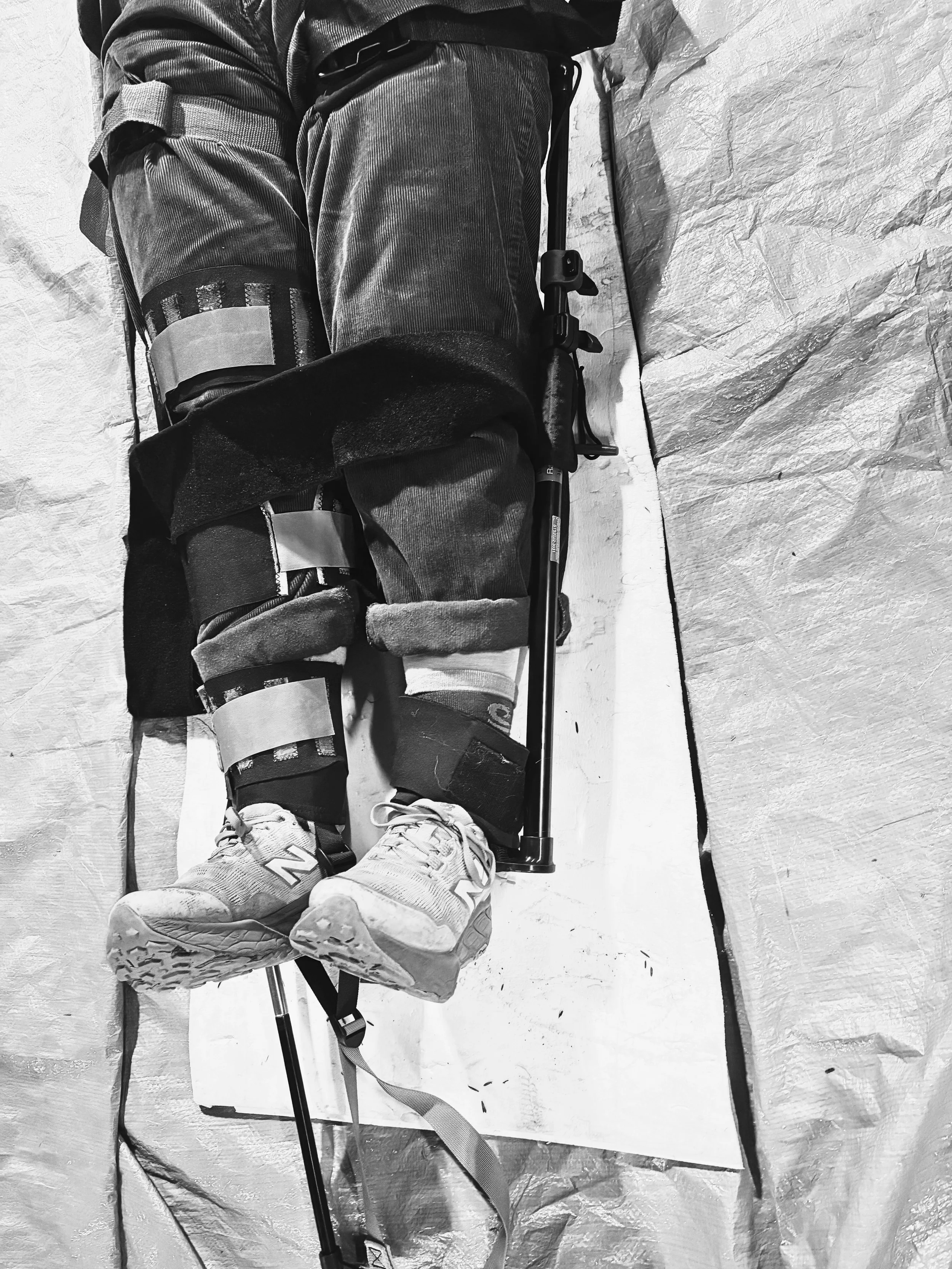
By week’s end, EMT Sensei—his own MOI wrapped neatly in a knee brace—led us to a ridge where five classmates and two mannequins lay strewn in dramatic disarray, moulaged with almost theatrical verve. Moving toward emergency always feels like approaching a mirror: the mountains we climb, the waters we cross, the people we love; the moments when things go wrong and you kneel beside a body, hoping your hands remember their choreography.
“So, what did we learn this week?” he asked on the final day.
“CPR doesn’t work in the woods!” we shouted.
But the unspoken second half had become obvious: But that doesn’t mean we don’t try.
I tucked my badge away and climbed back into the Subaru, pointing myself west. At my cushy resort mountain, is ski patrol. Helicopters on call. An army of elite orthopedic surgeons.
But first responder training isn’t about conquering chaos or even saving lives; it’s about cultivating a kind of interior ballast. The ability to arrive—at accidents, at relationships, at your own life—with a little more steadiness than the day before. To assess scene safety first, then decide whether you have a duty to act. And if you don’t, whether you will act anyway. It’s about widening, however minimally, the fragile circle in which you may be able to make something a little better. Including, it turns out, the slow, awkward business of getting older—especially when you find yourself wedged between the sendy, twenty-year-old hopefuls and the sixty-something wilderness sages. It is, like everything else, a continuum.
In the end, MOI feels less like a mechanism of injury than a mechanism of insight: why we are drawn to these places, why we return, why some of us build our odd little lives at the edge of weather and chance.
And why, in a hexagonal building in New Hampshire, twenty-one strangers worked so intently—earnestly, imperfectly—to learn the simplest and hardest thing: how to keep one another alive.
On HABs
The Hudson falls ill.
―
The Wolf’s had a birthday since I last saw him at the Seattle airport fussing over his boarding pass, not quite thawed from our Inside Passage trip. Seventy-seven Augusts and counting, he now boasts a gold hoop in his left ear and a turkey feather tucked in his hatband. “Talismans,” he calls ‘em, to sanctify his new status as a sea kayak guide.
We met unloading boats at Kingston Point, and have paddled together ever since. From Rhode Island to Alaska, the Wolf’s hand-of-godded and towed me out of trouble more times than I care to admit.
This summer, while I’ve been away in Maine, he’s been leading trips Bannerman Castle, the eccentric ruin on Pollepel Island. I sign up to see him in action my first weekend back. The wolf wades into the shallows and shoves the Pungos off the beach. Their sturdy, almond-shaped hulls rock in the barge wake as Maine’s erratic lobstermen and postcard beaches give way to New York’s working waterway.
Here, city etiquette seeps upstream—sidewalk habits translate to current and channel. Boats of all sizes and kinds dodge, shift, merge. The tour crowd changes, too—New Yorkers, kin to New Englanders, but tempered: grittier, somehow sleeker. A Women’s History professor from Albany tells me why she drove her family three hours downriver to kayak today: “History,” she says. “What else?”
We cross on slackening flood and scramble over the rocky landing, slick with periphyton. The Hudson doesn’t swing ten feet like Maine waters, but its three-foot tide still breathes diurnally through this ancient fjorded valley.
A volunteer guide in a BANNERMAN’S CASTLE shirt with a Long Island lilt greets us at the island and gathers us by Mrs. Bannerman’s pie garden. The Wolf hangs back, chewing the inside of his cheek. He stands by and listens with the seasoned stoicism of one who’s spent the whole summer silently judging another guide’s schpeal. He knows her script by heart.
“He was the country’s original arms dealer,” the Wolf whispers to me. “Ran the biggest military surplus operation that became the Army Navy Surplus Store. This place is an adult game of hide-and-seek.”
After the Spanish–American War, Bannerman bought 90% of the US military’s unused weapons, uniforms, and black powder—so much that Brooklyn officials blanched at the thought of his munitions next door to the naval yard. The baron desired storage and spectacle, so he doodled himself a castle—part Scottish baronial, part billboard—its crenellations spelling BANNERMAN’S ISLAND ARSENAL for every passing steamboat to read. Poured quick and cheap, the concrete fairy-tale went up quick. For a time, it advertised a fast-tracked empire.
Then came the classic Gilded Age plotline: the warehouse exploded in 1920, Bannerman followed soon after, and the slow unspooling began. In 1969, fire set the period at the end of the sentence. What’s left is a buttressed rib cage open to weather, a shell that now stages local theater and a ruin Metro-North commuters know by heart—a concrete pastiche of The Great Gatsby’s closing line: “So we beat on, boats against the current, borne back ceaselessly into the past.”
Neon dots of algae whorl off my paddle like confetti. They are HABs—harmful algal blooms. A spotted lanternfly touches down on my hat —cryptic gray forewings, sudden aposematic red beneath.
“Kill it,” the Wolf says, soft but absolute. “Slowly, if you can, to send a message to the others. They’re very invasive.”
HABs on the Hudson.
The worst outbreak of blooms in 40 years inscribe the present tense in a scientist’s lexicon. Cyanobacteria and other phytoplankton—neither fish nor tree—are photosynthesizers catalogued by color and clade: green, red, brown; diatoms, dinoflagellates, blue-greens. In balance, they underwrite primary productivity, turning light into living carbon. But increase nutrient loading—sewage, lawn runoff, manure; warm the water; slow the flushing—and eutrophication takes hold. Pigments slick the surface like spilled paint.
Some blooms merely shade; some produce toxins. All are a message in dissolved oxygen and turbidity: choke the light, starve the gills, tilt the river toward hypoxia. Longer heat stretches stratification; drought reduces turnover; nutrients light the fuse.
Contamination isn’t dramatic. It’s steady—like sedimentation, a floodplain filling grain by grain. To get rid of the HABs, as the Columbia Riverkeeper says, the task is none other than tackling climate change itself.
While small efforts from individuals can always help, like picking up pet waste, the true remedy is for it all just to stop. Then wait for as long as it takes for the water to clean itself. But once the bloom is here, there’s little that can be done. Don’t swim in the waters, keep the dog away, and, in time, maybe it’ll dissipate.
“For time is the essential ingredient,” writes Rachel Carson in Silent Spring; “but in the modern world there is no time.”
The day after the paddle, the Hudson Valley Garlic Festival sprawls in a field to the west of Saugerties.
The mosaic of garlic hats, witches, vampires, and soil-rich hands throngs in the late September heat. “Eighty degrees,” sighs a vendor, wiping sweat from her brow with her forearm.
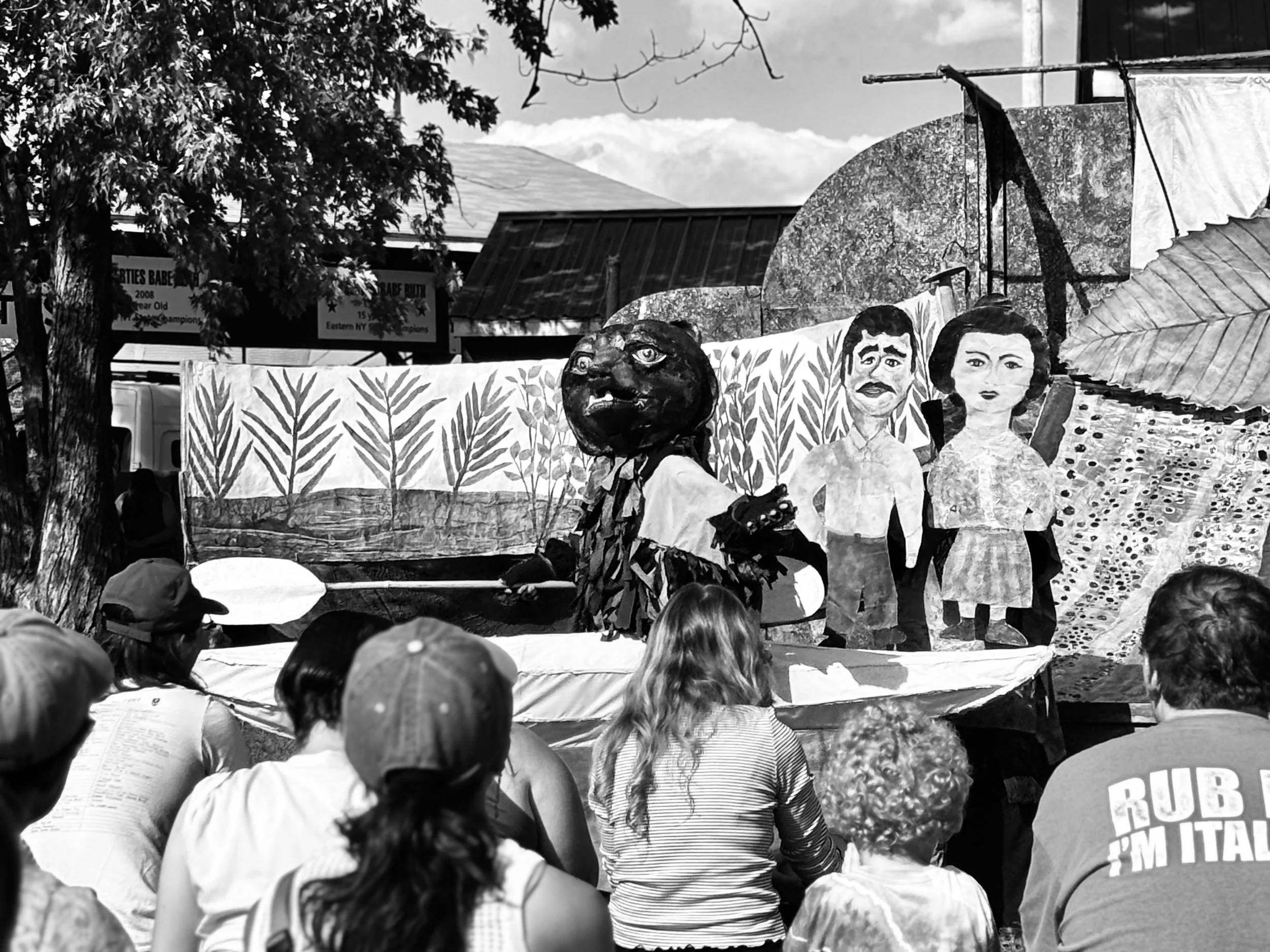
In the hay-bale commons, the Arm-of-the-Sea Theater unfurls a puppet river in cerulean silks and sings a song about photosynthesis to a chorus of equally delighted adults and kids. The troupe’s mission—“handmade theater as an antidote to ubiquitous electronic media and consumer culture”—ripples through the crowd as boos meet the colonial realtor and cheers rise for hemlock, oak, and pine.
Some of us are locals; some are not. Everyone is listening. For the finale, a black bear waddles onstage with a kayak cinched around his belly, paddle in paw. He dips the blades into imagined current, singing of environmental resilience to papier-mâché trout and city transplants alike.
Tucked in the generous allium bounty of small farms, the play reminds me that this place where I’ve made my home holds more than ruin and warning.
Sea kayak guides lead people into many waters. In Maine, we sell clarity—porpoises and ledge ecology, tidal respiration you can feel in your bones. We point to eiders surfing swell, pull out lobster gauges, and say, look how well the world keeps working.
It’s easy to forget that Rachel Carson spent her summers on Southport Island, just across the bridge from Boothbay Harbor where I lived this summer—and that her time there shaped the work that helped end DDT’s reign. Without her, the islands where I taught kids to Leave No Trace and delight in shorebird abundance might have read differently.
The Wolf threads us through the arteries of an overbuilt New York watershed to a Gilded-Age folly between interstate bridges. The Hudson’s riparian speaks in closures and neon veils, but also in the older key of resilience and succession: flood-pulse, leaf-drop, Forever Wild. On the banks, a countercurrent slowly gathers—garlic-festival crowds, hay-bale audiences, a bear in a cardboard kayak. Creativity is the Hudson Valley’s unique civic hydrology: it braids strangers, slows the current of despair, and makes room for oxygen.
The river remembers how to heal. We must remember how to belong.
The Spectacles
Somewhere on the Sheepscot.
―
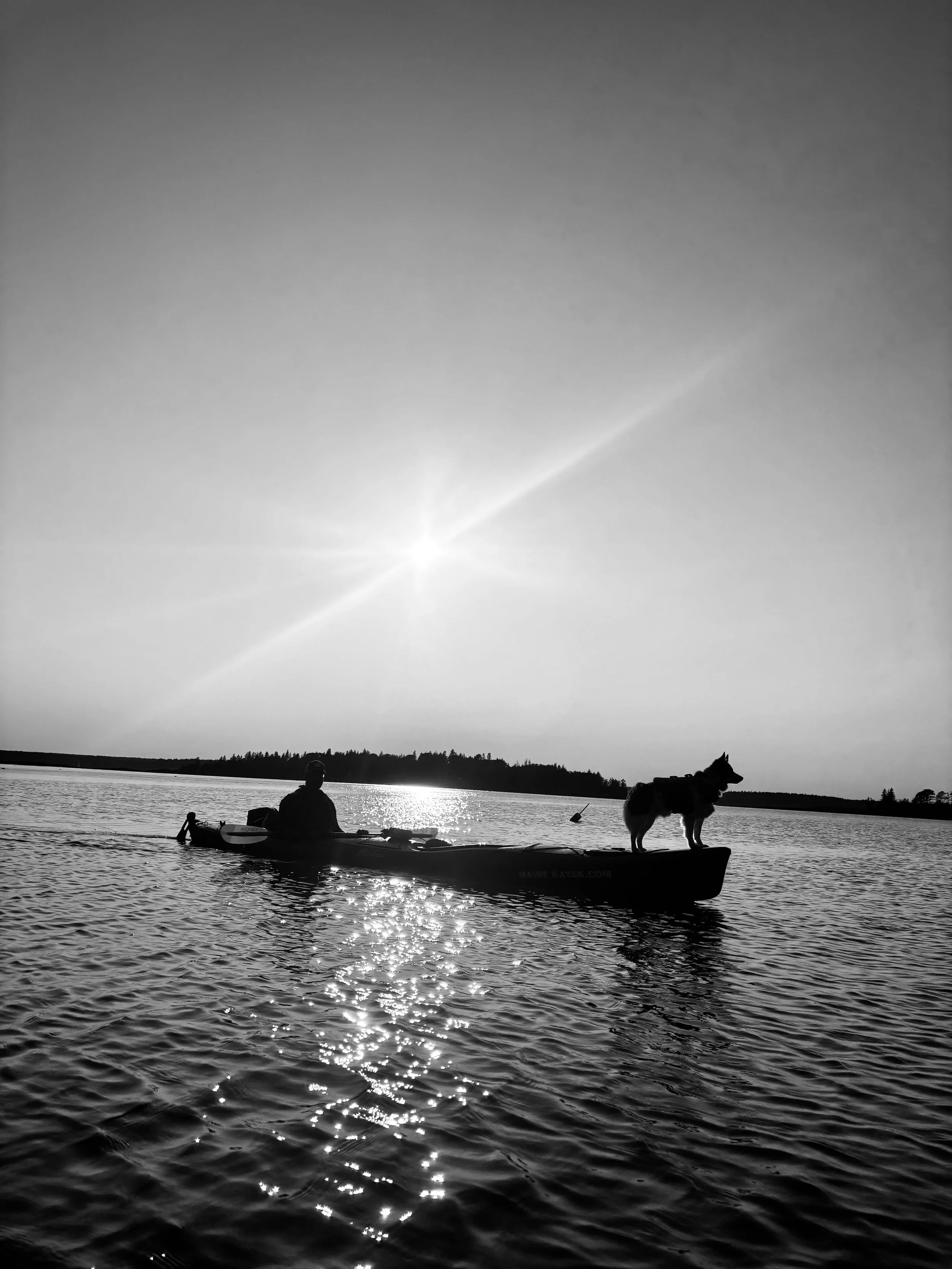
The corn moon lifts over the Sheepscot. Somewhere upstream near Alna sleep the descendants of pines cut for the spars of the USS Constitution, the country’s oldest surviving warship. Downstream, the nearly extinct native Atlantic salmon inch home against the current. Between them, us—two kayakers bookmarked for the night on the edge of the estuary, our REI Penates—stove, sleeping bags, thermoses—set up on an islet known as the Spectacles.
J. and I pass the dromedary of rosé and watch the pale apricot sphere climb beyond the river’s mouth as the tide slides toward its night low. Nine feet of water pull off the ledges like a cloth whisked from an altar. Low water bares the rocky bar that joins the two small islets, the feature that gave this place its name. It’s classic glacial work: granite shoulders rounded by ice, boulder till suturing the halves, cobble glued by crushed shell. Spruces hold the higher ground, wind-flagged by years of nor’easters. Down near the wash, bayberry and sheep laurel dome the edges, and a belt of eelgrass lets go and combs the beach in long green hair.
Our kayaks lie bow-to-bow above the high-tide line. The tent faces east at the northern end; a spruce limb serves as a rack for PFDs, spray skirts, and tow belts. Someone has carved TWO FEATHERS into a dead branch and cinched on a pair of cormorant plumes. Off the eastern shore a sloop anchors for the night. Its mast light and watery reflection shine like two ancient coins suspended in a museum case.
Back on the mainland, long-throated geese arrow south; a rim of crimson edges the maple outside the Boothbay library—living messengers of fall. Breckenridge saw its first dusting yesterday. My hours in this northern latitude stretch toward their end. The click of seasons drives a compulsion to distill the last months into a cohesive narrative. For a skier and paddler, the impulse to arc arises as natural as the geese.
Unable to relax into the moonrise, I break the silence with someone else’s wisdom: “You know, J., kayaking in Maine is special because it gives you intimacy with islands.”
A friend offered this insight earlier this summer. I pass forward as if it were my own.
“Intimacy?” J.’s headlamp confronts me like a cyclops.
“Yep. Spending the night on an uninhabited island isn’t like normal camping. They’re all different, the MITA islands. Their energy, what they give you…it’s a form of intimacy.”
On the rocks below, our border collie noses the periwinkles working the weed lines and the barnacles flexing in the last of the ebb. She returns muddy-pawed and full of tidal-river smells: iodine and sweet rot. She, too, is restless. Comma-splicing at our feet, she scans for seals, who write their script where the moon lays its verse across the watery velum. A gray, blunt-muzzled and big as a buoy, surfaces like a macron, a sight like a long flat sound over the vowel of a small wave. Our collie whines and a loon answers from the black cove. Its one-to-three-note wail—the tremolo—resounds like a dactyl across the scroll of liquid glass.
“So what’s intimacy look like on the Spectacles?” J. grins.
I leave the bait.
“Never mind,” I groan. “Forget I mentioned it.”
I step off our perch, circle to the tent, and shrug into the puffy—the first time since May. I linger with the dark. The thought I dropped finds me again: intimacy. On the Spectacles, it unsettles the eye—apparition or perception, mirror or twin? My own twin answers from a peak 10,000 feet high, calling across corn-flat miles: Snow’s here. When are you coming back? Can it already be time to turn west for winter and slip into my other life? The weather in Maine remains kind; its myriad islands aren’t finished with me yet. I want to stay here. On the Atlantic’s margin, where the tide writes a path and unwrites it, twice a day.
In Book 3 of Virgil’s Aeneid, Aeneas recounts his long apprenticeship by islands—the Odyssey-esque counterpoint to the mini-Iliad of Book 2. Epics within epics, retold by the losing side: Aeneas is a Trojan, Rome’s mythic ancestor; Homer’s heroes are mostly Greek.
After Troy falls, Aeneas puts to sea in search of a sanctuary: first Thrace (where he cuts down trees for new ships and Polydorus bleeds from the soil), then Delos, sacred to Apollo. The hero misreads the god’s oracle—“seek your ancient mother”—and sets a course for Crete. There, he claims ancestral heritage and the island answers with plague until, in a dream, the Penates correct his course and nameItaly as his fated destination. The archipelago continues its syllabus: the Strophades, where the Harpies foul the table and Celaeno curses them to hunger; Actium, where they invent games to discipline fear; Buthrotum, where Aeneas finds Andromache, raw with grief.
For Aeneas, the sea becomes a page and omens his pen. Island by island—punctuated by waves, bound by current—he rewrites his story. It takes seven long years of wandering.
In August, I dreamed a katabasis. I visited the River Styx the way tourists visit Rome: gift shops, a ferry terminal, the buzzy public rush of famous monuments—and, most memorable, waking with the sensation of a cold hand in mine.
Morning rationalized. I led a group of six to Burnt Island Lighthouse and back, pointing out osprey nests and cormorants drying their wings.
A few days later, over Labor Day weekend, I took J.’s family kayak camping. We launched late to evade the rain. Stars lifted on the orange-blazed horizon by the time we were ready for dinner. Kneeling on a granite slab to thread a canister onto the stove line, I felt the phone hum in my back pocket. A message from Japan.
“I am sorry to write with sad news,” my cousin said through Google Translate. “My father, your uncle, has died. We cremated him last week.”
The next morning, there was no more news from Japan. I slipped from the tent before the others and boiled water for tea and oatmeal—a small, solemn meal offered to the dead. Light spilled from the east, and the tears came. For a moment grief caught, then passed.
We slid our keels into the flood and hopped island to island along the outer edge of the bay. We ate lunch on Black, where a yellow-and-blue lobster buoy had washed ashore, Sharpied with a blunt oracle: REAP WHAT YOU SOW.
J.’s father’s partner asked if she could keep the buoy, wanting to take it home as a coastal keepsake.
“I’m afraid not,” I said, thinking of karma and Tokyo. “Technically you’re supposed to turn them in.”
“Hey, can we go to that island next?” J. asked, changing the subject.
He pointed to a dark sickle on the horizon, Wreck Island. The name is literal: a late-summer storm in the 1500s, a ship on the ledge, cries the locals heard and—by law’s perverse permission—ignored. Salvage only if no survivors. Winter smothered the cries until spring’s silence licensed the pillage. Not all place-names instruct; some indict. Locals say you can still hear the ghosts howl in the throat of a gale.
What do you reap if you sow nothing?
Leave No Trace ethics are as anti-Roman as can be. Try to be good guests, not founders. Land and launch toward invisibility. Pitch above the wrack on durable ground; keep off the lichens. Cook on a stove, skip fires unless allowed—and then keep them small and erased. Pack out everything: food scraps, dog waste, tea leaves, and on thin-soiled islands, human waste too. Keep voices low after dark. Give wildlife room; birds and seals own the shore before we do.
Conquest and conservation cannot coexist. And yet, Virgil’s epic, like Homer’s, endures as a work of western literary genius precisely because, somehow, through writing, it overlaps them anyway.
The two feathers are someone else’s marginalia in Spectacle island’s manuscript. Or are they quills—reminders that there are multiple ways of writing and reading, of leaving something behind for others to interpret? A carving is not a colony, but it also not nothing. What about a poem? A cousin grieving half a world away?
We did not take the buoy. Nor did we make for Wreck. We turned around. Part of island literacy is knowing when silence isn’t yours to enter. I felt the pull—the old heroic shape, the easy narrative of confronting the unknown and coming home with a lesson pinned to the mast—but the learning here was different: not everything wants or requires pilgrimage. Turning back is often just as good a reading.
As we pivoted, three gray seals rose around us, big and deliberate. One rolled a shoulder and showed a pale map of scars. Another clapped the surface—a sound like an oar slap. The third thrashed after a mackerel with a great splash. I thought of my dream and my cousin’s message. My mother was the youngest of three. With the passing of my uncle, the middle brother, the postwar generation of siblings is gone.
If Virgil were writing this, my kayak would capsize and I’d meet a sea god riding a seal’s back who’d speak in a voice thick with grief and command. This Maine Sea Lord would address me the way Apollo spoke to Aeneas at Delos, with the confidence only deities can muster: “Seek out your ancient mother,” remember? That oracle is so Freudian it can only invite mistakes. Nothing good comes of chasing an absent mother. For Aeneas, that meant setting a course for Crete, and the island rewarded his misreading with a plague.
But Virgil’s not writing this essay. I am. And even though I studied Classics in graduate school, I am not an ancient Roman. I do not get gods—maybe, now and then, a little bit of kami. If I’m lucky, I get cold hands, constellated skies, no cell service for a few days, and animals that watch closely and need nothing from me. Like memories, they surface long enough to be recognized, then left well alone.
Why do people paddle out to islands?
We give these islands our time, sweat, salt, love, attention. They give us a living grammar. A windline becomes an audience; a fogbank, an argument you shouldn’t force; a name like Wreck, not a dare but a boundary to be respected. Prophecy, closure, visitation, omen—it’s all the quiet feeling of being very close to the world in a vernacular only you can understand.
We are not Trojans exiled from a demolished city, goaded by inklings of destiny. And yet, we are goaded by something. Two feathers. An oracular buoy. A good story.
You are not yet done with the sea, explains my mountain twin to me. You come for the small, accruing knowings: which mossy flat cushions a root; that an onshore breeze will snuff the stove unless you turn its mouth a few degrees leeward and shield with a pot lid. For the field-marks that make a place become itself: the late-season tern that should have already gone, the single monarch angling south over salt, the way eelgrass stains your hands sweet-green.
As 21st-century island-farers, we strive to be better guests. To leave no trace, but maybe take home a learning. An essay. A story. The deeper flow of this narrative is still Virgil’s, translated across millennia to a humbler register for a less heroic age. For that is what good epic poetry does. It conveys the legacy of human saga, great and small, allowing it to be repurposed and contextualized, long after the empire has fallen. The ruins of Aeneas’ heirs attract millions as they decay. The trees of Thrace and Alna—felled for the ships that carry the stories—meanwhile have grown and grown.
Whether the Mediterranean or the Gulf of Maine, seafaring adventures teach human beings to read the world as a text, but caution of arriving at any fixed point of interpretation and anchoring there too long. Scylla and Charbydis remain hazards as real today’s sea kayakers as they were to antiquity’s sailors. The hydraulics of minds and river confluences will always hold the power to swallow a boat whole. Ancient epic’s register can still give us a vocabulary for charting modern meaning. An uncle dies in Japan; a sea kayaking niece on an island in Maine mourns. A seal is not a mother, but also not not her, for the feeling this sighting conveys. Aeneas misreads Delos; Crete corrects him. At Strophades the Harpies make a lesson out of hunger: you will mistake want for destiny until you know the difference in your bones. At Actium, courage becomes ritual. In Buthrotum, grief becomes a craft Andromache lives. The archipelago teaches the threshold—sandbars that appear and vanish with the tides, doubles that are mirror and not twin, moons that look like prophecy but also simply illumine the life that is already there.
Back on the Spectacles, the September morning arrives diluted, the color of milk left in a cereal bowl. The corn moon loosens into it and disappears. Lobstermen work the channel in tight circles, haulers clacking, diesel thrum low in the chest. A gull drops a quahog on a rock and misses; on the second try it scores; the shell shatters clean and neat, a violence that is purely practical. On the sloop, two figures in sweaters step out with mugs and give us the small nod of morning boats. We answer with our spoons, lifted from the oatmeal pot.
We break camp without speaking much. Drybags slot into their hatches; our collie leaps like Palinurus to the bow, and the tow belt clicks back around my waist. J. walks down to the boat, carrying a stick. The dog’s tail immediately begins to swoosh. She leaps off the boat and re-muddies her paws. She’s ready to stay here and play fetch in the intertidal zone forever.
“Hey,” he says. Let’s take just this one, for her. We’ll start a stick library. She loves it here so much…she’s explored every inch of this place. I get it now. Intimacy with the island.”
The bar is already taking water; the path becomes a darker seam and then only memory. One island becomes two again—tidy, divisible. I dip a blade. We slip past the last granite shoulder into the channel, where the river’s cold meets the bay’s salt and stitches a line you can feel with your knees. Behind us, the Spectacles regard us the way a good poet does when you read their work not by luck but by practice: not praise exactly, but recognition.
Virgil. The Aeneid. Translated by Scott McGill and Susannah Wright, introduction by Emily Wilson, W. W. Norton & Company, 2025.
Muscongus Metamorphoses
Island shapeshift.
―
On the east side of the island, the girls circled on the schist play a game they call Silent Football. All but one. A curly-haired camper in a giant sweatshirt lingers out of sight. With her long stick-legs poking from the hem and a mop of honey-colored hair, she looks less like a child than a cria, a young alpaca. At dinner, while we spooned out sticky skeins of over-boiled spaghetti, she whispered something to a counselor and then vanished back to her tent.
The tide drops, and I recall another gathering of girls on this same stone, a little older than this group. Their silhouettes bent in a half-circle against the dark, voices carrying the ritual debrief helmed by the Leader of the Day. To soften the agenda, she decreed each girl claim a “spirit animal.”
“Lemur.” “Gazelle.” “Penguin.”
My co-guide, soft-spoken and bearded, was christened Panda. Sensing his unease, they quickly revised him into Owl. When they reached me, they chose Arctic fox. Perhaps they recognized some intuition of winter in me.
Now, a few weeks later, Muscongus Bay’s horizon again glows pastel. The sky is awash in the candy-colored gradients of Lisa Frank Trapper Keepers, which were still in vogue when I was their age: tie-dyed seas, hot-pink leopards, dolphins leaping from galaxies of glitter. Those binders were Ovidian portals reimagined for the late ’80s—open one and you tumbled into another cosmos. So too here, on an island briefly inhabited only by women and girls, the veil of ordinary time lifts. Without phones, female adolescence reverts to its ancient rites: hair braided into ropes, songs composed, dances rehearsed for the end-of-camp recital. Watching them, I feel as though I am leafing through an illuminated manuscript of my own eighth-grade summer, each page preserving a transformation caught mid-gesture.
The Game Master appoints N., the group’s 22-year-old trip leader, to start the fwap—a pat on the thigh that sends the invisible football spinning left or right. N. is Australian, hair freshly shorn, grin wide, eyes softened with a koala’s solemn playfulness. They tell me how their parents were more concerned with them coming to the U.S. for the summer than going to Africa. They describe a cautionary metamorphosis as temporary as an ESTA visa: “I grew out my hair before coming here,” they recount. “Wore hot-pink Juicy Couture on the plane. Customs didn’t blink. The first thing I did when I got to the camp was cut it all off again.”
The Koala does not know the rules. Neither do I, but I join anyway, alongside my counterpart, M.—a kayak guide-in-training on the edge of her first semester as a high school teacher. She has already memorized all ten girls’ names while I still fumble. She radiates an effortless empathy, connecting with the ease of mythic figures who could charm beasts and gods alike. In my Lisa Frank menagerie, she is the Unicorn—surefooted, luminous, prancing through neon stars. She knows all the rules.
The Game Master intones: “Above all, players must be silent. No student may speak, smile, or show teeth. Permission to speak must be granted by the Game Master. To ask a question, you must raise one hand, cover your mouth with the other, and say, ‘Mr. Game Master, Sir?’”
The fwapping begins. The Unicorn flows effortlessly. The Koala giggles and breaks the spell.
“Mr. Game Master, Sir?” cries one girl through lip-lidded teeth. “The Koala laughed.”
The circle convulses in pantomimed glee. Votes condemn the Koala to further laughter. Democracy and its parody entwine. We play until the sky deepens into purples and electric blues, a neon-coral afterglow burning behind silhouettes of pine. The air shimmers not with rainbow dolphins but with mosquitoes rising in clouds, as if the night itself were sloughing one skin for another.
At last, the Game Master calls it. Teeth flash, sighs escape. The night is promised now to whispered confidences between nylon walls that do not muffle sound. An hour later, around nine-thirty, the three counselors patrol with beams of light and a comforting crunch of dry leaves. I circumnavigate the site, then return to my tent pitched on a northwest outcropping of grey schist marbled white—the sort of surreal geology Lisa Frank herself might have dreamed.
I crawl into my sleeping bag with my book about rivers. While I read of the Valley of the Eagles bifurcating the Mutehekau Shipu in northeastern Quebec, outside, the bay hums with islands. Macfarlane writes, “Spring becomes stream becomes river, and all three seek the sea.” The sea just outside my tent keeps seeking itself. It’s fallen almost ten feet, exposing inshore lobsters scuttling ever closer to the surface. Soft-bodied from a recent molt, they creep from their cast-off shells, tender and luminous until the armor hardens again.
Ovid would know this hour as Macfarlane knows his rivers: when forms seem to slip, and the mind is stirred to speak of new shapes. Myth seeps into real moments, and the ordinary is already in the act of becoming otherwise. I tell myself all is well. The Cria is safe. And yet, as sleep pulls me under, I wonder if hidden in that tent is no longer a shy girl in a sweatshirt, but some liminal creature of the night, eyes startled and luminous in the dark.
To be a sea kayaker is to apprentice yourself to catastrophe. A cosplayer of shipwrecks. We rehearse rescues with the precision of battle reenactors, parsing choreography as if survival depended on it—which, of course, it might. We debate endlessly: should the swimmer seize the toggle or the deckline? Should the towline be clipped gate-up or gate-down? Should a capsized boat be emptied before it is righted, or heaved dripping across the rescuer’s skirt? Even our vocabulary is contested. Is the person in the water a swimmer (neutral), a victim (tinged with pity), a casualty (too severe)? The older the paddler, the harsher the term.
To paddle the ocean is to be drawn into the mythology of disaster. On rivers, dangers are obvious—holes that gulp and gargle, strainers lying in wait, rocks greedy for a snag. But at sea, danger is diffuse, infinite, invisible: storms that consume whole fleets, creatures terrifyingly antithetical to Lisa Frank fantasy—white sharks, tidal bores, flesh-eating bacteria. Sea paddlers scull the threshold of myth itself.
And so, like actors in Greek tragedy, we rehearse our dramas in the amphitheaters of bays and coves before a bemused audience of gulls. We cast our friends as victims and point them toward the foaming rocks: “Capsize there, please!” We rescue, tow, re-rescue. We debrief over whisky, parsing seconds saved, gestures corrected, the chorus of our mistakes echoing back. We tell ourselves we hope these skills are never needed. But deep down, in the ego’s secret Trapper Keeper, we long for the test—that the wild will rise, and we will answer it. With flying Lisa Frank colors.
Later that night: a whisper at my tent.
“It’s me,” says the Unicorn. “The Cria’s sick.”
I follow her into the dark. The moon is a mere crescent, offering no help. Stars blaze above the white pines, their branches pointing skyward like fingers toward the Milky Way. Four tents glow faintly. Three are sealed tight; one yawns open. Around it huddle the counselors like anxious sentries: the Koala, the Game Master, and another, tall and shifting on one leg, a Heron in her blue-grey fleece.
The Cria shivers at the center. Gone is her oversized sweatshirt; she wears only swimsuit bottoms and a thin ribbed tank. Her skin burns, fluorescent with fever. Words rise unbidden—appendicitis, hospital—as fear tie-dyes the counselors’ faces. For all their competence, they are barely older than the campers themselves. The Unicorn is not yet thirty. I, deep into my thirties, am suddenly the elder here.
As we scramble for contact with the mainland, I already know what the oracles have decided.
We launch close to midnight. Dead low tide. The Cria hunches in the bow of a tandem, the Heron at the stern. The Koala fidgets in their single. I raft everyone together and clip on my towline, belted tight at my waist. Above, the Pleiades cluster faintly—or perhaps I only constellate the stars so, needing their sisterly symbolism to steady my forward stroke. On shore, the Unicorn and the Game Master stand hapless, their headlamps the last twin beacons of land. Then they are gone, swallowed by the island’s shadow.
Darkness closes in. I am floating in its midst, small and alone. Do the girls tethered to my boat feel my fear humming through the line like an umbilical cord? For a moment, we drift in tidal nothingness. I remind myself: you are trained. You know what to do.
I paddle. The darkness persists. My headlamp reveals only a few feet of water at a time. Another stroke, long and quiet. Then another. At last, an outline of earth returns. The weight of three laden boats drags me back, but I fold it into cadence. The sky explodes. Stars mirror on the black sea like disco lights on a roller rink. My yellow blades flash gold in the beam of my lamp: wings. In that instant, the Arctic fox dissolves. I become Pegasus. The girls I tow are my chariot.
We glide past tide-born rocks. Crowned like naiads in rockweed, they urge us on. As we near the marina, the talisman appears. We all see her at once, weaving deftly among the sunken traps.
“Oh! Look! A lobster!” cries the Heron.
She scuttles across the sand, separated from us by only a few watery inches of crystalline fulcrum. Her V-notched tail flicks and flashes her onward. Female, armored, ancient—immortal in theory, doomed only by the labor of endless molting. She embodies what Ovid could not see: that metamorphosis is not linear, one body fixed into another. Like girls’ adolescence, it is a continual process of becoming and unbecoming. Tidal, protean, infinite.
And just like that, we have come through the portal. The sea equalizes time, gathering all in its molting myth.
By dawn, the Cria’s appendix is declared safe. She rests on antibiotics and fluids, her fever breaking. I collapse for a few hours in the backseat of my car, then wake to lobstermen hauling traps—men already hours deep in their labor, backs bent, ropes and buoys slick with brine. When I paddle back to the island, the bay has reverted. The rocks that rose like naiads in the night have sunk beneath the tide. What remains is only the memory, filed in the Lisa Frank binder of the mind, its pages still shimmering with otherworldly glitter.
The Unicorn has shrugged off her rainbow mane to become my friend and coworker again. M. sits crosslegged on the rocks before the stove, rubbing her eyes while boiling water for oatmeal and coffee.
“Hey,” she greets me.
“Hey.”
The Argonauts once felled pines to cut their first ships, and with those hulls carved the Greeks’ first great sea story, the Argonautica. To paddle the ocean is to do the same: to hew experience from the deep and carry it back to land as story. The river, like the mountain, has its rhythm—an immediate, urgent narrative pulled by gravity. But the ocean, with its vastness and tides, resists such straight lines. It is the realm of crossings, of epics, of prehistoric species in which the females—protected by laws they did not write—can, in theory, live forever. Ever since humanity began inscribing stories, seafaring has repeated itself, molting like a lobster’s shell. Sailors relive them until, exhausted, they sink back into myth.
Accidental Birder
They said it would happen.
―
It’s said that all paddlers become accidental birders. The ocean makes one by necessity. You move through the places where birds feed, nest, and migrate. When you spend seven days a week on the water, you learn the grammar of silhouettes quickly: the quick dagger of a tern, the buoyant bounce of an eider, the prehistoric patience of a great blue heron stalking eelgrass flats. The bay becomes a kind of page, the birds the marginalia. Eventually, you stop identifying species and start cataloging behaviors—circle, hover, plunge, wait—as if memorizing an unwritten manual everyone else already knows.
When I first came to Maine, I knew birds the way I knew constellations—vaguely, romantically, without understanding. They were background: white flashes in the cove, silhouettes above the fog line. But guiding recalibrates the senses. You start by reading wind and tide, and then—almost without noticing—you begin reading wings.
Like anyone new to the Midcoast, I began with Atlantic puffins—clown-faced emissaries of the North Atlantic, beloved for their improbable flight and perpetually startled gaze. Their colony on Eastern Egg Rock is the southernmost in the world, resurrected through decades of careful conservation.
But devotion shifts. And by July, mine had shifted to the terns.
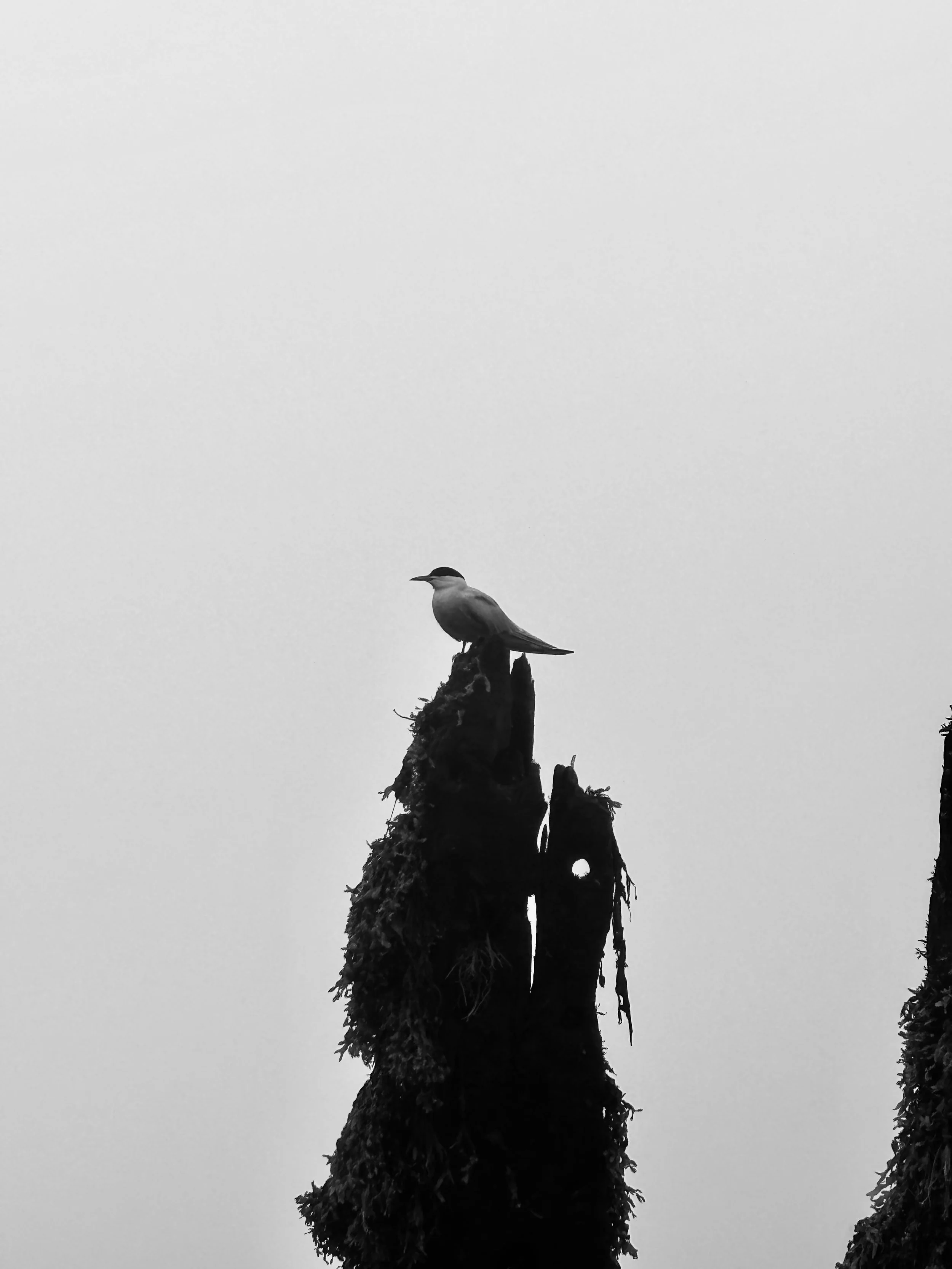
Terns are built like exclamation marks and behave like they invented airspace. Slender, fork-tailed, bright as chipped porcelain, they fling themselves across the sky with a kind of weaponized precision. Their cry—kee-arr!—has all the charm of an alarm system and none of the restraint. They navigate the world as if the rest of us are simply in their way, which, to be fair, we are. In their lifetimes, they log enough miles to reach the moon and back. The Arctic tern is the world’s longest migrator. For a seasonal human who was itinerant long before she was a guide, the temptation to anthropomorphize is obvious—though the terns, to their credit, would never approve.
Still, the everyday residents held me too: the black guillemot with lipstick-red feet nesting deep in granite seams; the double-crested cormorant drying its waterlogged feathers—the only seabird that never fully repels water; the osprey’s unhurried hunt and that electric cry slicing fog. The nest I point out on every harbor tour—balanced high on a mast—has rendered the boat unsailable for the season, protected by law and by the birds’ sheer obstinacy.
And at low tide in the inner harbor, the snowy egret performs the opposite act: absolute stillness, vibrating at a frequency just beyond human impatience. Her black legs end in yellow “golden slippers,” an evolutionary lure she uses to stir prey from the mud. She moves with the precision of something attuned entirely to tide, not spectacle.
Then there are the gulls—loud, declarative, impossible to ignore—ricocheting off pilings and rooftops. Herring and laughing gulls quarrel over bait scraps with the operatic confidence of creatures convinced the entire coast is their personal franchise.
Some birds reveal themselves slowly; some only at low tide; some not at all. And then, sometimes, a single egret standing in a minus-nine-foot harbor becomes the entire evening—white, patient, unimpressed—stepping through the lavender sunset as if nothing else exists, least of all us.