
The Grammar of Ice
A trip to Glacier Bay.
—
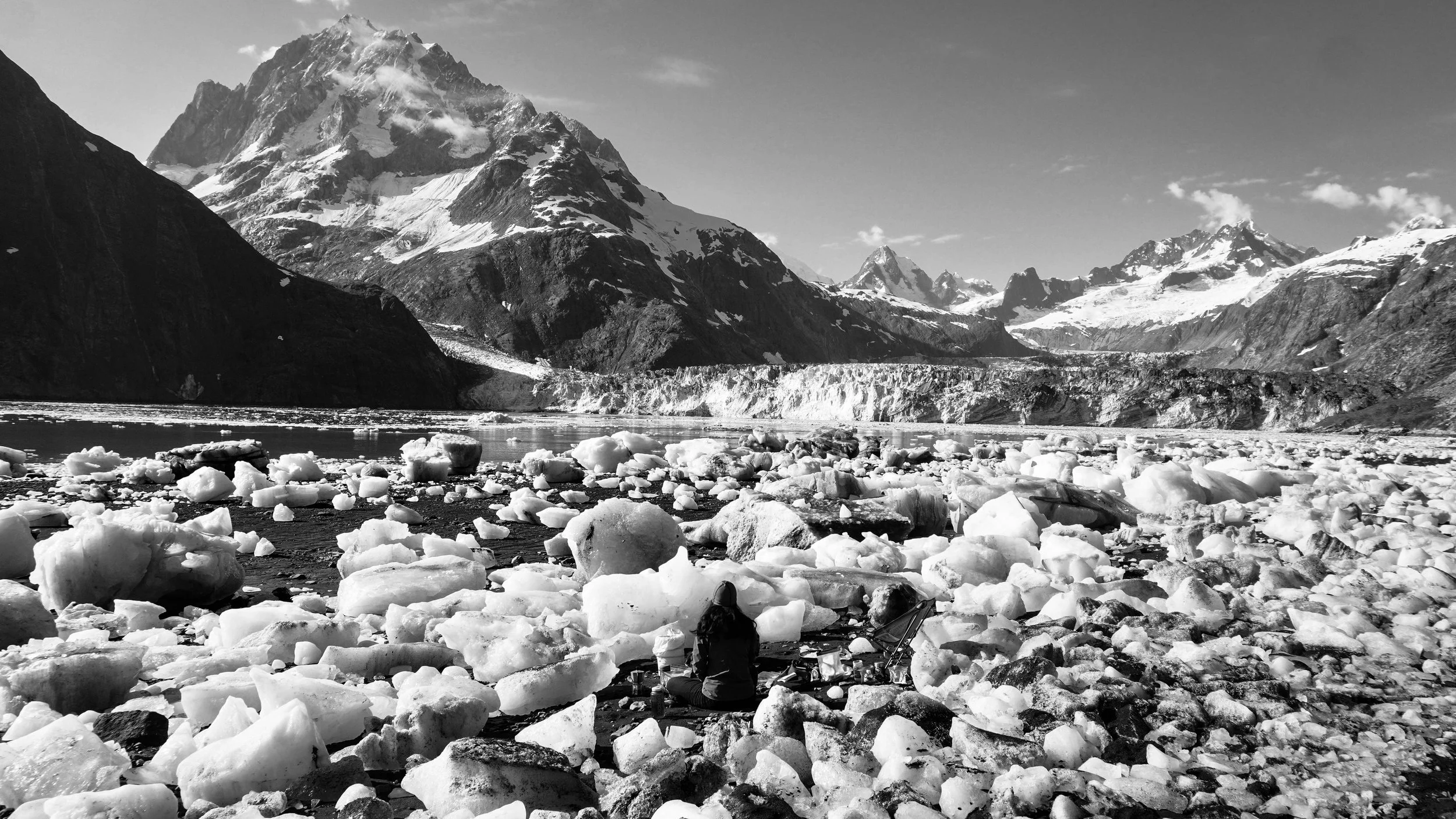
The first growlers and bergy bits first appear early in the morning on our second day in the West Arm. We have left our campsite at Reid Glacier with a heading for Johns Hopkins—Glacier Bay’s crown jewel. With each stroke, more fragments arise, drifting smoothly toward us on the tide.
Their shapes are conceptual, like clouds on a sky of glass. Some resemble animals—whales, birds. Others take abstract forms, arrangements of mass and negative space. The sun climbs higher, and the ice sweats. As the ice grows bigger and denser, claiming more of the horizon, the wildlife recedes. Sighing humpbacks and birdsong give way to the seltzer-like hiss of ice slowly melting into the sea.
We glide past Lamplugh, now technically a tidewater glacier only at high tide. The tide is mostly in, so the water almost grazes the glacier’s toe. Mark Zuckerberg’s superyacht is anchored here. On the day boat that ferried us and our gear into the backcountry, the park ranger told us, “He’s been paddleboarding around with armed bodyguards.”
Lamplugh’s wall of intense blue ice, striped with dark bands of moraine, rises more than 150 feet above us. There is no movement from the superyacht.
Staring up from a kayak into the face of the glacier, it is hard to believe such a thing is capable of dying.
A death measured in feet. Up to a hundred per year.
Listening to the park ranger on the day boat, I could not help but marvel at the language of glaciology. It has accumulated over time the way a glacier itself does. Words picked up from different places, transported, and deposited into the mouths of scientists, naturalists and outdoor guides.
Growler, bergy bit, serac, nunatak, moraine, moulin, crevasse. Calve, creep, surge, advance, retreat, accumulate, ablate.
The words come from French, German, Greenlandic, Germanic English—and the classical languages—the lexicon piles into a kind of verbal moraine. Even glacier carries older sediment inside it. It glides into English through French, but farther down lies the Latin glacies: ice. Terminus, the end of a glacier, is Latin too: a boundary, an end.
I went to graduate school to study two languages we habitually call dead. Yet, as any classicist will gladly tell you, Greek and Latin are everywhere. They survive by a kind of linguistic succession: glacies becomes glace, becomes glacier; roots migrate into other languages; meanings mutate; grammatical structures leave traces.
Dead does not necessarily mean disappeared.
This is useful to remember while paddling into Glacier Bay’s West Arm, where glaciers have their own strange grammar of death.
They advance. They retreat. They creep and surge and calve. They accumulate and ablate. We give them verbs because, although they impose a sense of permanence, glaciers are defined by infinite, colossal movement. A glacier that ceases to flow eventually ceases to be a glacier.
Glaciologists have a word for what follows the ice: succession. Again, Latin. Succedere: to follow after.
In Glacier Bay, succesion is unusually literal. You can see it from the deck of the dayboat or a kayak’s cockpit. As the glaciers retreat, life follows.
The farther we paddle into the West Arm, the farther backward we seem to travel through ecological time. Flashes of humpback tails no longer break the water’s surface. When we land for lunch on an alluvial fan just north of Jaw Point, it is the first time since we entered the park that we do not wear bear spray on our hips.
The closer we get to Johns Hopkins, a vernacular of rock, gravel, glacial sediment and ice takes over.
We are paddling toward the beginning.
The process of glacial succession has been studied in Glacier Bay for more than a century. In 1916, botanist William S. Cooper began marking plots on newly exposed ground to watch what happened after the ice withdrew. His work became part of the longest-running study of post-glacial plant succession in the world.
At first, almost nothing. Then came organisms capable of making a life from almost nothing: lichens and mosses; low mats of dryas; horsetail and fireweed. They grow and die and, in dying, leave something behind. Roots catch sediment. Organic matter accumulates. Something resembling soil begins to form.
Willow and alder follow. Nitrogen enters the impoverished ground. Eventually spruce rises through the thickets; later, hemlock. Given enough time, bare glacial sediment becomes forest.
We tend to think of succession among humans as legacy: what comes after us, what we leave behind, the evidence that we were here.
Here succession is more literal. One form of life makes the conditions for another.
The glacier retreats. The forest and animals follow.
After consecutive days of sunshine, Chocolate Falls runs thick and loud, brown with silt and rock flour: bedrock pulverized beneath the enormous weight and movement of ice. The glacier grinds the mountain into sediment, and the meltwater carries it down to the sea.
Nothing disappears cleanly here. Mountain becomes flour. Ice becomes water. Rock becomes soil.
Our camp is about a mile from the calving face of Johns Hopkins. The velvety black sand beach glimmers like a diamond field, littered with ice. There are no trees here. To make a fire, we hike along the waterfall looking for twigs, then sit beside it roasting pieces of cookie dough as the tide comes in.
The tide beats us.
Water rushes over the stones and extinguishes the little fire with a hiss.
“Glacier Bay hates fire,” my paddling companion says.
I think of this later, lying awake in my tent, listening to Johns Hopkins come apart in the dark.
BOOM.
Ancient languages hated fire, too. Or perhaps it is more accurate to say that philologists hate fire on their behalf. So much of what was written in Greek and Latin is gone that classical literature is, in part, the study of absence: works known only by title, poems surviving in quotations by other writers, histories reconstructed from fragments, words preserved because someone happened to copy them before the manuscript disappeared.
We call Greek and Latin dead languages, although their words are everywhere. Glacier. Terminus. Ablation. Succession.
What survived did so by being carried forward.
BOOM.
You only hear calving after the ice has crumbled.
The muted sound moves through the tent without the sharpness of thunder. Waves curl onto the black sand in the dark—black on black, edged by a moonlit line of white foam. I unzip the tent to make sure the water is not going to reach us. It stops less than fifteen feet away.
BOOM.
A lost text and a calving glacier share something uncanny: by the time you perceive the loss, the event has already happened. The sound reaches you afterward. The fragment is evidence of something already gone.
In the morning, the tide has gone out and rearranged the ice during the night. It is a long carry of gear and boats to a sea puzzled with fragments. The beach is so jammed that when we launch, we can barely get our paddles into the water. The pieces shift and drip in the sunlight.
Then, we turn away from Johns Hopkins.
We began by paddling from life toward ice. Now we paddle from ice toward life.
The farther we travel down the bay, the vocabulary changes. Geological verbs become biological ones. Calving, moraine, terminus, ablation give way to pups, nesting, shedding, swimming, feeding.
Kittiwakes and terns crowd the nesting cliffs. Sea otters raft together with pups on their bellies. Harbor seals tend their young. Humpbacks blow and surface around us, flashing their tails before diving deep.
The next morning, a bear swims out toward our island camp and walks the stretch of beach where, moments before, our kitchen had been. We launch in haste.
The morning after that, a pod of orcas appears. A large male splits from the group and turns toward us before disappearing beneath the water; the females travel with the juvenile.
It is the most unedited wildlife I have ever encountered. A library of life. Not simply the abundance of it, but the diversity, coming after the strange quiet of the glaciers.
Life conjugates itself everywhere the ice has been.
Somewhere behind us, below the blue wall of Lamplugh, Zuckerberg’s superyacht is still anchored.
After ice measured in centuries, succession measured across hundreds of years, mountains pulverized into flour, forests assembling themselves out of gravel, I find myself wondering about the languages of the future. A future, perhaps, without glaciers—or at least without the glaciers as I see them today.
There is something almost too neat about the tech baron floating beneath a dying glacier. Greek and Latin persist here in the vocabulary of ice, while aboard that boat is a man whose world is built in another kind of language: code.
Growler. Bergy bit. Calving. Ablation. Glacier.
Python. Java. C++.
Languages accumulate. Languages disappear. So do glaciers. And human beings. The surviving fragments carry forward long after the worlds that produced them have changed. Perhaps, at first, they are rearranged into collective memory before ablating into myth, and eventually forgotten.
The day boat picks us up by the cairn where it left us, five days earlier. We crack open celebratory beers. As we speed back toward Bartlett Cove, I wonder which words we will carry home with us.
And what will remain in the years to come for them to describe.
Anadromous
I wait for the salmon.
—
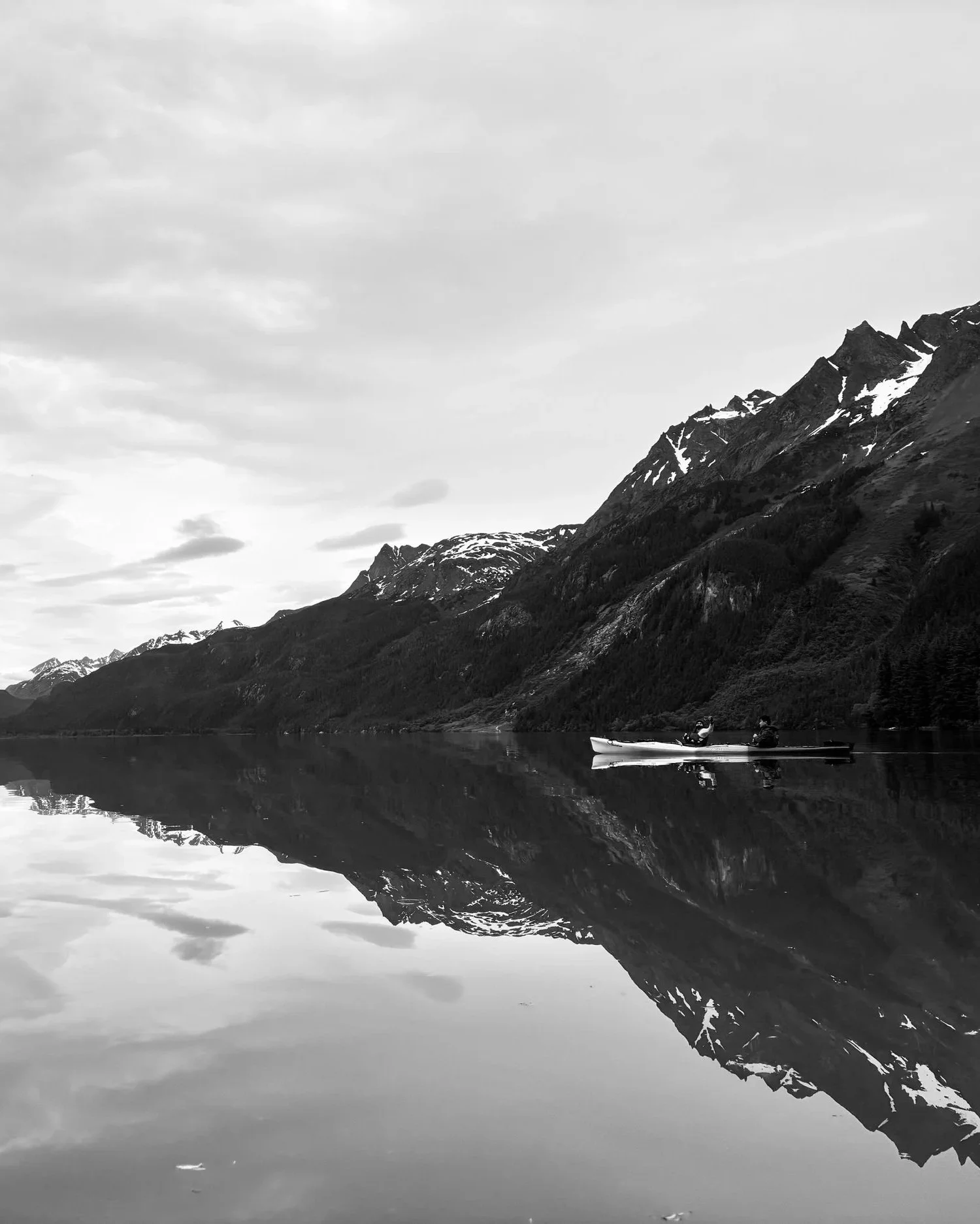
Our kayaks hover along Chilkoot Lake’s western shore in the lee of katabatic winds that race the sockeye upriver. Cushioned between glacial moraine and young peaks curtained with Sitka spruce, the lake curls placid in its bed, three hundred feet deep. An early warm spell loosens more snow, swelling the lake and shifting the shoreline daily.
The opaque coverlet of sedimentary turquoise thickens with glacial silt. From sawtooth mountain to mountain the lake stretches, except for where its southernmost end frays into the Chilkoot River. A mated pair of bald eagles, whom some guides call Uncle Sam and Martha, perch in the sitka spruces posted like gates above the place where the current grabs the lake water and begins to run. The river barely makes it half a mile before surrendering to the saltwater of the Lutak Inlet and the Lynn Canal just beyond.
These waterways carved from coastal mountains trace the lifecycle of the salmon. Once they leave the cradled waters of their birth, they are swallowed into the North Pacific. Their adult years are spent swimming through the same ports where cruise ships call at Sitka, Glacier Bay, Ketchikan, and Wrangell—creatures of the open ocean.
The same ocean delivers another lifecycle. Our weekly ration of cruise ships tender ashore passengers crowned with Glacier Bay baseball caps and garlanded with binoculars. These floating cities charge around the Inside Passage like modern-day gold rushers. Except, unlike their ancestors, the gold that floats these ships has already been laid up. Fortunes long since made are now being expended in retirement’s hope of spawning a less dense currency than bullion: wildlife, selfies, and legacy-bolstering adventure.
We pick them up at the dock. We stand there, beneath the Alaska State flag, our little sign advertising sea kayak alongside all the other excursion contractors’ little signs: cycling, rafting, bald eagle preserve.
The 90s van bounces off to the state park. Its ancient leather seats smell like my childhood field trips. Meanwhile, I act as an ambassador to elsewhere. My cargo are my audience, the ultimate apex consumer nature has set upon to devour this final frontier. But I masquerade as more, peddling the mystique of guide.
I plod along in lightly scuffed Xtratufs, explaining to the the tourists how the bears will soon gather at the fish weir. I gesture to the narrow opening in the fence, which stretches from bank to bank like a comb jammed into an unruly snarl of long dark hair, and joke about a vending machine for salmon—like I’ve seen it all a hundred times before.
“They cut back the brush at the forest’s edge so you can better see the bears coming,” I try out another guide’s facts in my mouth like a salmonberry that’s not quite ripe. Who are they, anyway? “We saw one from the van yesterday. Watching us watch it from the side of the road…”
For now, no representative from Fish & Game posts up in the middle of the weir, swathed in rubber to gaze through the fish-sized opening, counting the Sisyphean salmon. The sign where the run’s tally will eventually be inscribed twice a day in red dry erase marker stands at zero. It’s been that way since I arrived.
For now, the salmon and bears are ghosts of the lake’s future. I worry that that the cruise ship people are the ghosts of mine.
We paddle along Chilkoot’s western shore to gape at the empty spawning beds. The still waters hide in their pockets of gravel and moss, tucked behind pale green curtains of old man’s beard.
Even where there aren’t performances scheduled, this theater in the round opens to the public for tours about its storied history—hundreds of years of drama comprising the cultural largesse of an ecosystem, an economy, a people. Protected between the streams that deliver the cold, oxygen-rich water the salmon seek, the gravel waits like boards to be trodden upon by the fish selected by nature from life’s audition to give us the performance of their deaths.
Sometimes, a mature bald eagle darts overhead with a cotton-colored dolly varden in its talons, a rag doll torn from the river. The fish will flicker in the silver sky like a diamond until the trees swallow the spectacle from sight. Other times, mottled juveniles flash cinnamon and orange on the trees above the beaver dams. The eagles, which are enormous here, can always be counted upon to put on a good show.
I spiel like a priest preaching an ecological gospel of what’s to come. Like the guests, I too have never seen the salmon run, but I proselytize it with the zeal of one who knows.
“In a few weeks, the females will rake their redds with their tails and slip their eggs inside.”
My audience nods with feigned interest before gazing toward the cascades thundering down the far shore. Their feet go to sleep inside the kayaks, and they wonder what they might find in Haines’ gift shops.
Waiting. Always waiting.
Day by day, the weather brightens. Sunshine comes to Southeast like an old friend who never married or had children and so sweeps through the neighborhood with no regard for routine and no idea how long they’ll stay. Locals haul their shoeless children to the beach and cook dinner at ten o’clock over driftwood fires.
Evermore expectancy gathers along the lake's edge along with small cloud-like clusters of black cottonwood fluff. Buffleheads and common mergansers hatch their ducklings and hide them from the eagles in the brush. If our group swings too close to one of their nests, the terrorized downy family will rush from their cover out into the water, immediately summoning the eagles from their lofty perches. The birds of prey will swoop, and the ducks will dive. Some will pop up to the safety of their mothers. Others straight into the mouths of their enemies. Others still will not come up at all, drowned in an attempt to get away.
Last year's sockeye fry, who crept from their dead mothers’ redds beneath the ice back in February, flicker silver beneath the surface. They will spend a year growing and dodging the shadows of eagles and kayak hulls in their littoral cradle before heading out to sea.
The generation before them, meanwhile, circles somewhere beyond the mouth of the Lynn Canal. Out of sight, and silver-backed in their Pacific prime.
Everyone knows the sockeye’s journey home is one-way. This is the icon of this place, the keystone species around which the entire ecosystem of giants revolves. Their one-way journey is the reverse way of the cruise ships whose passengers also only travel here once in their lifetime. Our guests go home and tell everyone they saw Alaska like Alaska is a play the magnitude of Hamlet; the same five universal acts, a classic produced in a myriad of creative ways.
But in truth, they see this place more the way the salmon, pelagic fish who dwell in the sea’s uppermost waters, see the Pacific Ocean. They swim through the layer of the enormity that is most conducive to their getting back to where they need to be when the grand adventure is over. The immensity of this land, its verticality and proto-historic reach, cannot be comprehended in a day, a week, a year, a decade. But it takes time being here to know that one will never really know a place such as this. Not unless one’s ancestors were here before everyone else. One must be born of a land such as this for time immemorial to even dare to think it.
As a metaphor, however, anadromy is not too different from our idea of contemporary American retirement. And that is one thing that the coming and going of the cruise ships and the salmon can teach those who come and may stay or come and leave the next day.
The moment the sockeye reenter freshwater, they stop feeding and subsist entirely on their zooplankton 401Ks, energy stored from years in the ocean. As they struggle upstream for their beds, their bodies begin to dissolve. Time catches what the net does not. Fins fray. Flesh wastes away. Eyes cloud. They quite literally fall apart while still moving. ("Zombie fish," the locals call them).
They spawn once.
Then they die.
The show goes on.
By the Fourth of July, the body count on the weir board creeps toward one hundred. Sometimes, I think I see a few bubbles ruffle the surface of the spawning beds. My new fishermen friends tell me they’re catching nothing but dolly.
“Soon,” I promise the guests, “the salmon will be so abundant, the bears can be picky about the parts they consume: eggs, brains, the fatty hump behind the head—the most calorie-dense. Heads will be torn off, and the carcasses tossed into the woods becomes food for ravens, eagles, weasels, insects, and microbes. The forest itself will close the chain, metabolizing the salmon’s nutrient delivery system: marine enrichment will end up in the ferns, berry bushes, and Sitkas.”
For now, the bears have swallowed all the dandelions, and the salmon nowhere to be found, so the juveniles are magnetized to town. They lope hungry through the parking lot and stare at the cruise ships, salivating at the tonnage of trash. Up in Seward, a pregnant fin whale is pushed into town on the nose of a cruise ship. She is pregnant, and dead.
The hungry bears leave little cairns of tar-black scat splattered along the Lutak Road, breadcrumbing all the way to town. When the town puts down yellow paint lines to refresh the road, the workers paint right over the scat.
On July 16, a lone figure emerges from the Fish and Game truck and crouches on the weir, dressed in fishing rubbers as fine rain mists around them.
Their head bows towards the current.
2,609 …
Weir count, July 18: 18,972.
The first of the large pulses has arrived—6,173 up just this morning alone. The sockeye amass in the inlet then wait for the exact right temperature and tidal conditions to make their rush up the river.
Sunset pink streaks like broad, gestural brush strokes twist in the shallows and leap at the river mouth. They make an impressionist painting in the mouths of drainages.
“A hospice and a nursery,” one guest muses. “And these are the lucky ones.”
After all those years dodging commercial trawlers at sea, they must escape the subsistence fishermen’s long, lethal lines into which a salmon swims in but not out. Their bodies held in suspended animation, trapped with the realization, perhaps, of one of the violent deaths that will soon find them. If they try to reverse and get away, the nets pull at their gills, ripping them of their watery breath. If they are pulled up, the gutting knife waits on deck. If the fisherman dozes on his phone, and they’re left too long, harbor seals devour them like cookies pulled from the oven still cooling on the sheet.
Everything is against them. Everything wants them dead. Eagles, bears, loons, humans, ducks, gods—but, most of all, themselves.
And these are the lucky ones.
The Southeast Alaska State Fair begins. Fireweed’s exhilarated blush darkens to ruby purple along the beaches, and Fish & Game’s tally climbs to just under 30,000. The fish arrive like the wildflowers, in heats. They appear suddenly on their own schedules, like cruise ships of various sizes, docking and flooding the place all at once; 2,000 appear, then 200, then 500, then 1,500. Then nothing. A day off. The restaurants close, the eagles digest, and the town sighs quiet. Then another 1,800. They splash their way upstream and vanish into the lake. They are absorbed. Depending on the year, this is the beginning of the end of the run.
The jubilant eagles’ high-pitched popping and piping wraps through the woods. Where they concentrate, six or more, the scent of fish thickens. Since the run began in earnest, we haven’t seen a single bear on any of our tours. The fishing guides say they haven’t really been seeing them either. It’s the eagles who cluster on the banks, hungrily eyeing their catch.
“We’ve seen more glaciers than bears,” moan one couple.
The Fish & Game people count on, unmolested by bears. They are the attractions photographed by the cruise people out the windows of our white vans. They keep their hoods up, even when it’s not raining.
It’s not that I’ve been lying about the bears, but only that this year’s production is being staged with a different casting thus far. No one knows why they aren’t at the river and are instead popping up on the other end of town. I am glad for the bears to remain ghosts. I do not need pictures of them. I’d rather they stay alive catching their salmon and napping in sedge grasses someplace where no one even thinks about counting salmon.
The cruise ship people pull anchor and sail on to Glacier Bay or Icy Straight or Hoonah—the next performance of Alaska that is and isn’t Alaska, but like the salmon runs, keep this place humming from generation to generation. Ecosystems here braid like the Chilkat River’s channels across the broad valley or the lives of strangers who come from near and far to witness some idea of wilderness.
Maybe they’ll get their pictures of bears elsewhere, someplace like Katmai, but for most of the guests, the bears will remain ghosts. Soon, the season will extinguish, and daylight will disappear and the cruise ships, for a time, will become ghosts too. My past, rather than my future. Among the many lesson of the salmon is that there are innumerable ways to produce Hamlet, infinite ways to go home, spawn, and die.
More salmon will come. Some will be caught at the last minute. Snatched, a few thrashes of a tail from home. But a few will make it. They’ll tuck into the beds nature has so graciously made for them, point into the drainage currents, and ensure another generation will wake this winter, under the ice, long after the rest of us have gone home.
A Few Interior Landscapes
I keep going to the Yukon.
―
33 Mile
The roadhouse just seven miles shy of the Canadian border up the Haines Highway flies both flags—US and Canadian.
One does not have to go very far up the Haines Highway for the mistiness of the fjord to lift off. How fast the sea becomes a postcard swallowed by Yukon’s vast network of mountains and rivers. Mountains rise sharply around the one-lane highway hewn into it—Southeast’s only connection to the continental road system. A bear stumbles in a ditch just down the twisty road, skinny and dazed. He or she is likely sniffing for dandelions, but all they are already gone.
The place is hewn from large timbers. They’re playing 50s tunes, the condiments lined up on linoleum tables look almost as old, and the portions are bigger than anything you’d ever see in Haines proper.
It’s Fourth of July Eve, and a pig carcass lolls unattended on the lawn, right by the freestanding gas pumps. I don’t want to know how they got it. 33 Mile’s Fourth celebration is a local favorite because, well, the pork roast. Besides, the Haines police don’t bother coming this far up the road to shut down the fireworks.
A skinny girl with forearm tattoos strolls in right past me in Xtratufs. A long knife swings on her belt. She orders soup, and the server seems to know her. She repeatedly calls the girl “honey” as they chitchat. Weather. Bears. Fireworks. More bears. That one in the ditch has been looking at folks funny, like he’s about to charge. They reckon he won’t last the month.
Finally, I catch a side-eye. Honey goes and takes a seat, and I step forward to order. The server sighs when I ask about veggie burgers.
“Yes, we have them, if that’s what you mean.”
Whitehorse
“You sure go to the Yukon a lot.”
My new friends say this to me like it’s a character judgement. Like it’s a referendum on what I think about Haines, and how it’s going here. Maybe it is.
Why do I keep spending so much gas money driving up and out of the fjord at the back of the Lynn Canal after I traveled so far to get to Alaska? It’s not just for Real Canadian Superstore in Whitehorse, or the bakery in Haines Junction, or even the sustainable shop downtown, with its endless shelves of delightful soaps and laundry powders. Is it?
The other side of the pass, the Yukon Territory (after a kiss of BC), just feels more familiar, easier than Southeast. The roads here go someplace else—all the way home to Colorado, if you’ve saved up enough gas money from tour tips to drive far enough. There are grocery stores and soaring cathedrals of hard rock, but with more greens, blues, and violets. Skies are bluer here. Fireweed rushes triumphant along the roadways, magenta arrows pointing the way to Kluane, to autumn, even though summer has just begun.
Like home, too, the rock here is strong: giant bones that can contain the enormity of the world they hold up. Caves rattle with eons and mammoth bones. Rivers howl. The bears here are “interior” bears: smaller than our coastal browns, but more territorial, which is north country speak for aggressive.
But there is a vastness here that is unlike home, an expanse of non-building and a horizon that just goes. There’s also the sponginess of permafrost. It gives way to a bogginess that swallows your Tufs with a sigh of Labrador tea. Back in Colorado, there is no sponginess: only the arid grind of stone and bone, occasionally veiled with a resolute crunch of dried-out pine needles. The horizon is broken by chairlifts and ski towns and desert sub-developments pretending they are California.
There are five more hours of daylight to go and it’s already bedtime. This too, is different. There is even more light here than in Haines. Yukon's southernmost border starts at the 60th parallel north, which is nearly 19 degrees farther north than Colorado's absolute northernmost point. Home, but norther.
Million Dollar Falls
And then there it was, the sound of the river.
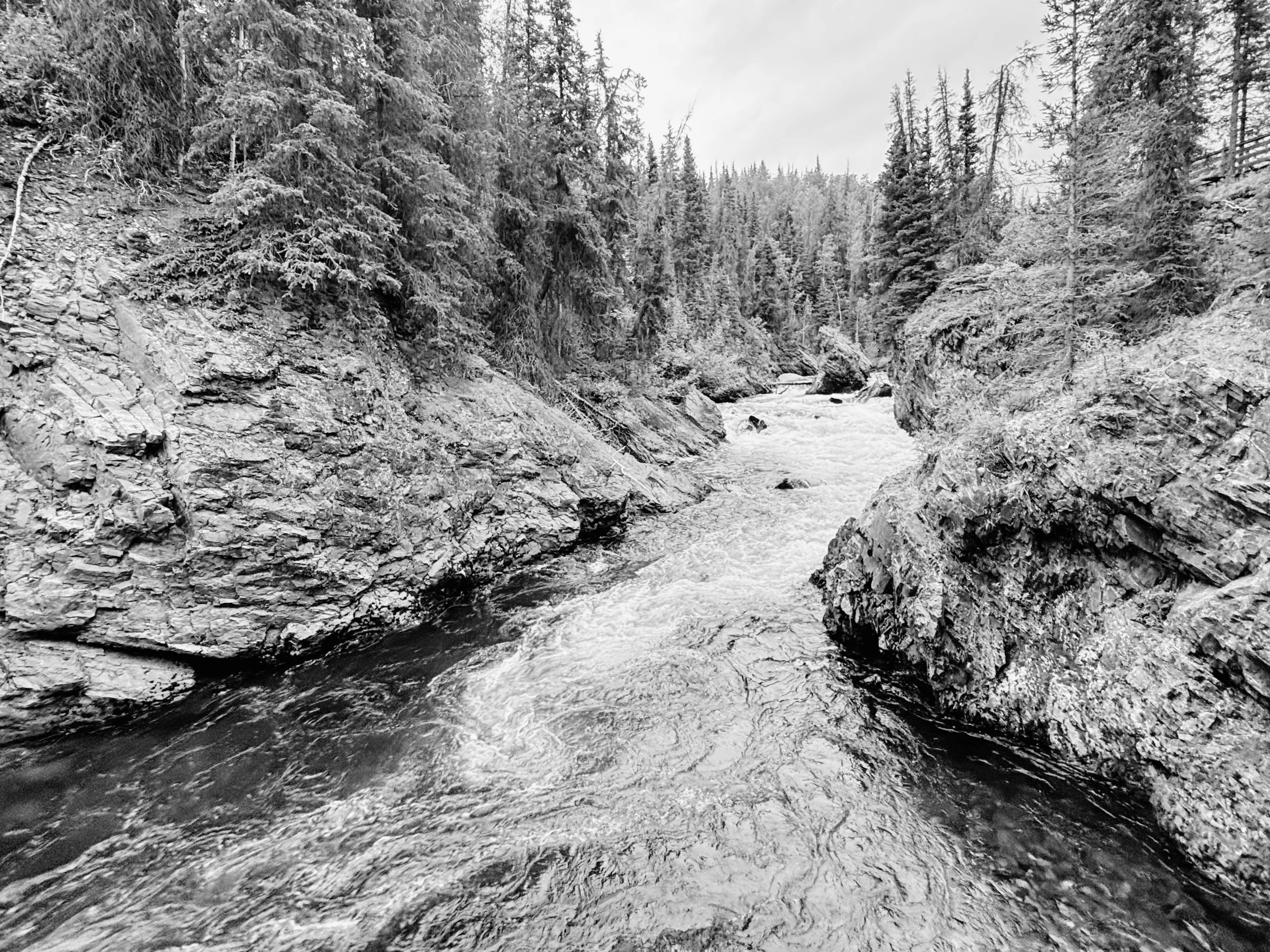
Neither the Chilkoot, which trickles its pewter around the weir with its as yet unrealized promise of salmon. Nor the Chilkat, big and braided while it milks its way down to the inlet. This is the Takhanne boring in my ears. It’s an earnest rush of a big snowmelt, bounding into the earth beneath me. Below the sixty-foot drop, wave trains crash and seethe before giving way on the dark brown banks blanketed by pine.
I light the fire starter I made from torn up shards of a Starlink box and the melted wax from a saint’s votive excavated from one of Haines’ endless free piles. The wax snatches the flame like Sasha snatches a snack, and bursts into righteousness.
I feed the baby fire with the kindling I stole from the ski hut in Haines Pass. Colorful crotchet oven mitts dangle above its door like Tibetan prayer flags. The hut is swept and stocked with dry food and firewood. Its plywood walls and door are tattooed in notes and drawings from people who’d stayed there before: Yukoners, Alaskans, hikers, skiers.
“Keep on birding in the free world.”
“Haines Pass Baby!”
Since I drove up here from home in April, Haines Pass has all gone green and gray with rain: the white a memory. Come again in six months and those words left by those skiers will be another bridge: winter’s long recoil. Bear spray at my hip, Sasha and I wander. But we are very much alone.
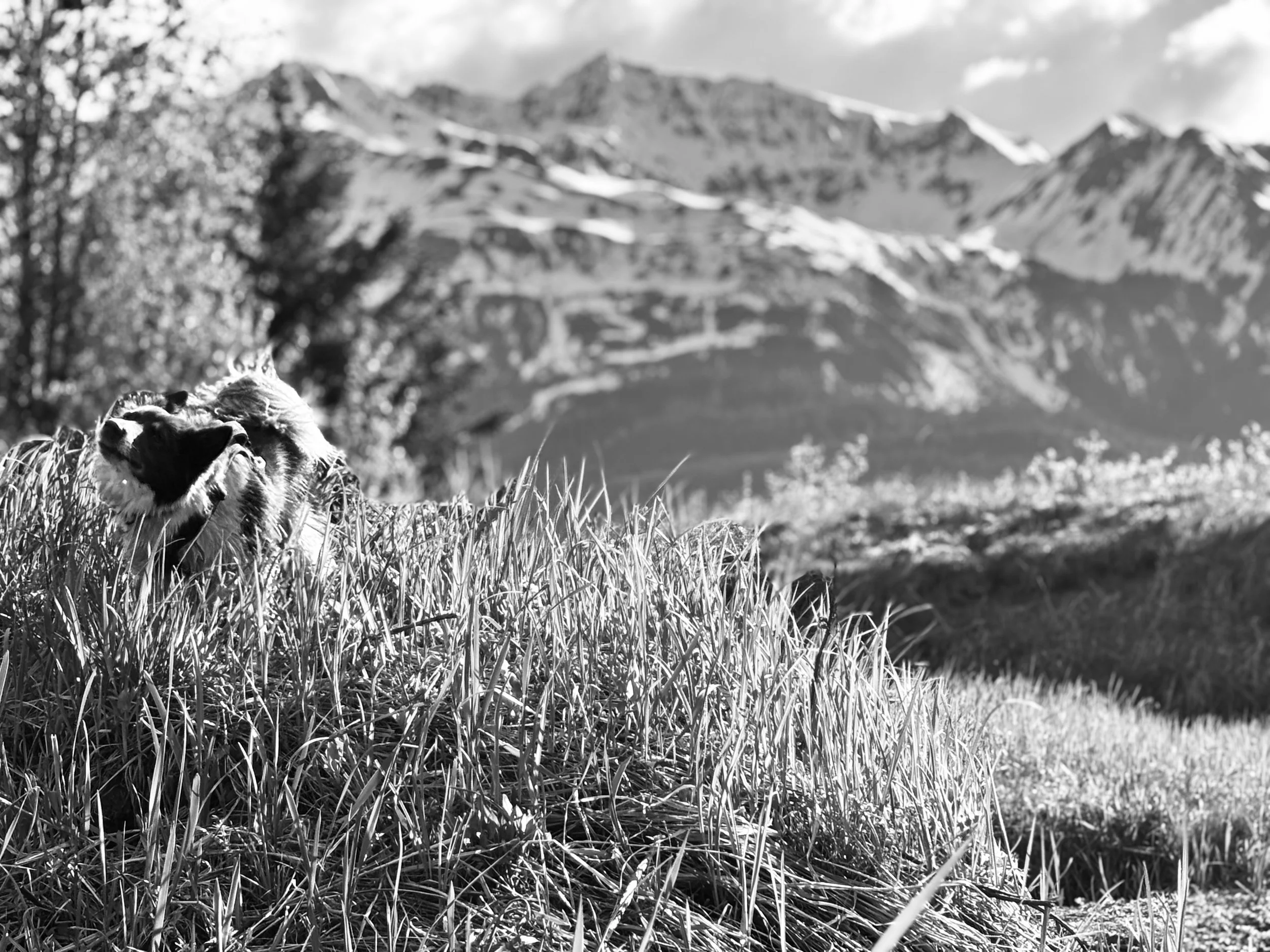
Now the water. And the waterfall. Insisting on erasing the sounds of my pasts—one in each ear. Sasha circles our site with joy. She knows what a campground is now. This sheepdog who requires routine to regulate her hypervigilance takes comfort in this newly forming idea of mutable home. The sound of the truckbed camper rising. The clank of kibble striking metal dinner bowl. I delight in spending the night away from our little dry cabin back in Haines, already crowded like a sunny patch of forest floor with new community.
The rain comes in hard before the darkness. My little fire persists, which leaves me feeling triumphant, like a guide capable of keeping a flame alive in a hurricane. Even Sasha radiates in the satisfaction of being warm and dry while the world around us absorbs the cold deflected by our heat.
The rain here is not Haines rain. It is not feathery rainforest rain. This is the rain that blows in on the wind and will pass shortly, returning the sun, mountain rain. It falls in fat drops that go splat on the rocks. Each splat leaves a wet thumbprint. Wet plopping to the earth with purpose.
This rain is familiar.
“You sure go to the Yukon a lot.”
The Yukon, the interior’s beginning at the end of the Inside Passage, is like homecoming without being anywhere near home.
Tagish Lake
I cannot see either end of Tagish Lake, whose unusual wishbone shape spans the border of the Yukon Territory and northern BC. While Alaskans speak of their oceanways as lower bodies, here, in the nearby interior, laconic nomenclature lives above the waist. Tagish’s long, blue branches are called arms, and they wrap around either side of the Canadians’ borders, 74 miles long.
I camp on the Yukon side. Sasha offleash sniffs the bones of what the signs tell me are what’s left of the Venus Silver Mine. The abandoned machinery of a long-dead era now rots like a caribous carcass on the grey rock beach. The story, to a Coloradan, is a familiar one. Claims staked early at the turn of the last century by men from elsewhere who came in hard, purged other peoples’ money, and established a boomtown—named after themselves.
In elementary school, while delicately skirting the stories of what happened to the Buffalo by choosing to focus instead on the mystery of the Anasazi, all Coloradan children are taught the history of our “Silver State.” Silver was our gold rush before skiing. But when the Panic of 1893 crashed silver prices, mines across our mountains instantly shut, and their villages and camps dissolved into ghost towns.
A Canadian with a mutt comes down. She’s new to Whitehorse, recently relocated there from Toronto after a divorce. The dogs play as she squats on the beach squinting through binoculars for mountain goats after rinsing her frying pan in the emerald and aquamarine lake. Snow patches still cling on the hills ringing the shores. The woman spots two mountain goats cleaving to a rib of ridge, and hands me the binoculars.
“See them? There’s two!” she exclaims.
I find them quick, like motes in the eye: just barely visible to the right of a tear-shaped patch of winter. But I didn’t come all this way to the world of whales and brown bears to see alpine animals who clog the side of our highways back home.
“Yeah, wow,” I reply. “There they are.”
Kluane Lake
Kluane Lake nestles in between mountains of brown and green and grey that rise from the vastness and settle beneath clouds. Fireweed borders the roads with its striking magenta. The one burst of color striking out to say I AM HERE TOO. Notice me! Yukon grandeur made even grander by the smallest flower: a border to the borderlands beauty.
The woman who minds the campground has blue veins that run down her neck like river lines on a topo map. She tells me, “a mama and her two cubs have been coming through. Once a day, but they cause no trouble. It’s the black bears that you have to watch out for—they’re curious. The grizzlies mind their own.”
The lake stretches like a secret. Not the U-shaped wishbone of Tagish so much as a liquid mirror in whose reflection are buried the secrets of northern places that bring people like me here. The Aurora. The caribou migrating in such numbers that “the mountain appeared to be moving.” Kluane has been wishing well to it all.
So much of the Yukon feels this way. Even as RVs cut through, cruise ships of two, usually retirees, that cut the land. They are swallowed by the landscape, which they then try right back to swallow up in turn. The cruise ships that dock in the fjords are less subtle. They lash out at the Coast and Chilkat mountains, floating mountains that block our view of the town. But if they did not come, neither would I. Interior and coastal, tourists and seasonal worker. Local and stranger. Lovers and ex. Brown bears and blacks; everybody has a point of comparison, of contrast, means of expressing curiosity or minding your own.
Why do you keep coming to the Yukon?
Because the air here is cleaner than Haines because it’s not heavy with the water. The air back home is not even the air back home right now. After our terrible drought of a winter, home, Colorado, is on fire.
I cry over my morning coffee as I finish The Sun Is A Compass, and the book ends with the author giving birth. Must all female adventure stories end this way? Epic hikes and treks or paddles whose terminuses are husbands and handmade cabins and babies who go on helicopter rides for their first backcountry trips?
Where are these women? I want to know. I think of the RV retirees and the woman with the river lines on her cheeks and want to scream. The majority of women I meet in this line of work—the guides and scientists and park rangers—are mostly in permafrost relationships. Spongey inbetweens. Melting. Fragile. Glacial remnants.
No one writes about that, though. The stories that get printed and sold in the smalltown Alaskan bookshops sell the narrative of the adventuring couple. It’s a new have it all fantasy for the outdoorsy millennial or gen z’er. Men, of course, have been doing this since the Odyssey. Since the Old Testament, or whatever.
They go out into the big scary nature alone, have revelations and write books, and get shit named after them. Peak baggers. Ocean crossers. Mythmakers. They go alone and come home to a new understand of self and a woman waiting whom they would have treated like shit before they left and probably will again once the sheen of glorious return has worn off.
But women must trek across the mountains or paddle around a continent into the arms of a man and birth a child. Then, she must take them with her back to the woods to truly be wild, free, complete. Bless these Madonnas of the Forest, for I am not one of them.
So far, none of the women I’ve encountered out here are. I’ve met all these women out in the Yukon, camping alone. I do not see men solo camping. Or groups of male friends. Couples, yes. Families, yes. But women—we venture out here on our won in droves. For so long, we’ve been told this tale of men leading women into the wilderness to keep them safe. But maybe, it’s the other way around. Most men won’t go anywhere alone. Not truly alone. Alone with the world watching them break a record or do a badass thing, yes. But that’s not the same thing as a woman who goes just to go, or maybe even get away from these men.
The aloneness as vast as this lake hiding between mountains seduces woman away from man quois man, even if we don’t or won’t speak of it. Mama bears roam without fathers. The trope is always mamas and her cubs. It’s evoked to remind us to be fierce in protecting our own. Do the big adventure with or without the mate, but don’t forget to take care of everyone when it’s all said and done.
Take care to mind your own. Eventually the yearlings go. Mama remains. Out there, fishing and scavenging for berries all on her own again.
Dyea
Tomorrow I will close the Golden Triangle and board the Hubbard, which will take me back to home for now, or Haines.
Four enormous cruise ships are docked in Skagway today: 12,800 souls. A gold rush for modern times. Concentrated human activity that breeds commerce. A dirt road out of the t-shirt shops winds down, down, down and away to the head of a trail that killed the cruise ship people’s ancestors. A graveyard for those who failed to get anything named after them except a cemetery that’s actually named for the thing that killed them. Slide Cemetery houses the bones of 19th century prospectors trying to get up the White Pass when the locals, natives, told them don’t go. Even most skiers know that avalanches are the mountain’s way of wiping the slate clean.
In the shops, they keep asking if I am local. I don’t even know what that means anymore. I don’t know where I live or where most of my mail is ending up right now. I’m unwashed, so I must look like a guide—is that what she meant? Or just that I’m not like a cruise ship person, so I must serve them. Black bear or brown.
Why do I keep coming to the Yukon?
Because, here, the dandelion aren’t quite done. Because there are women who roam free as bears who delight in an abundance of daylight and fish. Because wild iris bloom in the flats. Exquisite, tiny purple fingers reaching for the sun.
The Greenness of Green
Summer comes to Southeast.
―
And then, Southeast Alaska was green beyond all green.
Tennis-ball green. Green like the glow of bioluminescence trailing a kayak blade in the Florida Keys. Honeydew highlighter green. The kind of green Pantone announces as “color of the year.” To a girl with eyes grown in the rocky palette Colorado’s interiors, it is an extraterrestrial green, an impossible, invisible color only seen by multi-eyed insects.
After weeks of grizzle skies flocked with mist and rain, summer's sudden saturation startles. The sun crowns the fjord in Klondike gold and, with it, comes a regional heat advisory, though the temperature barely tops 65. Locals rake the beaches for ingredients for "beach green burritos." Along the Chilkat, they're harvesting spruce tips for beer. The neon-green shoots grow heavy as they ripen, pulling the boughs downward.
A young couple plays with their infant in the intertidal zone. The mud shimmers and ravens circle for fish the tide forgot. The boy sheds his clothes, throws back his head, and screams.
"He was born in winter," they explain, almost sheepishly. "Today's the first time he's ever seen the sun."
A woman with snow-streaked hair follows her elated dog along the beach, pants rolled to expose calves the color of cod. Here, comments about the weather carry the weight of intimate conversation rather than pleasantries. Last summer, they say, there were only three days without rain. So much sun, so early in the season, feels almost overwhelming.
"The ache that always lives in my bones," she tells me, "it's finally gone."
Life in Alaska has a short window in which to get everything done: be born, grow fat, find a mate, raise young, and prepare for winter. It is a meticulously choreographed performance in which all who hurry to the stage know their roles. Nothing hesitates.
The green acts as a scrim to the grand reveals: the brown bears, who I learn are serial monogamists. The oldest female bear recorded in Alaska lived to 39; the oldest male, 38. If I were a brown bear, I'd already be dead.
The only bear we've seen on our lake tours so far is a small black one, romping through the Jurassic skunk cabbage that soars its yellow between plunging cascades. Each day, the sun siphons more snow from the mountaintops, and the water rushes thicker, louder.
On the lake's east side, enormous beaver chips confetti the shoreline. They punctuate the green creeping up the mountainside like ivy. The beavers are turning poplars into toothpicks to enlarge and enliven their lodges.
One afternoon, we return from a tour to find a dozen tourists spilled from a bus, telescopic lenses trained on the far bank of the river. A cow moose is shepherding her calf through the shallows. The calf's spindly legs wobble as it picks its way around the eddies while its mother pauses, alert and watchful.
Everyone is watching them: the tourists, the guides, the river itself. Eagles peer down from the Sitka spruce. The forest is like a restless audience, holding its breath.
A few days later, I'm tying up kayaks when a veteran guide comes down to the boat ramp. Unlike the green twenty-somethings, who post up for the season in their beater cars with bandanas tied around their foreheads, he’s year-round and all brown. This soft-spoken Oberon has eyes like a bear in the forest and dons a weathered khaki jacket. He asks if we've been seeing any bears.
I tell him about the little black rambler on the eastern shore.
"Well," Oberon says, glancing toward the river, "they found that baby moose right there on the rocks by the boat ramp yesterday. I reckon that black bear got it. Lots of scat on the road, too. That's a bad sign. Means they're hungry and coming into town."
He pauses.
"But they got the weir in. Sockeye should be here any day now."
No sign of the mother. They cut back the brush to better see the bears coming.
A group of twenty-something guides—the boys shirtless and the girls in bikinis, all of them in Xtratufs—smoke old-fashioned cigarettes on the dock on a sun-spilled day when, for now, no cruise ship is anchored in Haines harbor.
"Smoking is actually good for you because it teaches your lungs to clean themselves," I hear one girl say.
They load cases of beer where they normally load overstimulated tourists into their fourteen-person voyager canoe. The motor roars to life and they bounce toward the back of the lake, slicing through a glassy reflection of mountains collapsed into sky. Their laughter is soon swallowed by the waterfalls.
Like the bears, the otters, the skunk cabbage, and the moose, they are part of summer's great performance. They emerge from the green like the mechanicals in A Midsummer Night's Dream: overconfident Nick Bottom turning the color of a boiled Dungeness crab while refusing sunscreen; Peter Quince directing traffic on the dock; would-be Thisbes in tie-dye overalls; Robin Starveling, the mushrooms already kicking in, convinced she's Moonshine.
Merrily they stumble onward, performing their play within a play. There is something beautiful about it—the recklessness, the costumes, the certainty that summer will last forever. On one of nature's grandest stages, far from the critics of the cities, a riot of green.
Every week, a few Coloradans step off a cruise ship and into the kayaks I lead. The first thing we talk about is the rain.
Back home, it's all brown, they tell me. They look up at the Coastal Mountains layered in spruce and hemlock, their peaks disappearing into low clouds swollen with rain, and say, almost wistfully, "A week of this would solve all our problems."
Fire restrictions are already in place. Reservoirs shrink. The winter snowpack is devoured weeks before it should be, and whole counties hold their breath through another summer.
The moose calf had been born like a prop presented to an audience. Dozens of cruise ship tourists stood along the riverbank photographing its uncertain first steps. By now those images are scattered across phones and social media accounts, tiny souvenirs of a life that lasted less than a week.
Most of those people will never think of it again.
But I find myself wondering about the mother. Do moose mourn? Is she still searching the riverbanks? Or has the forest already folded her loss back into itself?
The salmon are coming, Alaskan Oberon had said.
Summer is short.
Someone Who’s Been There Before
Getting schooled in guiding.
―
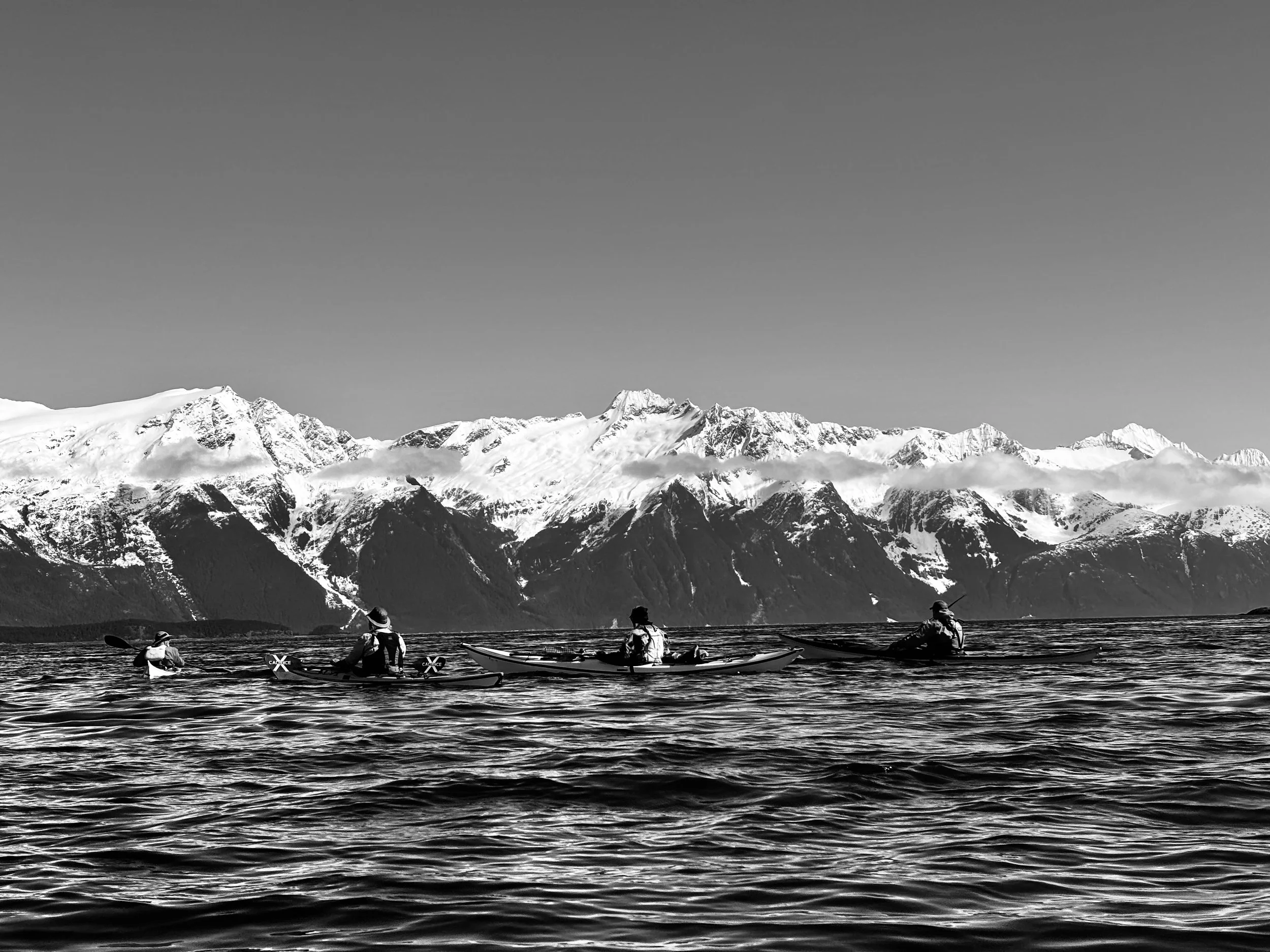
Beyond the windows, the Lynn Canal wrinkles beneath a cold southerly wind. White flashes appear between waves the color of jade. A gull. A whitecap. A whale.
It is April. Humpbacks are moving north with their calves, leaving Hawaiian breeding grounds for the nutrient-rich waters of Southeast Alaska. Soon the herring will spawn, turning sheltered coves silver. Eagles, sea lions, bears, and whales will gather for the first of the annual feasts.
Winter, meanwhile, seems unconvinced it is over. Snow from a record-breaking year remains heaped around town. A damp chill drifts off the fjord. Tomorrow I will spend hours immersed in that water.
For now, there is coffee.
The clubhouse offers the comforts of shore life: showers, Wi-Fi, washing machines. A whiteboard blocks the view. Scrawled across it is an ambitious syllabus: incident management, expedition skills, sea survival.
There are four of us in the Grey Heron’s coastal sea kayak guide course. It is scheduled for sixteen days. It will eventually stretch to nineteen.
The Grey Heron is already in the room. Among sea kayakers, he is known as an expedition paddler, coach, and guide. Decades on the water have carried him along remote coastlines from Japan to Norway. He has spent much of his career teaching paddlers how to become guides and guides how to become mariners.
Tall and long-limbed, the sixty-something Brit moves with the economy of someone who has spent much of his life outdoors. He has a habit of pausing before speaking, as if checking conditions. Weather, tide, wildlife, group dynamics—it all appears to occupy the same mental shelf.
In the absence of bears and rough seas, we become the object of observation: a seasoned outfitter from Sitka, a young NOLS graduate already guiding in Alaska, the Wolf whose enthusiasm arrives several seconds before the rest of him, and me, knees still aching from a winter of teaching skiing.
When the Grey Heron paces before the whiteboard, the room takes on the feel of a vessel underway.
"As kayakers, each individual is captain of their own ship," he says. "Through your leadership, they're going to follow you. Seamanship is about knowing what's coming up."
Long before maps, roads, and GPS satellites, traders crossed deserts, pilgrims crossed mountains, and sailors traversed unfamiliar seas by following someone who had already done it. Today’s recreational guiding remains essentially the same arrangement, albeit with lighter equipment and more expensive gear.
A tourist paddles a kayak along a stretch of coastline.
A sea kayak guide reads the same coastline the way a philologist combs a manuscript.
The lessons move quickly from theory to practice.
"Stop! Capsize! Swimmer!"
One by one we tumble from our kayaks and feign hypothermia until the real thing begins to creep in. We tow one another through confused seas, rescue swimmers beneath rain-slick cliffs, descend rock faces in improvised harnesses, and build fires with whatever will burn. The line between exercise and reality proves surprisingly thin.
The Grey Heron's preferred teaching method is disruption. Whenever the group settles into a comfortable rhythm, disaster arrives. A flooded hatch. A shoulder injury. Cold shock. A cardiac arrest. One moment he is paddling quietly among us. The next he is upside down, a sea anchor holding his breath while someone struggles through a rescue.
Every module points toward the same conclusion: weather deteriorates, equipment breaks, people become tired, and assumptions fail. Rarely all at once, but often enough that some scale of catastrophe should be expected as the guide’s constant companion.
Just because people follow you doesn't mean you always lead them well.
A month later, I find myself leading a group of six experienced river kayakers from Letnikof Cove. Their goal is ambitious: paddle the entire Inside Passage from Seattle to Skagway the following summer. This trip is their forerunner. Our just is to show them tides, crossings, and the practical realities of traveling through bear country.
The strongest paddlers quickly pull ahead. A high-school teacher drops behind.
"My arms are screaming at me right now," he says.
"Push with your feet."
Later, around camp, he recounts my advice.
"'Push with your feet,' she told me. STFU."
The group laughs.
The guests show little interest in rescue scenarios. What concerns them is weather, mileage, and wildlife. They care about making camp on a beach with a short carry and a foreshore of small rocks. They care about the porpoises surfing a ferry wake and the river otter snacking on a fish until an eagle arrives and attempts to steal it.
They care about seeing Alaska.
The previous summer I had traveled this same route under the watchful eye of a local guide. Waterfalls poured from hanging valleys carved by ice. Evening light moved across the Chilkat Range. Humpbacks blew along the deep cliffs before flashing their tails and disappearing beneath our hulls. The place seemed less like Alaska than a rough draft of the planet.
Now I was returning with a pencil. The landscape itself unchanged, but I had begun to read it differently. Freshwater here, lunch beach there, porpoises off this point, bears on that one. My rough draft was acquiring footnotes.
When we reach Juneau, rain falls in sheets. Everything is soaked.
We emerge from the water like seals flushed from a haul-out and gather beside a stranger's fire. Steam rises from wet fleece. Around us, the guests swap stories from our last crossing as though it happened years ago instead of hours.
I smile. Before he left, the Grey Heron offered perhaps the simplest definition of a guide: someone who's been there before.
44h 41m (2,635 mi) via Alaska Hwy—Part 2, Canada
More travel sketches from a long drive north.
―
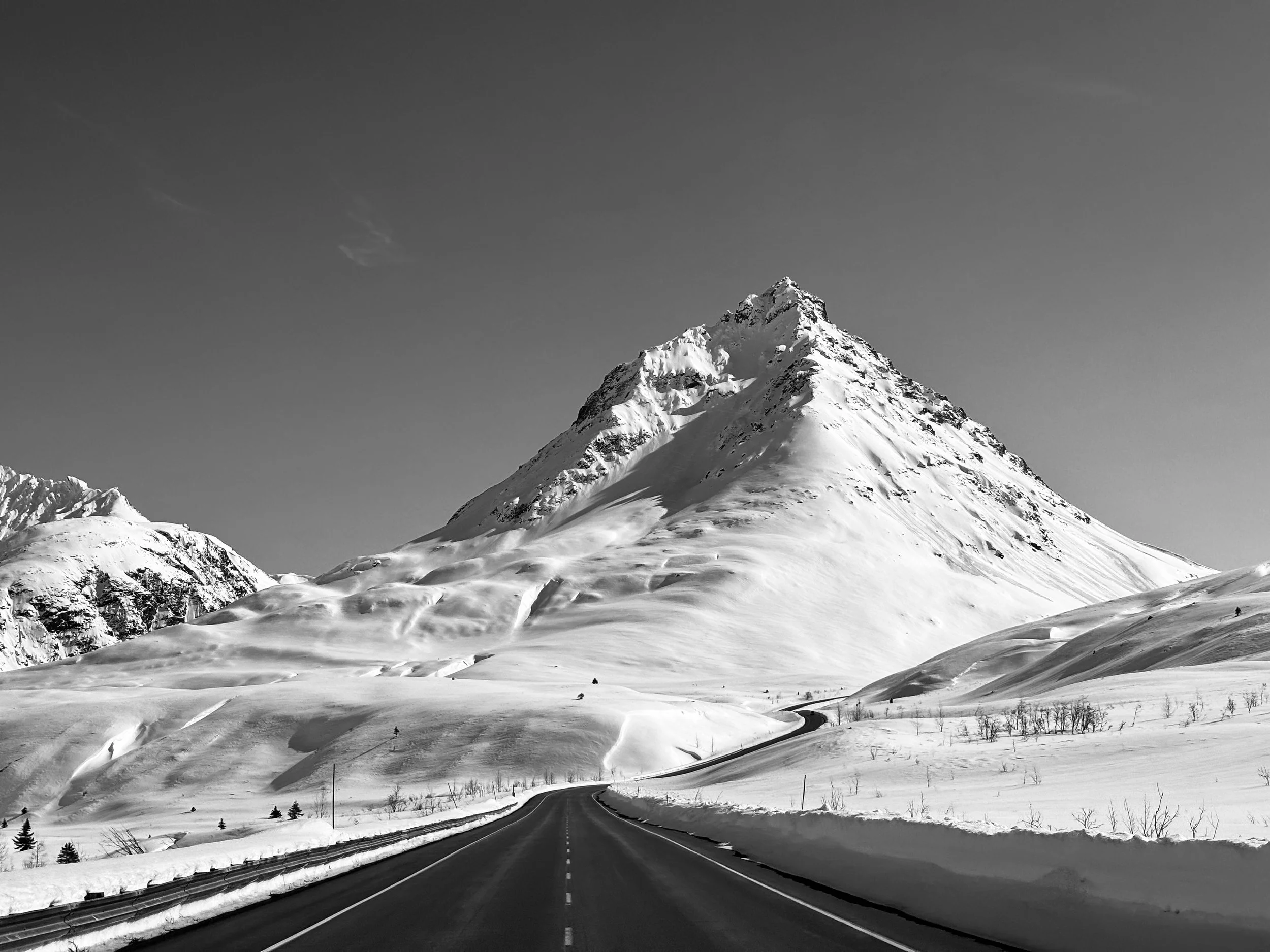
An eagle crouches on a frozen deer carcass, tearing into winter’s remains alongside the Icefields Parkway.
This 232-kilometer stretch through Alberta links Lake Louise in Banff National Park to the town of Jasper. The route cuts through high alpine passes, waterfalls tangled in ice, and turquoise glacial lakes.
Before leaving, we did the math twice to make sure we had enough gas to get from one end to the other. The fuel gauge holds it breath.
Near Jasper, a husky stands alone on a frozen lake, its grey-blue coat almost stitched into the ice. I scan for the owner, assuming someone must be ice fishing nearby. But there is no owner, because that is no dog.
“Wolf!” I yell. “Grey wolf!”
By the time the Wolf and Sasha turn to look, it is already gone. The lone predator vanishes back into the spruce-rimmed ice.
We turn off onto a dirt road toward the gas station in Nordegg, where fuel is prepaid in liters and the numbers spin too fast for me to translate.
Antlers over Shell—
sun pools in the roadside mud
like spilled copper light.
A sign for Sunchild First Nation slips past the windshield. Up here, the history of the land’s original peoples feels less entombed than it does back home—not battlefields sealed behind museum gates, but living communities patchworked into the contemporary landscape. Here, there are bridges over roads for wildlife to safely roam.
Deer ricochet wild
through twilight on the Range Road—
tails strike like matches.
Nearly every truck carries Starlink on the dashboard now: white squares tilted toward the heavens, harvesting signal from the open sky. They tether the isolation of rural Alberta to invisible constellations of machinery overhead.
Somewhere beyond them drifts Artemis II, carrying human beings farther into space than anyone has traveled in half a century. Another last frontier. The news says the toilet onboard isn’t working.
Oil wakes early—
breakfast starts before daylight
for the gasfield men.
The Days Inn in Drayton Valley feels like one of those hotels where it is always nighttime: labyrinthine hallways, no windows, doors opening onto nowhere.
I am starving, so I fill a Styrofoam bowl with Froot Loops from the breakfast buffet, which has already been carefully laid out, and quietly steal tomorrow morning’s milk. It is nearly midnight. A stuffed dinosaur and a scattering of Hot Wheels lie abandoned on the ancient carpet, its pattern faded by decades of boots and winter salt. The man at the front desk wears a turban and speaks with a kindness that makes the whole strange place feel briefly less lonely.
A laminated note in the bathroom politely asks guests not to wipe soiled hands on the white towels.
In the morning we take the truck to Young’s Garage to check the engine light that flicked on somewhere in BC. Nothing serious. Still, the Wolf asks the mechanic about the shocks—his pet obsession for the last thousand miles, the thing I’d started to think he was harping on just to needle me. But he’s right. The shocks had been installed backward in Denver and one had rubbed a small hole into the driver’s side wheel well. I stand there feeling vaguely indicted while a gentle mechanic with a husky mix pads around the shop floor. An hour later, the shocks are set properly and we are back on the road again. The Wolf grins.
Oil and natural gas country is vast—the overlooked middle of things. These are the places no one photographs: logging roads disappearing into spruce, mining towns held together by diesel and shift work. In Dawson Creek, the sign marking the start of the Alaska Highway sits awkwardly inside a roundabout. We circle twice so the Wolf can lean out the window and snap a photo.
The Peace Region stretches north in long industrial corridors. Heavy machinery rusts beside gravel lots. A frozen lake with a single bench faces the ice as though someone once intended to stay awhile. At the roadside café in Pink Mountain, Wi-Fi costs two dollars.
A heavyset man opens his laptop with the resignation of someone settling in for the entire afternoon. The Wolf buys a “Feces of the Wild” sweatshirt for his fourteen-year-old nephew back home in New York.
Billboards for Jesus reappear for the first time since Montana. We fill the truck from freestanding fuel tanks on the honor system: two Canadian dollars a liter. Somewhere far away, the war in Iran grinds on. Up here, the pumps click slowly beneath a white northern sky.
Gas plants in spruce woods—
no pumps for a hundred miles,
only extraction.
This is a land that gives more than it keeps: oil, gas, timber hauled south in endless quantities while the towns themselves remain sparse, provisional, half-lit at the edges of the boreal.
More darkness. More oil and gas plants. The horizon collapses into plowed snowbanks and the double yellow line. Headlights appear ahead, bright enough that I dim my beams. I’m going nearly seventy, so they must be too. I wait for them to pass. The lights neither brighten nor approach. Minutes seem to stretch. Distance itself feels distorted by the dark.
Frozen rivers wait—
beneath the ice, water breaks
through paused movement’s skin.
Sometime after eleven, I pass an oil tanker. He doesn’t like that. The truck swings into the left lane and accelerates uphill, but I keep my foot steady and hold my line. Eventually he drops back behind me. The small contest sharpens my attention while the Wolf sleeps beside Sasha, whose curled like a comma, in the passenger seat. I put on early ’00s alternative, inch the volume louder, and sing softly to myself. They don’t stir.
Finally, Fort Nelson appears on the horizon blazing like New York City. The lights are shockingly invasive. Until now, we were the light pollution.
The next morning, a woman smoking outside a gas station near the Yukon border comes over to explain the pumps. Inside, the shop feels preserved from another decade: boots drying beside a woodstove, a cast-iron skillet blackened with use, the air thick with cigarette smoke. Five-dollar stickers of bears and Klondike men curl for sale on dusty shelves beside ancient bags of chips.
On the television, Artemis II bobs in the Pacific off San Diego, the capsule bright against the water like a red-capped mushroom.
Warnings about bears line the boardwalk at Liard River Hot Springs Provincial Park: electric fences, stories of an infamous mauling, repeated reminders not to linger alone. For the first time on the trip, I carry bear spray on my hip.
The Wolf does not bathe. He stays behind to walk Sasha, perform burpees against a picnic table, and talk with a young man living out of his truck with a whitewater kayak strapped to the roof. He is heading north to guide in Seward. “It’s the season for migration,” the Wolf says later. “For salmon and guides.”
The water is impossibly soft and clear. White stones feathered by sulphur mark the mouth of the spring—the seat of the kami.
Floating there, I feel more Japanese than usual. I think:
Heaven is onsen—
everyone I love drifts
beneath rising steam.
Clouds pass overhead while I listen to my heartbeat moving through the water, through my body, into the pool itself. Snowmelt rinses through my hair. I never want to leave.
Google often enough mistakes the entrances of unmarked oil and gas plants for commercial gas stations.
We turn into one at dusk, just after nine. The pavement gives way to a kind of lunar mud tundra, and the truck lurches forward with a grey Ford pickup close behind us. Ahead, a row of industrial cylinders points toward the sunset like rockets on a launchpad. Across from them stands a line of prefab grey double-wides: workforce housing at the edge of the world. Outside each unit sits a pickup nearly identical to mine.
The Wolf says:
“We could be them too—
same truck in the parking lot,
same mud on the doors.”
I reply:
“No, we barely pass.
They wake up here every day.
That’s the difference.”
Another wolf just outside Teslin, just before the hill leading down to the grated bridge over the endless lake:
Wolf beside the road—
sunset holds it one moment,
then forest takes it.
In Teslin, a chain-smoking Irish woman in a nightgown, pink fleece vest, and pink rain boots stands outside the motel office, already upset about Sasha barking.
“The guy who stayed in your room last night went out,” she says. “His dog barked and barked. I cannot do it again.”
All night, Sasha is quiet but semis idle outside the shabby motel beneath a flickering neon Bigfoot sign. Eventually the engines flatten into white noise, as steady as surf.
By morning, we are hungry again. Another heartland breakfast: eggs for me, eggs and sausage for the Wolf. Overpriced, perfect.
Whitehorse at last. A northern metropolis with almost no visible trace of the gold rush except in the names preserved by those who still care to remember it. The city feels unexpectedly modern and streamlined: one broad main street lined with gift shops, outfitter windows, and a kayak store overlooking the frozen Yukon River.
Rainbow flags hang soft—
espresso and pastries glow
under yellow lights.
Something in the Wolf brightens here the same way it did back in Montana at the sight of Custer’s battlefield. The old mythology catches him again—only this time it is less about cowboys and cavalry than the North itself: stampeders, bush pilots, river men, adventure novels with cracked spines and maps tucked into the front matter.
“Adventure novels start here,” he says, grinning like a little boy.
He wants photos with the murals and the prospector-and-dog statue, eager to gather evidence that we have crossed into the territory of legend. The bust of Jack London, though, he can do without.
From Haines Junction we turn onto the Haines Highway, a road driven like a wedge through white into blue.
Mountains cup the truck—
small toy beneath avalanche,
held in icy palms.
At Chilkat Pass, men sit in camping chairs beside their grandsons while fathers launch snowmobiles directly into the slide paths. Black labs roam loose across the parking lot, greeting Sasha with the casual confidence of locals: Where are you from?
Then comes the descent into treeline. The U.S. border crossing. The ICE agent waves us through with barely a glance. Suddenly the speed limits are in miles again instead of kilometers. The pavement roughens. Potholes bloom in the road. Public trash cans disappear. Signs begin appearing for the eagle preserve and rafting companies.
Whales somewhere offshore.
Juneau ferry docks at dusk.
Totem greets us: Haines.
44h 41m (2,635 mi) via Alaska Hwy—Part 1, USA
Travel sketches from a long drive north.
―
The interstate goes—
America’s alphabet.
Speed limit: eighty.
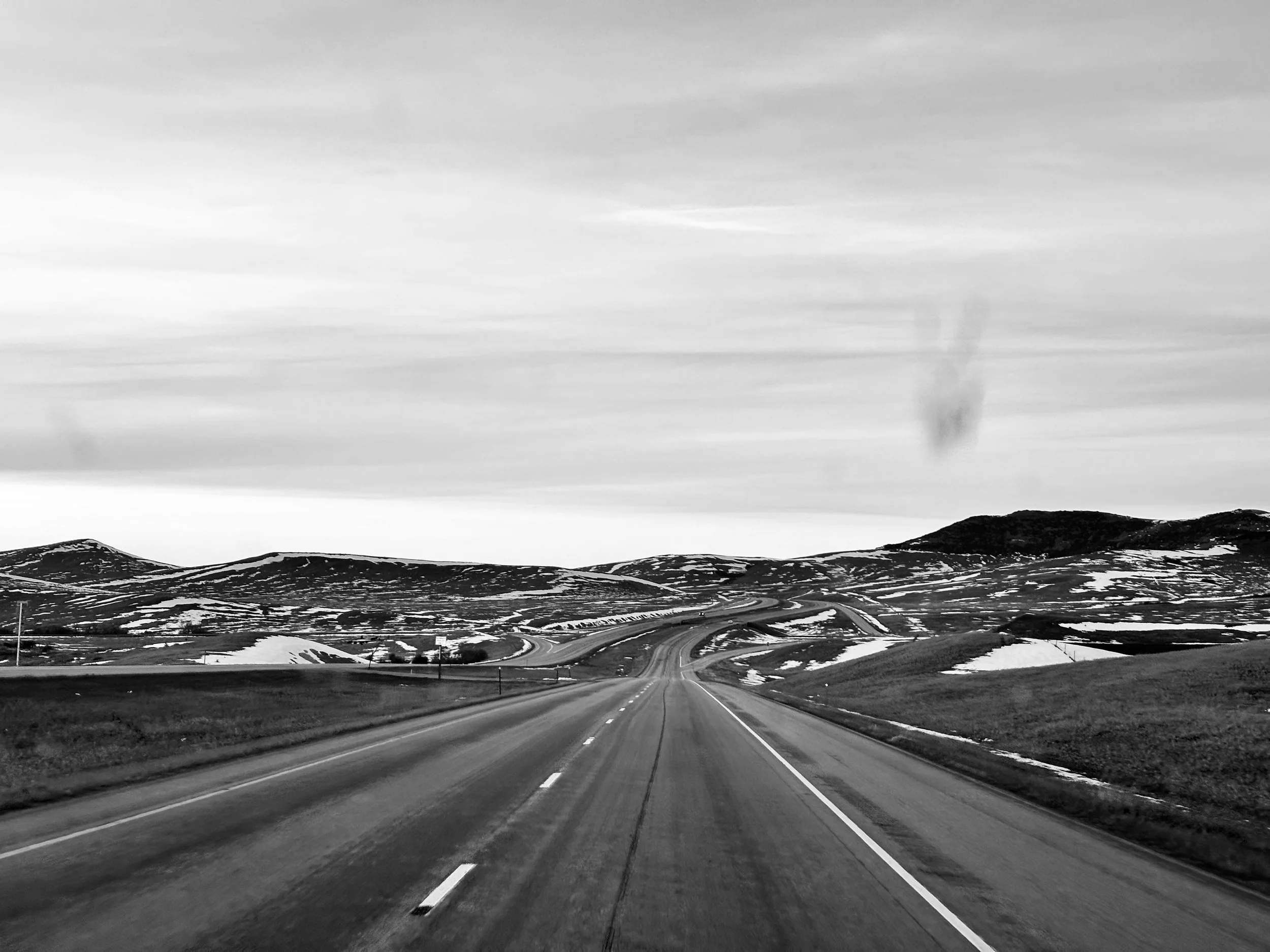
The farther we drive from Denver, the more the land opens. Southern Wyoming is so flat it seems to fold back on itself, like a section-sewn hardcover spread open on a table, flexing without breaking its spine. I-25 pursues broad pages of plateau, its gutters stitched with cattle gates and fence lines binding enormous ranches together like exposed thread.
Mile by mile, the truck keeps going, waiting for the story to write itself.
The Wolf flew in from New York to be my copilot on the long, lonely drive north to Alaska. Nearly seventy-eight now, he still wears his guide hat with a hawk feather tucked into the band and is remarkably spritely for someone who stepped off a dawn flight and straight into eight hours in the cab.
He rides shotgun peeling a clementine in one long spiral. Outside, the land opens wider and wider until it can hold almost anything. Memory rushes in to fill it. Herter’s catalogs. Roadside taxidermy. The old American West still flickering at the edges.
He was raised on its iconography in a way I never was. To him, the mesas and antelope are not symbols but returns to a place he’s never been. But his father came here in the 1950s, when the Wolf was a little boy, and shot an elk. He recalls:
Elk head on stone wall—
we bragged to the city kids
about the Wild West.
The wind wakes up and presses against the truck. I watch the fuel gauge sink as we climb hill after hill. It feels like Wyoming is trying to push us back toward Colorado.
Jackalopes linger
on the flat backs of mesas—
taunting the highway.
“They open the Strait, then close it. Open and closed,” the Wolf sighs after we top off at $4.39 a gallon. “They need to just make up their mind.”
There’s the book folding back on itself again.
The sunsets in Montana are so violently colorful they bruise the sky. Neon bands stack along the horizon like pancakes on a griddle. The truck follows the light slightly west, though for two days we have been driving almost exactly due north.
Northern light lengthens—
a compass pointing in twilight
up the latitudes.
The Wolf talks while I drive, though he still leans forward at every vibration in the truck. He thinks something is wrong with the new shocks and pulls up YouTube videos comparing suspension noises, holding the phone close to his face beneath the brim of his hat. I take his criticism personally, as if the truck were something I built myself.
In third grade we drew buffalo and talked about how magnificent it must have been to see them roaming the plains that had become our playgrounds.
Manifest Destiny—
taught like the dinosaur’s end:
violent, natural.
“The white men arrived in ignorance,” they told us, “like the meteor that killed the dinosaurs.”
“Huge and clumsy, yes, but ultimately a force of nature: inevitable, impersonal, beyond today’s judgement.”
Little Bighorn wind,
Custer dissolves into sage—
myths riot in dust.
We pass a sign for Battle of the Little Bighorn, and the Wolf jolts upright, startling Sasha who’s claimed him as her cushion.
“Can we stop? I didn’t realize we’d pass this way...”
He feels about Old Westerns the way I feel about skiing in Banff. Along this endless route, we each have our private sites of pilgrimage.
It is off-season, midweek, after hours. Still, a field is a field, and many people died in this one. That makes it the kind of museum whose exhibits reveal themselves like a wound that never fully closes.
The park gates are shut, so we pull into the gravel lot of the Custer Battlefield Trading Post, where rows of white tipis rise beside the interstate. Across the road lies the battlefield itself: craggy bluffs and dissected uplands folding toward the Little Bighorn River. Here, in June 1876, Lakota, Northern Cheyenne, and Arapaho forces defeated the 7th Cavalry.
The story still hangs over the West like a billboard advertising unfinished history. One version survives in trading posts and roadside museums, in Marlboro ads and old books written in heroic tones: doomed cavalrymen making a noble last stand against impossible odds.
But the land remembers differently.
The battle was part of a larger war over expansion, broken treaties, and the seizure of Indigenous land. What became mythologized as “Custer’s Last Stand” was also a decisive Indigenous victory against an advancing empire.
We climb from the truck and wander the closed property. Behind the gift shop, beside racks of toy tomahawks and Custer keychains, sits a mound of buffalo skulls whitening in the sun, their hollow triangles echoing the tipis nearby. Sasha sniffs at the pile of bones and reaches for a horn with her teeth. I pull her away.
The last light clings to the ridge while headlights drift along the interstate below like ghosts moving through the basin. As in places like Gettysburg, after the battles come the highways: shipping lanes, frontage roads, housing developments. The traditional American habit of building forward over the dead.
In the morning, we push on from Billings. This last stretch of America is a land of long trains sliding beneath denim skies.
Road without ending—
belief flattens into miles
beneath prairie sky.
White crosses sprout beside the highway like weeds. The Wolf has figured out how to get Starlink running on his laptop. The bones of the Battle of the Little Bighorn are behind us now, and he seems satisfied he has seen all the Montana he needs to see.
But there are older graves here.
Last year, a rancher near Hell Creek uncovered what may prove to be the largest Tyrannosaurus rex ever found, its teeth nearly fifteen inches long. Leviathans layered beneath leviathans. Cavalry beneath interstate. Dinosaur beneath cavalry. The land keeps burying and revealing itself in turns.
Tyrants under ranch—
Each age leaves its skeleton
inside the next one.
The farther we get from cities, the better the baked goods become.
Boarded-up towns with Main Streets wide enough for wagons reveal local bakeries like pearls tucked inside rough shells. Cinnamon rolls beneath flickering neon. Out here, sweetness survives where almost nothing else does.
Long skirts, lemon steam.
Better than downtown cafés
beside diesel pumps.
We continue north toward the Sweetgrass Port of Entry, where Interstate 15 becomes Alberta Highway 4. The truck rolls forward in silence. We pass the Duty Free shop—with its decent liquor prices and fluctuating hours—without stopping. For now, we have had enough of American history.
A Visit To Lost Winter
Detour to Banff.
―
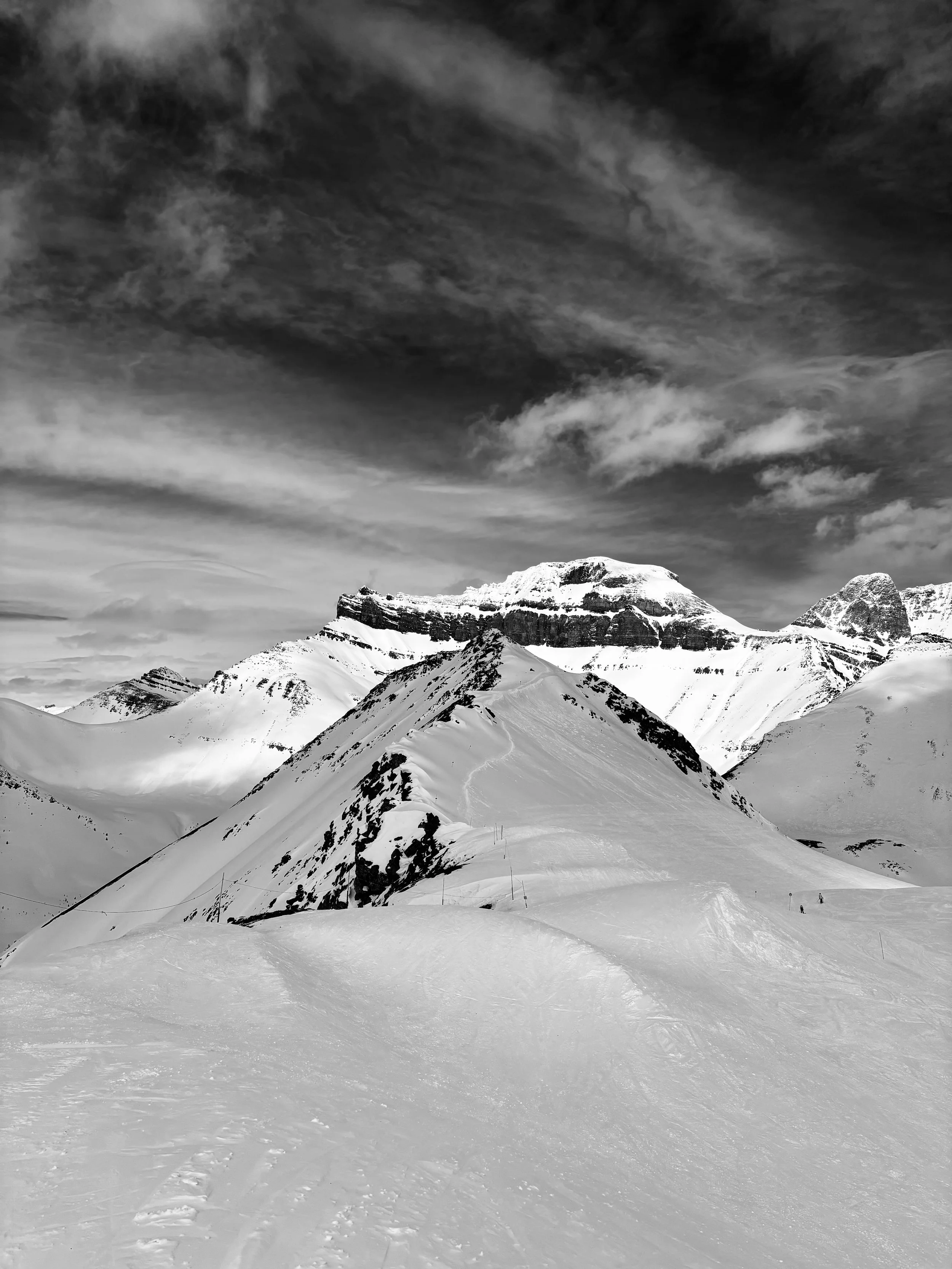
In Banff, the mountains are so big they could swallow Colorado.
Canada is winter’s prodigal daughter.
The pass narrows into twilight. Winter’s deep roots never died, they were just north of the border, buried on the other side of the Omega Block.
Alive snow shifts on the strange, humongous faces. Wind cries with the wolves, stiffening the pack. Sky-splitting peaks with their unfamiliar aspects pierce my heart and make me weep tears of snow.
We check into an AirBnB in Cranmore. The old cabin layered of lacquered logs sits 45 degrees to the road. The woodstove is big as a gondola but there’s no need to use it because forced air blows like a tropical wind through the house.
I find a ramen place for dinner and slot into the booths beneath murals of ski-themed manga. The broth slides steamy down my throat. A group of twenty-something ski bros crowds the booth beside us. Their hair is helmet tussled, cheeks still flush from hiking the steeps, as they breathlessly rehash the day’s lines.
Boots sink into snow
ptarmigan fading from sight—
a winter whisper .
Lake Louise has bowls that hold all of you. Bigger than your biggest Super-G turns; they make our Horseshoe Bowl look like a snack. It’s midweek, but the sun’s out and the parking’s free, so the mountain buzzes with enough energy to make it feel like February.
100% terrain open. There’s the boomerang, a groomer that rings the upper mountain and twists up along out-of-bound ribs before swooshing down toward the ridgeline’s hips.
I follow a duo of local twelve-year-olds who dart like sparrows into unmarked trees. They fly me to a rock garden where little boulders offer endless lips to launch off.
Top of the World chair whisks to a realm of rock and snow. Steeps that bind the throat are accessed by Paradise, an old triple fixed grip dangling high over a vast bowl. There’s no footrest, and the lowered bar offers a gap wide enough for a human torso to slip through.
By the third lap, I get used to the feeling of almost-falling.
At 3:25, I ride up with a guy from lift ops. The chair stops over the belly of the bowl. A tendon of rope below wriggles in the wind that wings its way into my belly. This mountain is not part of the mega corporation I belong to, but he’s dressed in black, just like our guys do.
I tell him where I come from and how shitty our season was. The chairlift ninja grins, and replies:
“We all have bad years
winter shits the bed sometimes—
it was just your turn.”
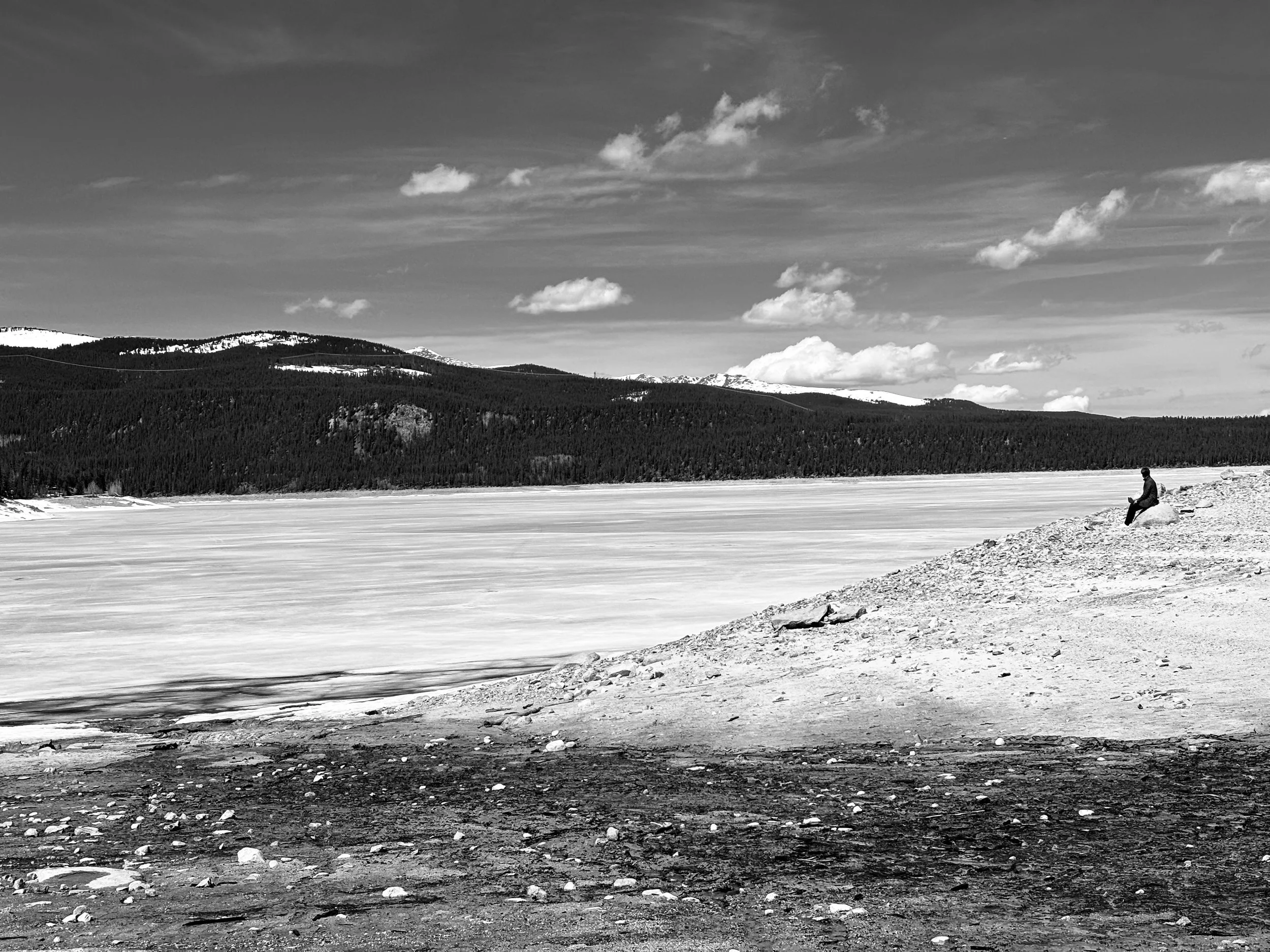
Omega Block
I personify the weather.
―
Easter week. The line at the base of Peak 7 reached long beyond what was left of the snow. They bootpacked around the mud, some because they couldn’t get refunds; others because they don’t know any better. The concept of winter—what it should look like, and when it should end—is subjectively relative.
Up the chair, things were not much better. The trees teemed with porcupines and bears waking up too soon.
Some locals in t-shirts glanced up at Peak 6, gashed with rocks and portending wet slides. They shook their heads.
“It’s the fucking end, man. They should have called it weeks ago.”
Artificial snow
covers dirt we try to hide—
then melts us open.
Colorado’s worst ski season in recorded history unfolded like a toxic relationship. November love-bombed with snow-making. The hardpack was expertly, hastily laid, while the resorts rushed to open with promises of a solid foundation. But stoke alone is not enough to conjure the real stuff needed to make a base stick. Mother Nature doubled-down on avoidance. She withheld precipitation with a stubbornness easily anthropomorphized. Meteorologists have a name for this pathology: Omega Block.
“It is one of the many types of weather patterns that can set up and be stubborn to move…Sometimes they bring us great weather, sometimes not” (NOAA).
Like most patterns, the Omega Block’s roots are in the sky, about 15-18,000ft up—atmospheric superego. It takes its name from the final letter of the Greek alphabet (whose shape the system resembles when it parks over a landmass), and is synonymous with eschatological speak for THE END. An Omega Block bookends two low pressure zones with one high trapped in between. Not unlike the seesaw of doomed love, depending on which side you fall, you get one of two extremes: deluge or drought.
For us here in the High Rockies, it was drought all the way. The snow stonewalled. No amount of spoons under pillows or shot-skis could coax it out. What little did fall stuck just enough to the rocks to give the illusion of softness for a couple of bluebird days. Breadcrumbing, I think the therapists are calling it now.
Ignoring the evidence and being led by emotion, skiers slid hopefully into the variability. Rocks greeted bases like backhanded comments over breakfast. Core shots accrued, but stubbornness is met with stubbornness, particularly where desire is concerned, so out came the P-Tex and diamond stones.
The weeks frittered away, and idealized images of what winter should look slowly lowered thresholds for what’s considered “good.” What was promised never arrived. What little we had, was gradually lost.
How do you know when it’s the fucking end, man?
War broke out in the Middle East. Gas prices ascended alongside lift tickets. A federal antitrust class action law suit was filed against the megapasses alleging unlawfully inflated prices. Apocalyptic feelings abounded, exacerbated by an unprecedented heat dome over the western United States. Ninety-degree days on the Front Range. Ninety.
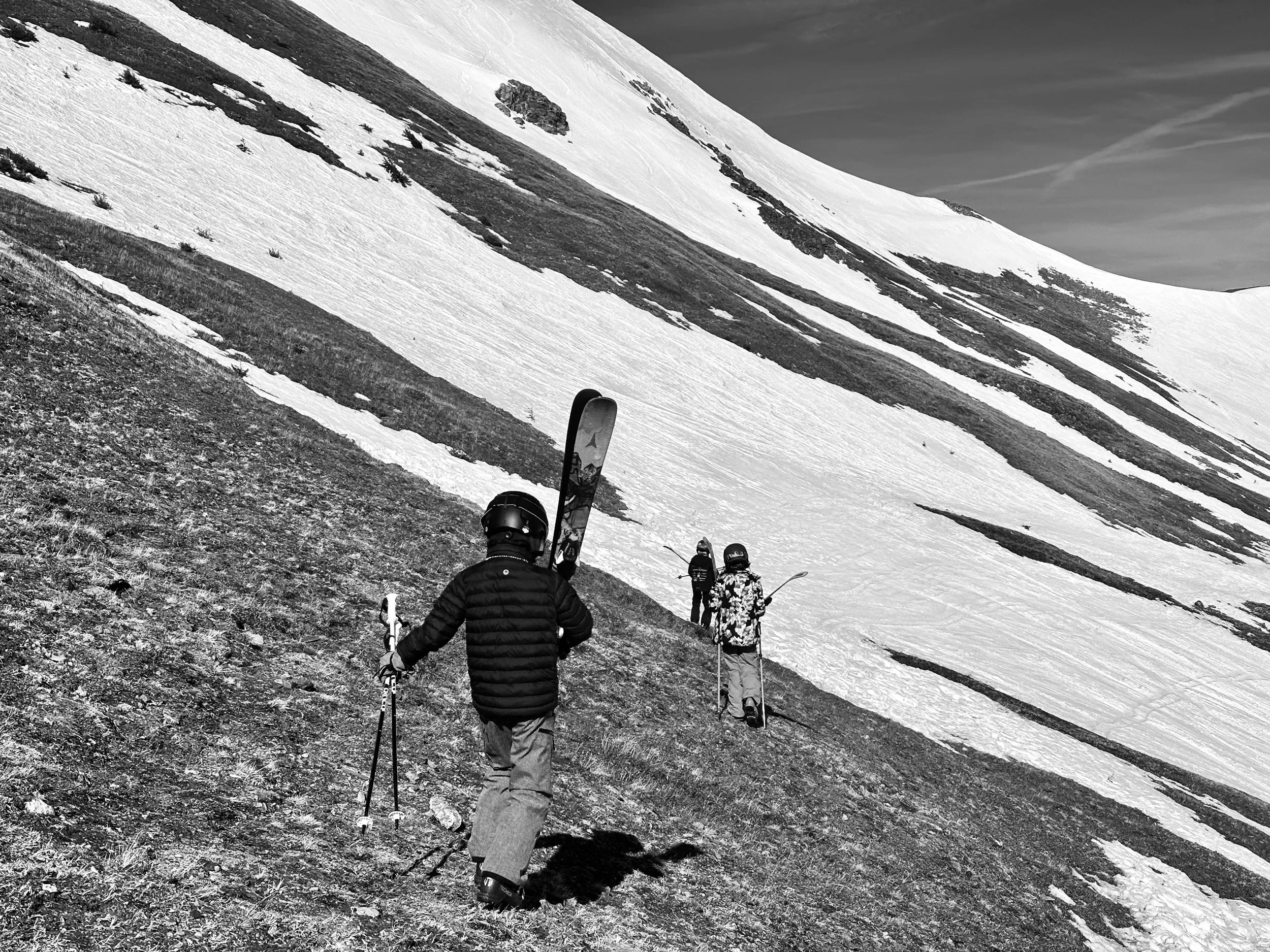
Peak by peak, the mountain shut down. The patches of see-through snow widened from windows into abysses so deep that grass began to reach through them. One of the mountain’s co-founders, Trygve Berge, died early in April. He was 93. The first green run where we take our beginners after the magic carpet is named after him.
The Omega Block lifted, just in time for Gaper Day. Forecasters in Denver crowed about a mid-week storm, but it was too late: the gaps are too big to be filled in now.
Operational Update
As discussed around the mountain.
―
As discussed around the mountain:
Records
Shallow snowpack fades
Tourists vanish with the lake
Locals hit food pantries.
Hibernation
Mama and two cubs
Race across Trygve’s open face
Too early to wake.
Terrain Status
Patrol ropes go up
Peak by peak, Breckenridge sleeps
Runs shut like old books.
Closing Day
“Hey team,” Broomfield writes,
“Things are dynamic out there—
Stand by for updates.”