
A Visit To Lost Winter
Detour to Banff.
―
In Banff, the mountains are so big they could swallow Colorado.
Canada is winter’s prodigal daughter.
The pass narrows into twilight. Winter’s deep roots never died, they were just north of the border, buried on the other side of the Omega Block.
Alive snow shifts on the strange, humongous faces. Wind cries with the wolves, stiffening the pack. Sky-splitting peaks with their unfamiliar aspects pierce my heart and make me weep tears of snow.
We check into an AirBnB in Cranmore. The old cabin layered of lacquered logs sits 45 degrees to the road. The woodstove is big as a gondola but there’s no need to use it because forced air blows like a tropical wind through the house.
I find a ramen place for dinner and slot into the booths beneath murals of ski-themed manga. The broth slides steamy down my throat. A group of twenty-something ski bros crowds the booth beside us. Their hair is helmet tussled, cheeks still flush from hiking the steeps, as they breathlessly rehash the day’s lines.
Boots sink into snow
ptarmigan fading from sight—
a winter whisper .
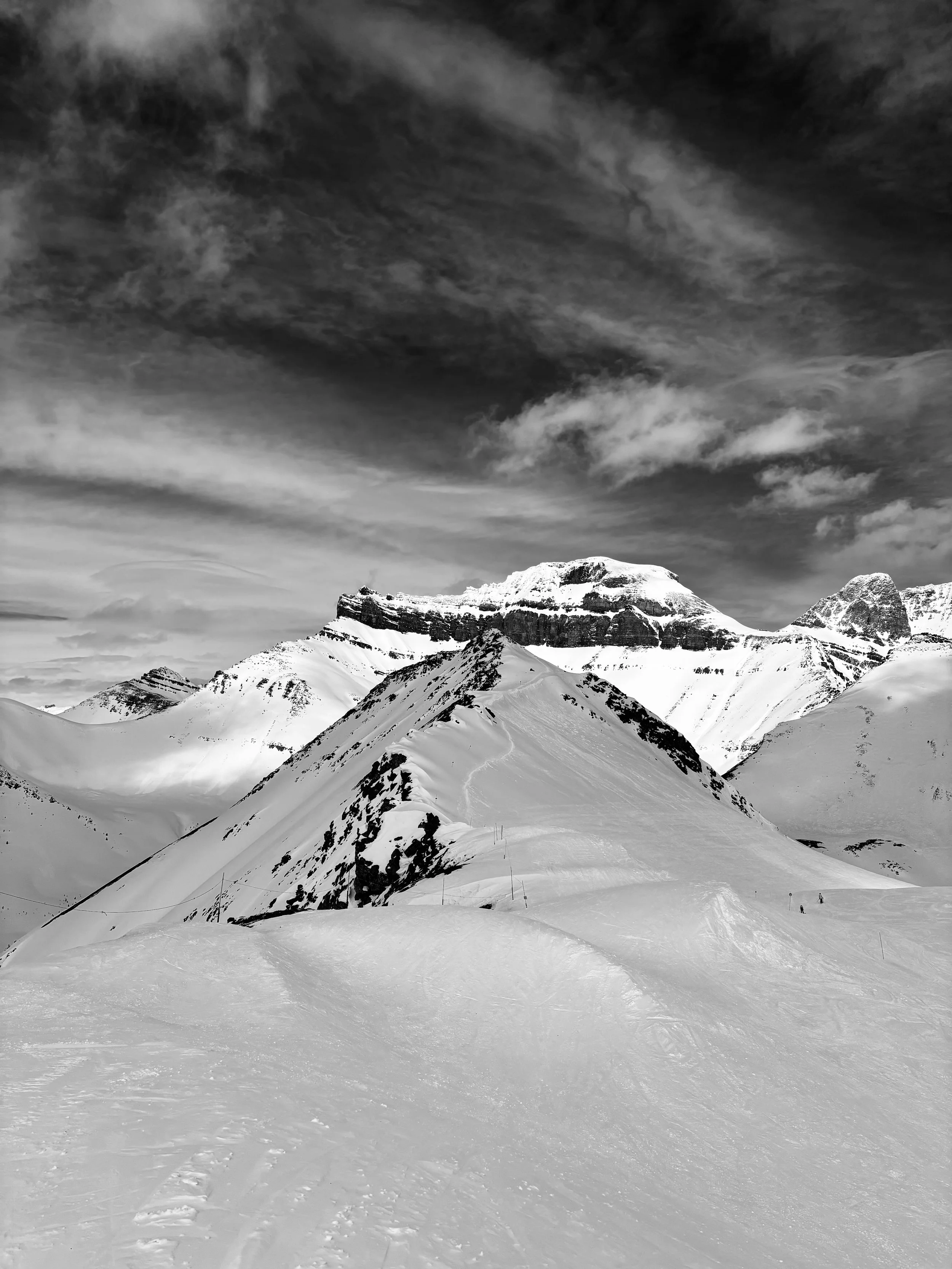
Lake Louise has bowls that hold all of you. Bigger than your biggest Super-G turns; they make our Horseshoe Bowl look like a snack. It’s midweek, but the sun’s out and the parking’s free, so the mountain buzzes with enough energy to make it feel like February.
100% terrain open. There’s the boomerang, a groomer that rings the upper mountain and twists up along out-of-bound ribs before swooshing down toward the ridgeline’s hips.
I follow a duo of local twelve-year-olds who dart like sparrows into unmarked trees. They fly me to a rock garden where little boulders offer endless lips to launch off.
Top of the World chair whisks to a realm of rock and snow. Steeps that bind the throat are accessed by Paradise, an old triple fixed grip dangling high over a vast bowl. There’s no footrest, and the lowered bar offers a gap wide enough for a human torso to slip through.
By the third lap, I get used to the feeling of almost-falling.
At 3:25, I ride up with a guy from lift ops. The chair stops over the belly of the bowl. A tendon of rope below wriggles in the wind that wings its way into my belly. This mountain is not part of the mega corporation I belong to, but he’s dressed in black, just like our guys do.
I tell him where I come from and how shitty our season was. The chairlift ninja grins, and replies:
“We all have bad years
winter shits the bed sometimes—
it was just your turn.”
Omega Block
I personify the weather.
―
Easter week. The line at the base of Peak 7 reached long beyond what was left of the snow. They bootpacked around the mud, some because they couldn’t get refunds; others because they don’t know any better. The concept of winter—what it should look like, and when it should end—is subjectively relative.
Up the chair, things were not much better. The trees teemed with porcupines and bears waking up too soon.
Some locals in t-shirts glanced up at Peak 6, gashed with rocks and portending wet slides. They shook their heads.
“It’s the fucking end, man. They should have called it weeks ago.”
Artificial snow
covers dirt we try to hide—
then melts us open.
Colorado’s worst ski season in recorded history unfolded like a toxic relationship. November love-bombed with snow-making. The hardpack was expertly, hastily laid, while the resorts rushed to open with promises of a solid foundation. But stoke alone is not enough to conjure the real stuff needed to make a base stick. Mother Nature doubled-down on avoidance. She withheld precipitation with a stubbornness easily anthropomorphized. Meteorologists have a name for this pathology: Omega Block.
“It is one of the many types of weather patterns that can set up and be stubborn to move…Sometimes they bring us great weather, sometimes not” (NOAA).
Like most patterns, the Omega Block’s roots are in the sky, about 15-18,000ft up—atmospheric superego. It takes its name from the final letter of the Greek alphabet (whose shape the system resembles when it parks over a landmass), and is synonymous with eschatological speak for THE END. An Omega Block bookends two low pressure zones with one high trapped in between. Not unlike the seesaw of doomed love, depending on which side you fall, you get one of two extremes: deluge or drought.
For us here in the High Rockies, it was drought all the way. The snow stonewalled. No amount of spoons under pillows or shot-skis could coax it out. What little did fall stuck just enough to the rocks to give the illusion of softness for a couple of bluebird days. Breadcrumbing, I think the therapists are calling it now.
Ignoring the evidence and being led by emotion, skiers slid hopefully into the variability. Rocks greeted bases like backhanded comments over breakfast. Core shots accrued, but stubbornness is met with stubbornness, particularly where desire is concerned, so out came the P-Tex and diamond stones.
The weeks frittered away, and idealized images of what winter should look slowly lowered thresholds for what’s considered “good.” What was promised never arrived. What little we had, was gradually lost.
How do you know when it’s the fucking end, man?
War broke out in the Middle East. Gas prices ascended alongside lift tickets. A federal antitrust class action law suit was filed against the megapasses alleging unlawfully inflated prices. Apocalyptic feelings abounded, exacerbated by an unprecedented heat dome over the western United States. Ninety-degree days on the Front Range. Ninety.
Peak by peak, the mountain shut down. The patches of see-through snow widened from windows into abysses so deep that grass began to reach through them. One of the mountain’s co-founders, Trygve Berge, died early in April. He was 93. The first green run where we take our beginners after the magic carpet is named after him.
The Omega Block lifted, just in time for Gaper Day. Forecasters in Denver crowed about a mid-week storm, but it was too late: the gaps are too big to be filled in now.
Operational Update
As discussed around the mountain.
―
As discussed around the mountain:
Records
Shallow snowpack fades
Tourists vanish with the lake
Locals hit food pantries.
Hibernation
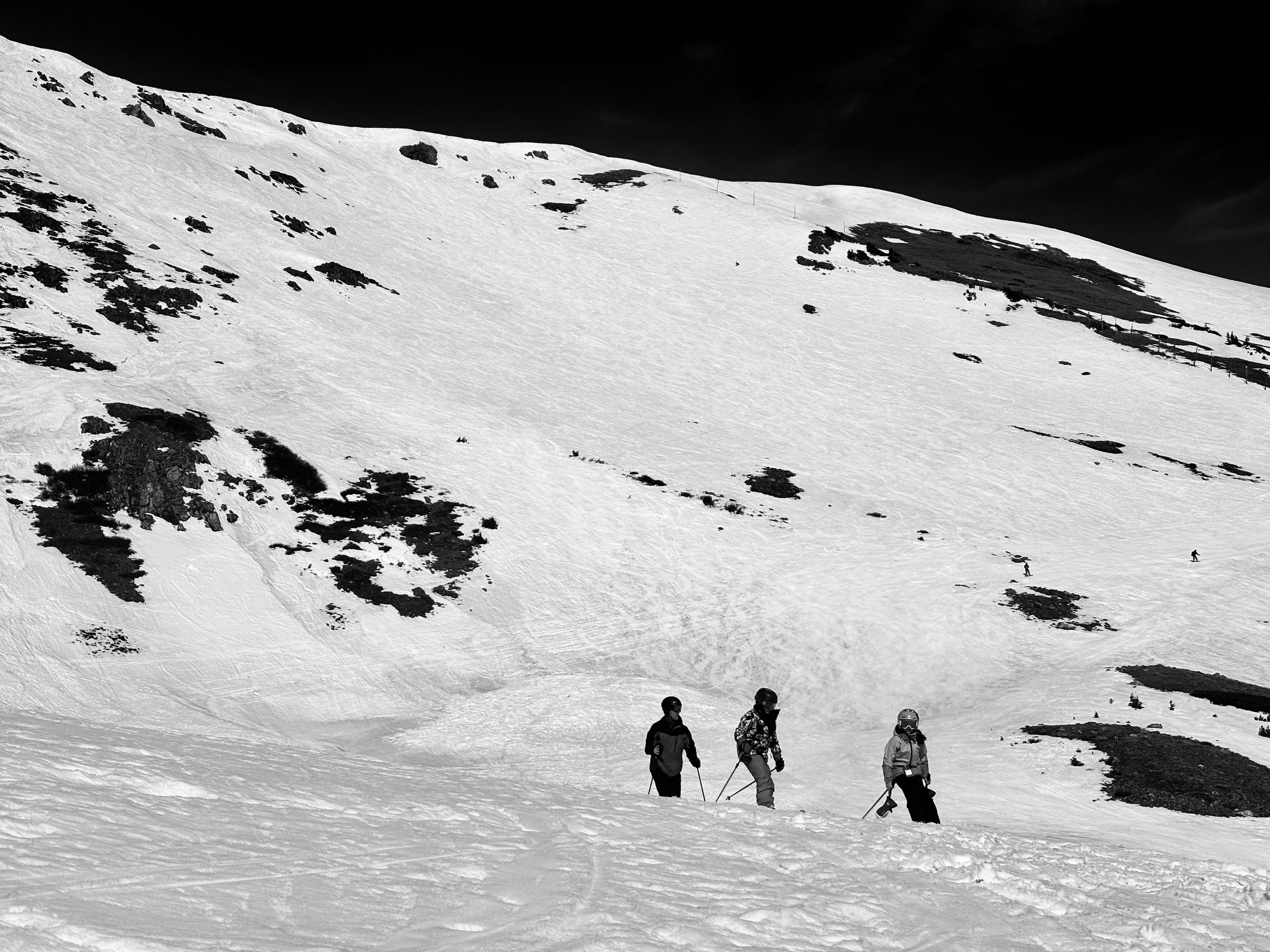
Mama and two cubs
Race across Trygve’s open face
Too early to wake.
Terrain Status
Patrol ropes go up
Peak by peak, Breckenridge sleeps
Runs shut like old books.
Closing Day
“Hey team,” Broomfield writes,
“Things are dynamic out there—
Stand by for updates.”
Half-Days
Souvenirs from a shitty season.
―
Snow gun hissing still
Bluebird sky dries the county
Kindling for June.
November.
Our new locker room occupies a hastily built-out corner of the Grand Colorado’s garage. There are no windows, so it smells of exhaust and feet. Returning pros squabble about where to put the computers and the vending machines, but everyone agrees there are not enough benches or places to put the skis.
A construction site behind the Magic Carpet swallowed our old home over the summer. Broken ground leaks diesel plumes into the learning area. When the wind turns north, they carry all the way up to Trygve's Platter, which isn’t running yet anyway. Through peepholes in the construction fence we glimpse bones being laid for the resort’s first five-star hotel: The Imperial Hotel and Alpine Chalet Residences. Embedded in its 70,000 foot sprawl will be the “Sky Domes,” glass geodesic houses where high-net worth individuals can dine and stargaze. For now, though, it’s just a big dirty hole.
Blue jackets swing on hooks. Boot dryers hum, filling the air with their familiar musk. The pros trickle in but the snow does not. A week is all it takes to shred the “White Ribbon of Death” to a shoelace. It feels more like April than November.
I return from another lower-mountain lesson, sixth toe burning, wearing only a thin base layer beneath my uniform, unsure what the uniform is for.
December.
Thirty-seven of 193 trails open. An 18” base. Daytime temperatures squat above freezing at base elevation, refreezing weakly at night, if at all. Snowmaking fills narrow wet-bulb windows, laying down dense, artificial ribbons that abrade quickly under holiday traffic. Natural snowfall hasn’t built depth; it sublimates, melts, or compacts back into dirt.
The hollow statue of the Norse god Ullr stands motionless at the base of Peak 8. His bow drawn, his arrow aims at a widening patch of dirt beneath the Colorado SuperChair. Kids slither around sharks—rocks hidden like prizes between moguls—and micro-forests that push up defiantly through the white stuff we’ve paid dearly to make.
Exasperated instructors confiscate skis and send groups of advanced kids one-footed down the greens. The sups laud such creative pedagogy, but the parents are not impressed. Lesson prices have gone up. A full-day private now starts at around $1300. A half day at $900.
“We’re in a donut,” lament the locals in bars. “The snow is hitting everywhere all around us. East, West, they’re all getting pounded. But not us.”
In Broomfield, the corporate wizards reach for euphemism: variable, packed powder, early-season conditions. But it isn’t early season. It’s Christmas week—the first rush of what’s supposed to be winter.
A persistent ridge of high pressure has diverted more storm tracks north. On Christmas Day, rain falls on Main Street.“Variable” isn’t just a euphemism for bad snow. It’s overworked bodies. Dwindling work. And rent that won’t quit.
January.
The donut shows no signs of abating. The apps show a 30” base at Breck, 70” at Hunter. Let’s not even mention what’s occurring at Jay Peak or in Vermont. The resort’s social media team burns overtime. As the weeks slip, they go from posting white rooms money shots taken last season (presumably to entice March bookings) to addressing the blight directly.
Look! We are so authentic! Come and have fun with us despite the shit conditions! Skiing’s not about quality or quantity! It’s all about who you slide with. Look! Here’s an adorable avy dog in training! Aren’t the views, like, so pretty?
In a week, the resort will have used all its state allocated water for snowmaking. While the local news quietly covers the debate about opening a thirsty new data center on the Western Slope, passholders are told not to worry about the snowmaking. The resort will buy reserves from the town. And where (everyone thinks but dares not ask), when that runs out, will the town buy its reserves from?
One Thursday, I ride the gondola down with a Boomer instructor after another day of no lessons. His beard is the color of refrozen snow and his Carhartts have holes in them; he wears the uniform of the veteran ski bum well. He smiles correctively at me when he asks how my season is going and I respond honestly.
“Don’t be so dower, dear. It’s great to have all this time to free ski! I took the day off to telly.”
He grins at me like a guy who bought real estate here in the 80s.
“You know,” he continues, “there was a winter like this once. Back in the early ’80s, before snowmaking. Breck shut down for a month. Then it dumped. Absolutely nuked. And when it did, we had the biggest spring I can remember.”
(Of all the words skiers use to talk about snow, that one— nuke—is the one I hate most).
One by one, my regulars cancel.
“So sorry,” they apologize, “but we’ve decided to go to Mexico this year. Hope you get some snow soon!”
Beginners take their place. My schedule fills up with the half-day privates that are all the rage these days. Value is squeezed like blood from stone in a sport synonymous with money. The culture around skiing seems to have shifted with the climate but here both subjects are mostly verboten. There is only Stoke, Send, and Slut Strands.
The Magic Carpet churns while prayers for inches resound through the county at night. The bars fill up and the restaurants report a boost in earnings. Across Vail Pass, in Eagle County, the southern facing aspects soak up so much sun they’ve stayed completely bald. Squirrels and chipmunks chatter on the treed fringes of blue groomers, and confused moose stumble out onto the runs at Peak 9. Birdsong, not normally heard til closing week, trills in the air.
February.
The Olympic torch burns through Cortina. And just like that, the world is enamored with winter sports again. Lindsey nearly loses a leg and Mikaela reclaims the glory that eluded her in Beijing. Everywhere but here, it seems, the skiing skies on.
Suddenly, the water for snowmaking is all gone. The sun gnaws what’s left into afternoon slush, which promptly congeals overnight. Patrol shuts down runs previously opened. Collisions after collision make local headlines. One bro at Keystone rushes a tree so hard that he loses an eyeball, then promptly sues the goggle company.
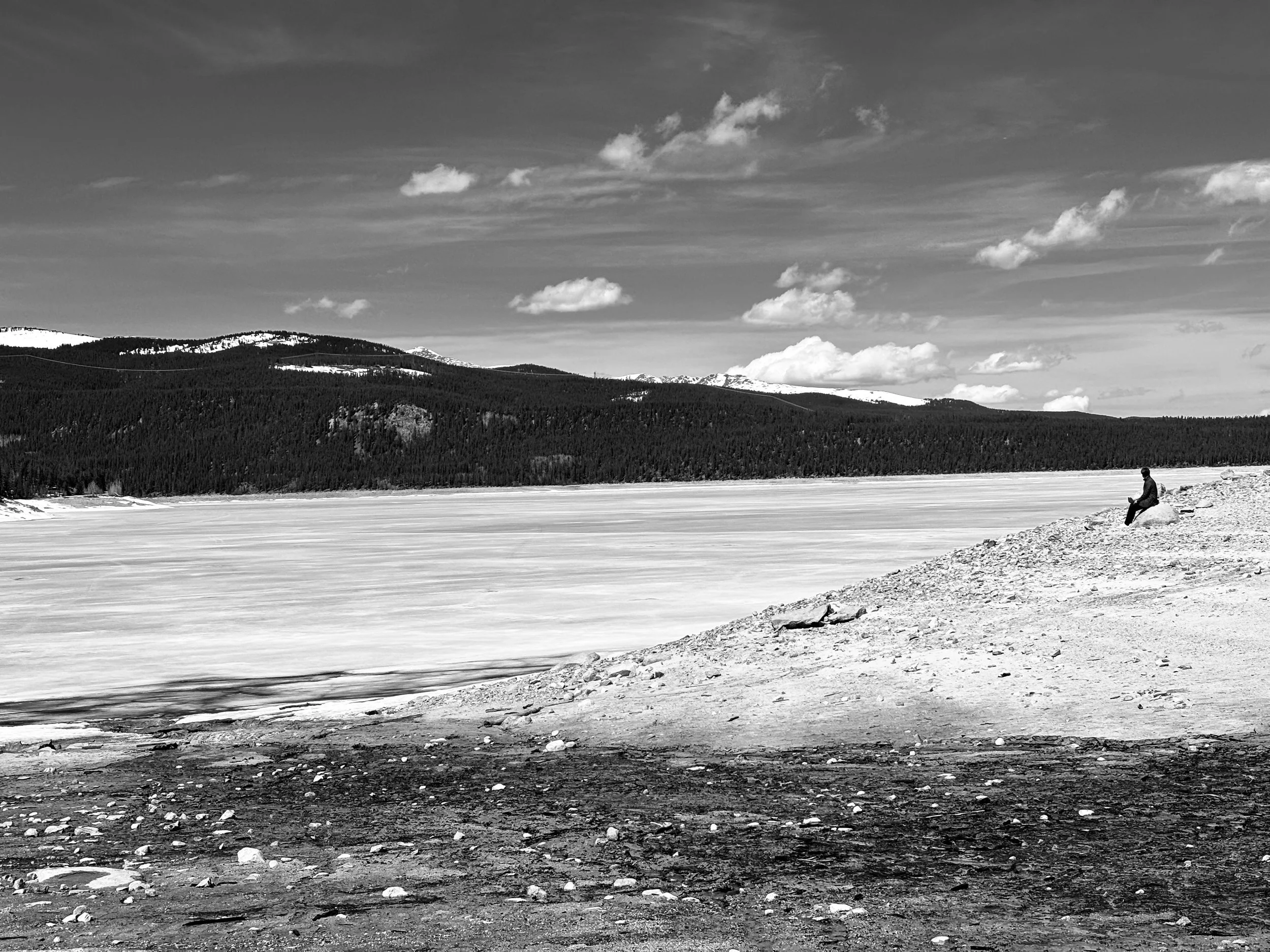
Prayers for powder dissolve into hushed chatter about summer. The experts say the threshold has already been passed to generate enough snowpack to see us safely through fire season. The runoff will limp along. Whatever does slip into the river beds will disappear quick. Lake Dillon, which hydrates the Denver metro area and didn’t freeze until this month, sleeps fitfully under her thin cover. She tosses beneath her thin sheets of ice like a child with a fever. It is announced that Frisco will close the marina’s dock and public boat ramps for the summer.
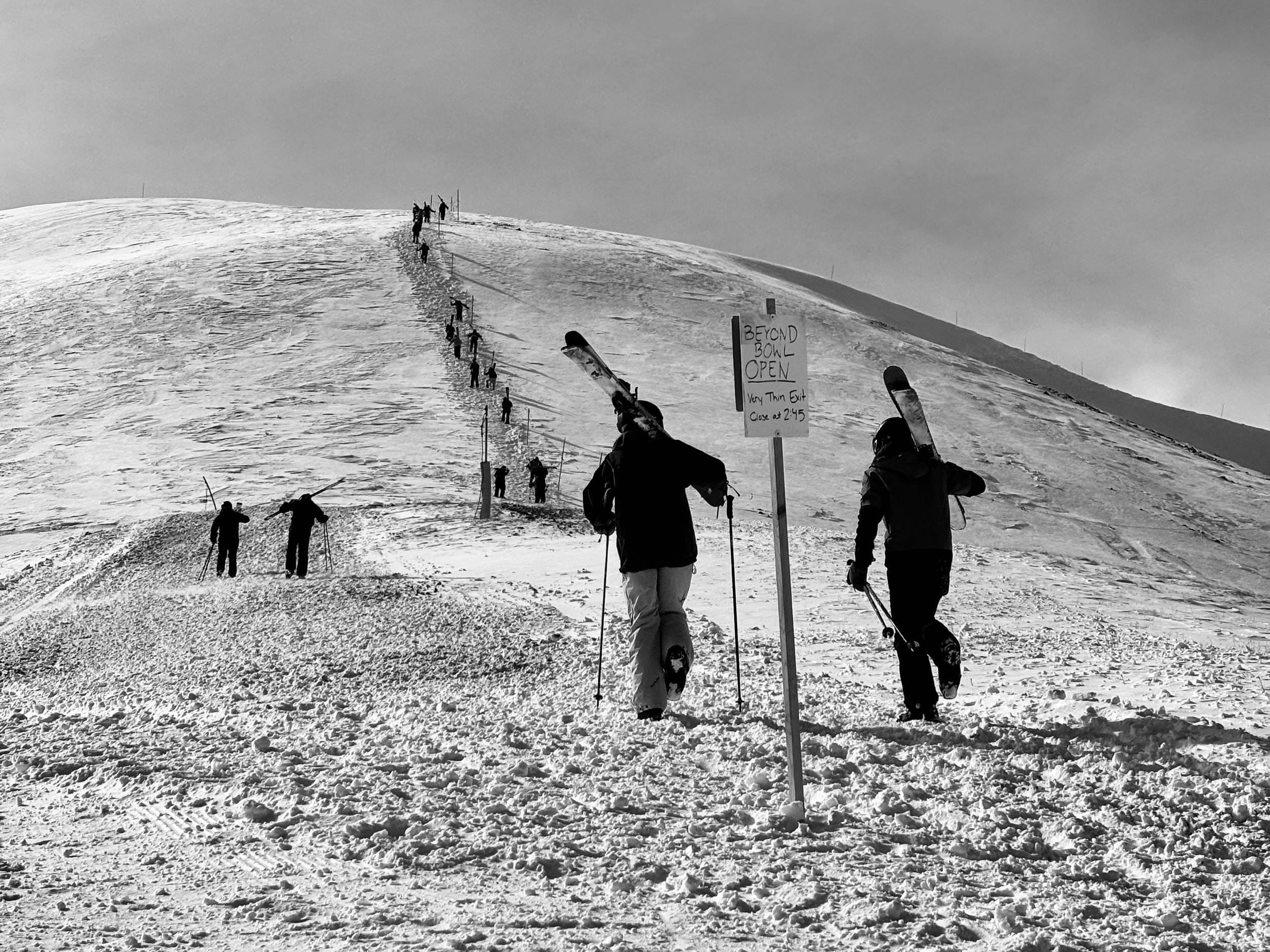
Just in time for President’s Day, patrol drops rope on T-Bar. There’s dirt in the track on the way up, and crowns of rock complicating all entrances to the bowl.
“Can we go ski up there?” the kids ask.
I shake my head. “Not today.”
Even the old timer isn’t taking days off to telly anymore.
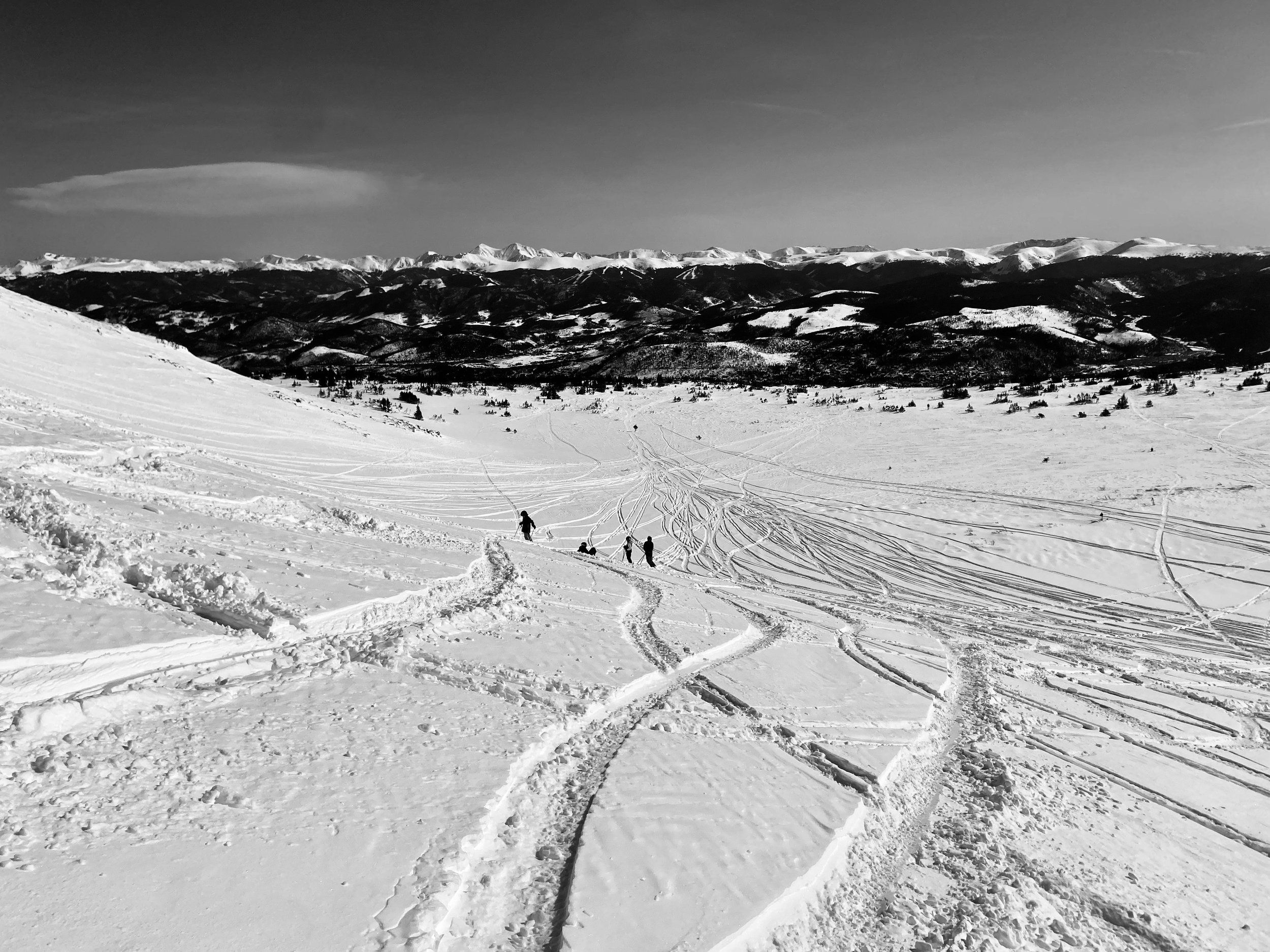
Turn Phases Are Places
I went to cert 3 clinics.
—
On Thursdays after a day of watching skiers ski around the mountain, Cert III candidates watched videos of more skiers.
It was the particular late of ski towns, when the lifts have stopped spinning but the day hasn’t quite let go. In the Village kids’ center, we folded ourselves onto chairs meant for children—too small for most of us, knees up, backs rounding, no one comfortable but no one admitting it. Someone filled bowls with Goldfish and passed them around like rations.
The trainer fussed with the projector like a substitute math teacher. Then, under fluorescent light, we began.
Movement analysis at the Cert III level has a way of clarifying things by muddying them. The lexicon of how bodies and skis perform their official ballet is mechanical, not moral.
“The skis tell the truth,” the writers of manuals and rubrics of the Professional Ski Instructors of America insist. What they really mean is, it is your bodies that try to lie.
Out on the hill, with real students, the language always feels simpler than the dense codex of sagittal planes mitigating centripetal forces. A student’s edges either hold or they don’t. You can hear the clean, high hiss of a ski set on edge, or the loud loose grate when it isn’t.
“Pizza!” you scream for dear life as the body locks and careens toward the fence. “Piiiiiiiiiiizza!!”
No parsing required. Just the peeling of Gore-Tex from fencing and the occasional wiping of tears.
Inside, though, the words always get in the way.
This week, the Irish national team performed dynamic short-radius turns. The video looped at half-speed. The trainer played it until someone emerged bold enough to speak.
It was a young instructor from Peak 9. He’d gone for the exam a few weeks back and found himself unsuccessful. He leaned against the cubbies stacked at the back of the room, still wearing his backpack, like a veteran returned to basic training after seeing combat.
“Um, the skier initiates his turns in the backseat. He’s aft in all three phases.”
All eyeballs rolled toward him like snowballs down the bunny hill. Uh-oh.
Movement analysis is the banality of precision. The dialect is exacting and faintly absurd. One does not say, “the skier is aft.” One says: at initiation, the center of mass moves aft of the base of support, limiting the ability to direct pressure along the length of the ski.
“Let me stop you right there, son.” The trainer—who’d been listening with the patience of someone accustomed to coaching three-year-olds—interrupted.“I fail a candidate as soon as I hear them speak about turn phases as verbs.”
The room imploded in silence. The projector whirred and some laughter drifted in from the ice rink nearby. Someone shifted; a boot sole squeaked faintly against linoleum. It was so white-out quiet you could hear a snowflake fizzle in hell.
“You don’t initiate the turn. It’s at initiation.”
It was, on its face, a small correction. But it carried the weight of a larger ideology. The minutiae, the semantics, in PSIA, they are precisely the point.
To speak of initiation as a verb is to imply control, authorship—an act a skier imposes on the mountain.
To speak of it as a place is to acknowledge something more existential: the turn unfolds in spite of you. The turn is ideal. It’s a Platonic Form that exists in a perfect arc apropos of nothing. But not you, the skier. You, with your bum knee and tight hips, are all too real. Real means fallible. As in, likely to fall—over your words, your crisscrossed tips, your boots on the frozen puddles laced throughout the parking lot at the gondola’s end.
Movement analysis’ purpose is to make you understand how you suck in relation to the turn, not the other way around.
At initiation.
In shaping.
Through finish.
“Ski–snow interaction” is best understood in prepositions, not commands.
On a warm January day, a training in Vail begins with a warning: rotary inaccuracies can cause fore/aft issues. It is delivered without emphasis, but once heard, it is everywhere. A slight twist at the top of the turn, a subtle pivot of the feet, and the skier is displaced. The skis scrape instead of carve. When pressure arrives late, the pelvis is usually the culprit.
“Not square,” the trainer, a different one from the one who loves prepositions, says. “Separation, not symmetry. Now, let’s try and task ourselves into good skiing.”
At the finish of the turn, she has us sideslip all the way down Pickeroon. Not as a rest, but as a reference. The skis flatten, the edges release, and there’s that familiar, dry whisper of bases against snow. Alignment of the center of mass to the outside ski is the goal. Lead it with the inside knee. The skis slide where they had once gripped. The toe of the downhill boot seeks the middle of the uphill arch. Micromanaging tip lead feels small, almost trivial, until it doesn’t. The sound changes, the sensation changes, and the whole system reorganizes around that point.
The body resists; the task insists.
There are images, occasionally. The ski is the bow, the snow the string, the outside leg the arm drawing the arrow back. You feel the tension build—not metaphorically, but physically, in the muscles, in the contact with the snow—and then you release. The turn snaps cleanly through. Less an action than a location you can pinpoint with an arrow.
Indoors again, this time at home on Zoom, the tone sharpens. The task is performance mediums. A mise en abyme: your spoken performance of the ski’s performance of your body’s performance.
“I’d like to see the skier continue flexing their outside leg through finish.” I say. “And develop more counter all the way through shaping to unlock more ski performance.”
The structure is simple, and unforgiving: I see this, and this is causing this. What I would rather see is…
“Yes,” the trainer agrees in a way I know I missed the mark. “But now connect the outcome to the ski performance and body performance. This skier’s tendency in movement pattern is to move from the hip. She gets a high edge angle early and cuts off rotation. Try again.”
I try again. And again. Over time, halting shifts closer to fluency. Initiation becomes a place whose boundary to shaping is as porous as shaping is to finish. They each last an infinity and are inextricably linked. I arm myself with PSIA words, none of them mine.
Your eyes memorize what you ski. And then, almost without noticing—
the verbs disappear.
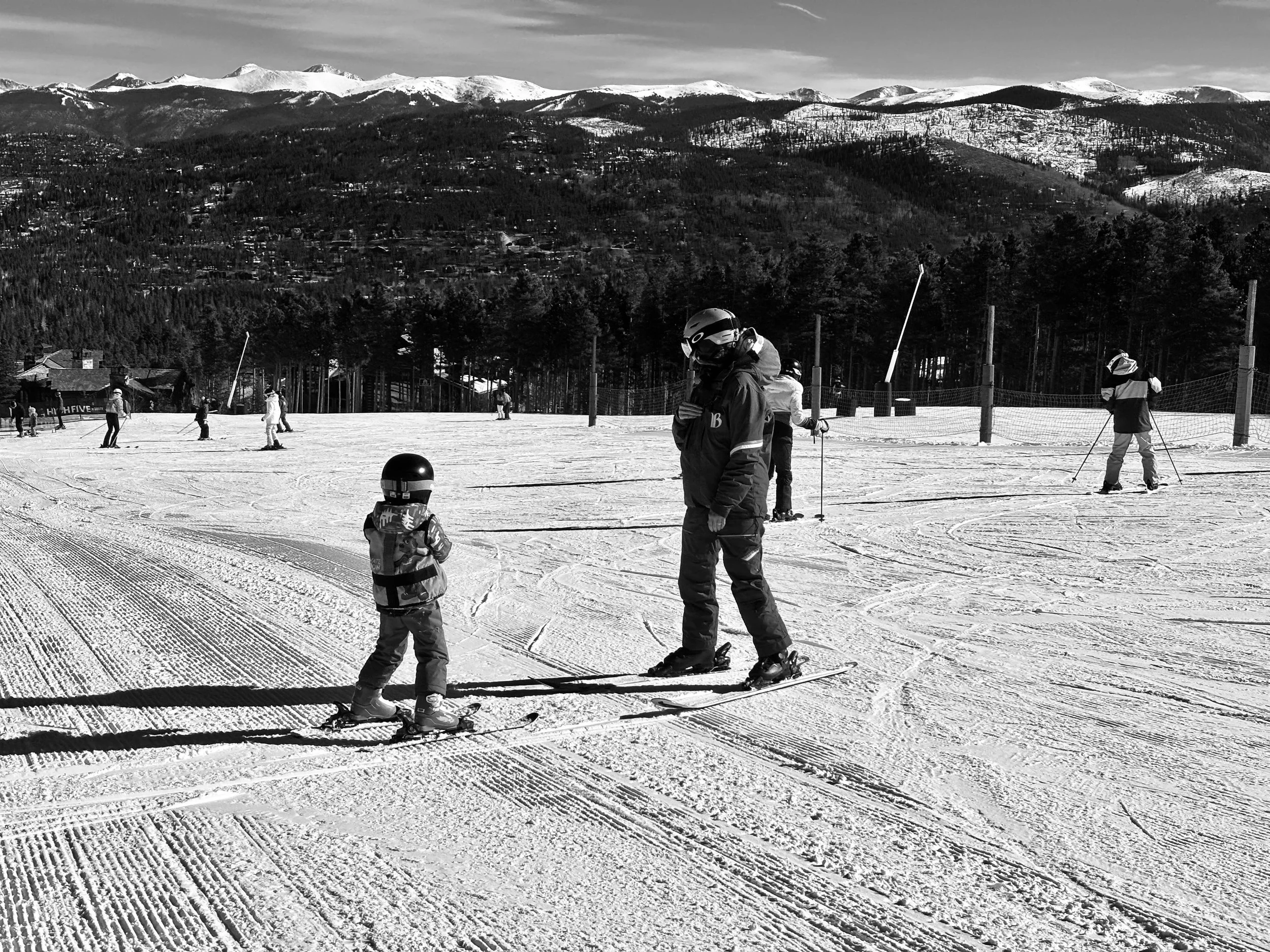
Fundamentalism
According to PSIA.
—
According to PSIA, the Five Fundamentals of alpine skiing are:
1. Fore–Aft Pressure
Mass moves over base
Directs pressure fore and aft
Along the ski length
2. Ski-to-ski / Outside Ski
Pressure foot to foot
Directed to outside ski
Arcing tip to tail
3. Edging
Edge angles controlled
Incline and angulate more
Tip from lower leg
4. Rotation
Skis rotate with legs
Separate from upper body
Steering with the feet
5. Pressure Magnitude
Regulate pressure
Ski to snow interaction
Flexion, extension
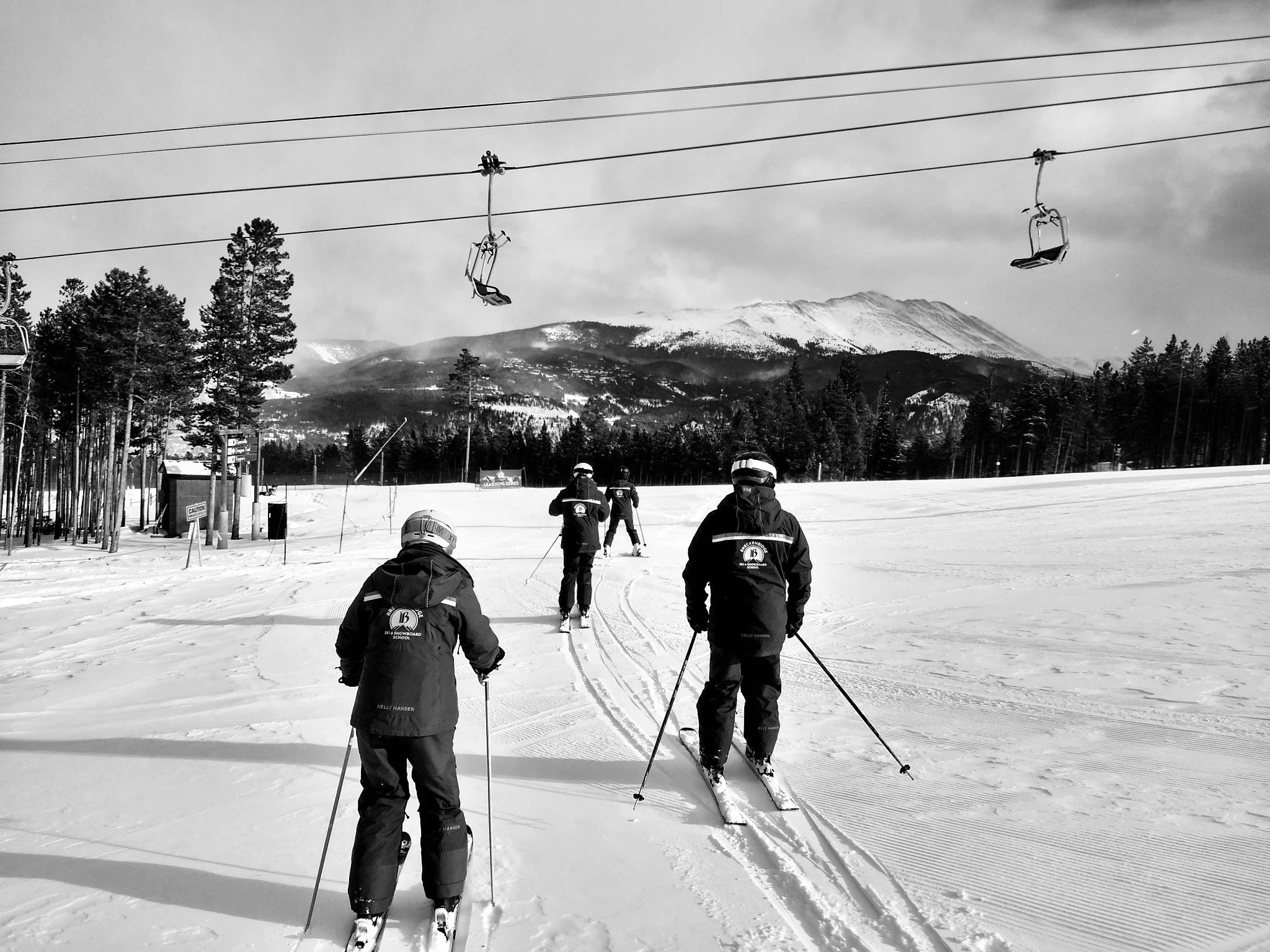
On Finitiation
Ski school is ending.
―
By April, the sun advances her agenda. Breckenridge’s lifts keep turning, but it’s mostly for show; chairs pass overhead like empty gondolas in a diorama. A film of windblown dust settles over the remaining snowpack, dulling its reflectivity and speeding its retreat. Down in the North Gondola lot, meltwater feels out the terrain with the patience of a surveyor, committing to the lowest routes with increasing confidence. Birdsong resumes its looped soundtrack. The mountain, deprived of school holidays and long weekends, begins its yearly slide toward irrelevance.
Ski school ends the way snow does—grain by grain. The J1s disappear first. Part-timers fold themselves back into their other lives. The rituals loosen: less chatter in the locker room, fewer dad jokes at line-up, a general sense of people backing away from the season without fully turning their backs on it. Someone’s Bluetooth speaker plays rock music at a volume that implies finale. Outside, bulldozers idle next to rows of early-season mountain bikes. Our locker room building will be razed as soon as we vacate. No one is sentimental enough to stop it; no one is immune enough not to notice.
Guests often ask, “What do instructors do in the off-season?” Most of us offer the old punch line about taking the moguls inside for the summer.
The first week of May feels illicit. No uniform, no hot chocolate vouchers, no obligation to pretend enthusiasm for a blue run in flat light. There’s a short-lived pleasure in domestic tasks: laundry, neglected mail, the rediscovery of sandals. Then the silence stops being restorative and becomes simply silence. By June, many instructors have drifted into a low-wattage depression—nothing acute, just a sense that the structure that held the winter in place is no longer load-bearing.
This drift can look like anything: minimum-wage summer jobs, halfhearted travel, or an earnest attempt to “catch up on life,” which typically collapses into scrolling through photos of powder days we already lived. Writing assignments returned to my inbox, and I met them with escalating reluctance. My dog became the only creature with a clear agenda. The off-season had a way of exposing all the seams winter had hidden.
The cognitive dissonance was consistent: without skiing, I felt reduced to the version of myself I’d paused in October, someone who didn’t feel entirely accurate anymore. Two identities rubbing together with just enough friction to blister.
I eventually understood that it wasn’t skiing I missed so much as teaching—its focus, its tempo, the way it stabilizes a day. So I followed that feeling toward water.
Whitewater, at first. Students practicing wet exits in a reservoir the color of tea; then peel-outs, ferries, a few tame rapids. On the Colorado, with a line of novice paddlers bobbing behind me, some internal gear re-engaged. Whatever part of me had belonged to winter recognized the structure: a moving medium, a technical vocabulary, the need to make good decisions in flux. The boundary between seasons, previously so rigid, began to dissolve.
It turned out the off-season wasn’t “off” at all. It was a misnomer—what felt like absence was simply an unclaimed form of the same work.
Ski instructors love to talk about transition—the hardest part of a turn. It’s often called “finitiation,” the moment between the old turn and the new, where direction and pressure reassign themselves and the skier pretends the change is smooth. Most of the time, it isn’t. The body knows it’s a hinge point, a brief negotiation before committing.
The end of the ski season functions the same way. April memorizes meltwater the way December studies snowpack. Nights refreeze; days undo it. Creeks rise and recede in a single afternoon. Water returns to its previous channels, records its edits: a shifted stone, a revised edge, a small rebellion in direction.
Nothing is lost, exactly. It just becomes something else.
This summer, I’ll trade the river’s turbulence for the abstraction of the Maine coast. Longer boat, broader water, fewer immediate hazards but more consequences when they happen. I’ll steer clients around lobster buoys, toast bagels over driftwood, check the winds with the same reverence ski instructors reserve for snow forecasts. The job description doesn’t really change: read the conditions, place the craft where it needs to be, anticipate the forces that want to move you.
Snow is water; water is weather; weather is work.
So, what do ski instructors do in the off-season? We finitiate, in the truest sense of the word. Sometimes awkwardly. Sometimes with fluency. Often with a brief, dull ache of disorientation and a touch of weight gain.
Spring Break
Poems about most of March.
―
Most of March:
Never-Evers
Magic carpet hums—
never-evers in neon
skitter like pennies.
Texas
Texas Week arrives:
time to ski fast, have some fun—
howdy, altitude.
College Kids
Skiing bikinis—
twenties spill toward the future
like snowmelt downhill.
4:00 To Town
Après hum rises—
music drifting up the slopes
like heat off spring snow.
Ski The Void
I conflate Hegel and skiing.
―
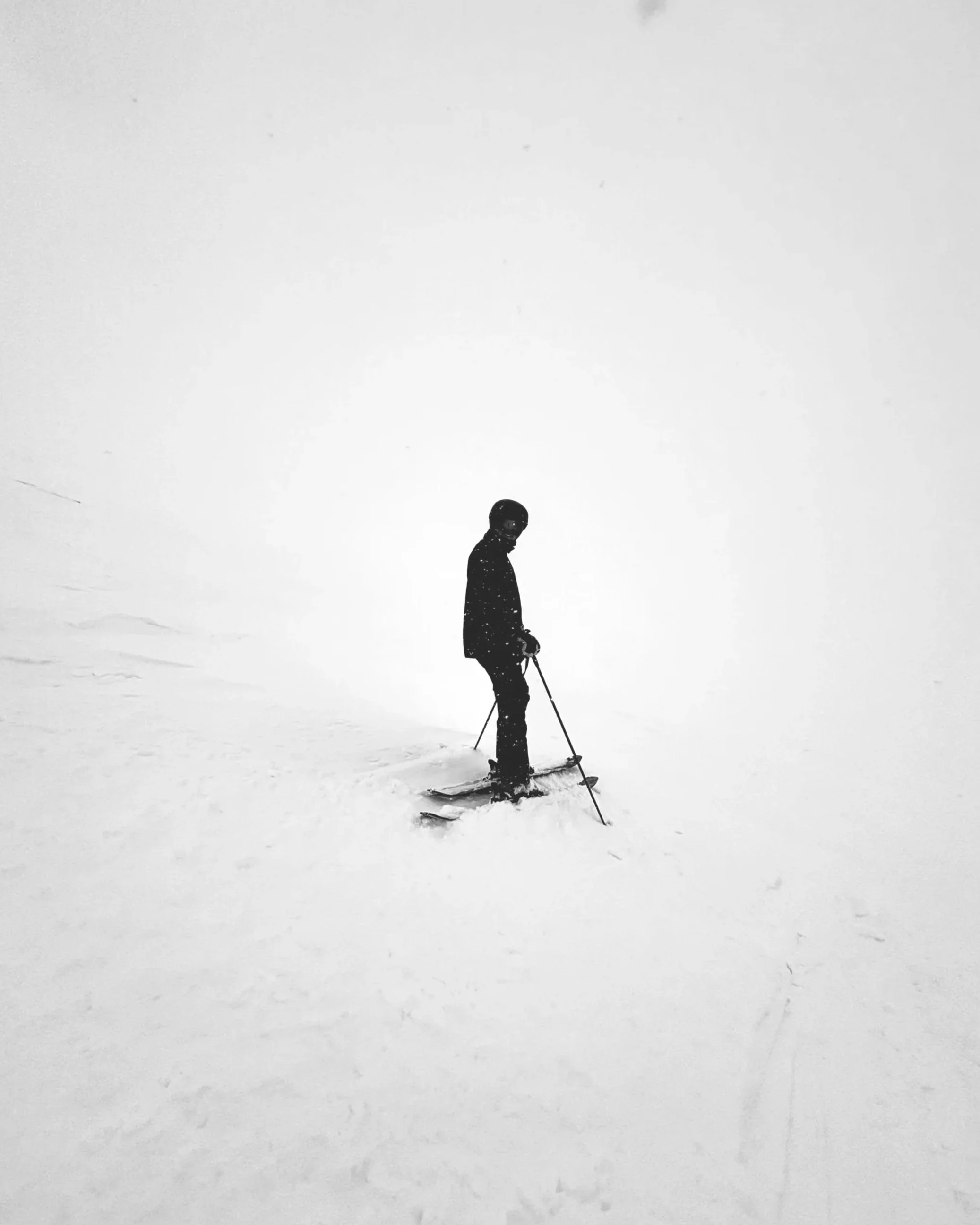
For most skiers, visibility mediates reality. It draws the line between a transcendent powder day and a whiteout in which sky and snow fuse into a single, horizonless field. Above treeline at Breckenridge, this happens often: forty-mile-per-hour winds lift ice crystals into the air, flattening light until even the chairlifts vanish. Perspective buckles. You feel motion while standing still, or stillness while moving. Skiing becomes a form of touch—performed with the feet, interpreted by nerve.
A teenager from Brooklyn had come for the above-treeline expanse, but visibility kept insisting otherwise. After a morning of hiding in the trees, he and I decided to try Imperial Bowl. Whale’s Tail was closed by a patrol rope, so we aimed for George’s Thumb, a face known for its rocks and its indifference to confidence.It was named for the man who first scouted it, George, who attempted to document his discovery and instead photographed his own gloved thumb.
We slid past the gate and stepped into nothing. No slope. No sky. Just a depthless gray. For a moment, I wondered if I’d misjudged the situation: a city kid, a burning-out guide, a vanishing world. But he stood patiently behind me, waiting for my instructions.
“One turn at a time,” I shouted. “Follow me closely.”
I nudged one ski downward, then the other. A single turn became a second, then a third—slow, tentative movements through the blank. Then a rock appeared: not a threat but a reference point. Another followed. We used what we’d usually avoid. Eventually the fence above North Bowl emerged, and the visible world returned.
Behind us, the featureless expanse resumed its silence. The kid yipped with victory.
Whiteouts are rarely described accurately. They’re not metaphors; they’re conditions. Yet skiing them strips away distraction in a way that makes metaphor tempting.
A few days earlier, on the T-Bar, a longtime client and I had talked about religion—not belief so much as the frameworks people use when certainty is scarce. Hegel’s phrase from the Phenomenology, “spirit is a bone,” rose up from memory: Geist locating itself in the physical. In the void of George’s Thumb, the idea shed its academic tone. Spirit wasn’t lofty. It had weight, bindings, and edges. It was a body figuring out where the next turn might land.
Philosophy has many voids. Buddhism’s shunyata—emptiness without nihilism. Existentialism’s lack of inherent meaning. Physics’ vacuum. Literature’s dread and absurdity. But skiing the void is different. It is not conceptual. It is immediate. Everything extraneous falls away. There is only the angle of your skis, the texture underfoot, the willingness to commit to a space you cannot see.
Nietzsche’s well-worn line about the abyss holds that it gazes back. Had he dropped into a whiteout, he might have added that the abyss also clarifies. Not grandly, but practically. It tells you what is actually under you. It strips your attention to its essentials. It edits the adjectives of the world until only verbs in the present tense survive.
We reached the bottom without incident. The boy found his mother; I found the locker room. But the void lingered after visibility returned. The sensation of moving through something that erased you even as you moved within it leaves a faint residue—an awareness that reality is more permeable than it seems.
It doesn’t take renunciation or retreat to recognize this. The mountains provide their own thresholds—spaces where perspective collapses and must be rebuilt turn by turn. You exit the void, but the recalibration lasts longer than the descent.
The void is always there, even when unseen, waiting for the next blizzard. And so, improbably, are we.
Self-Arrest
On stopping after falling down.
―
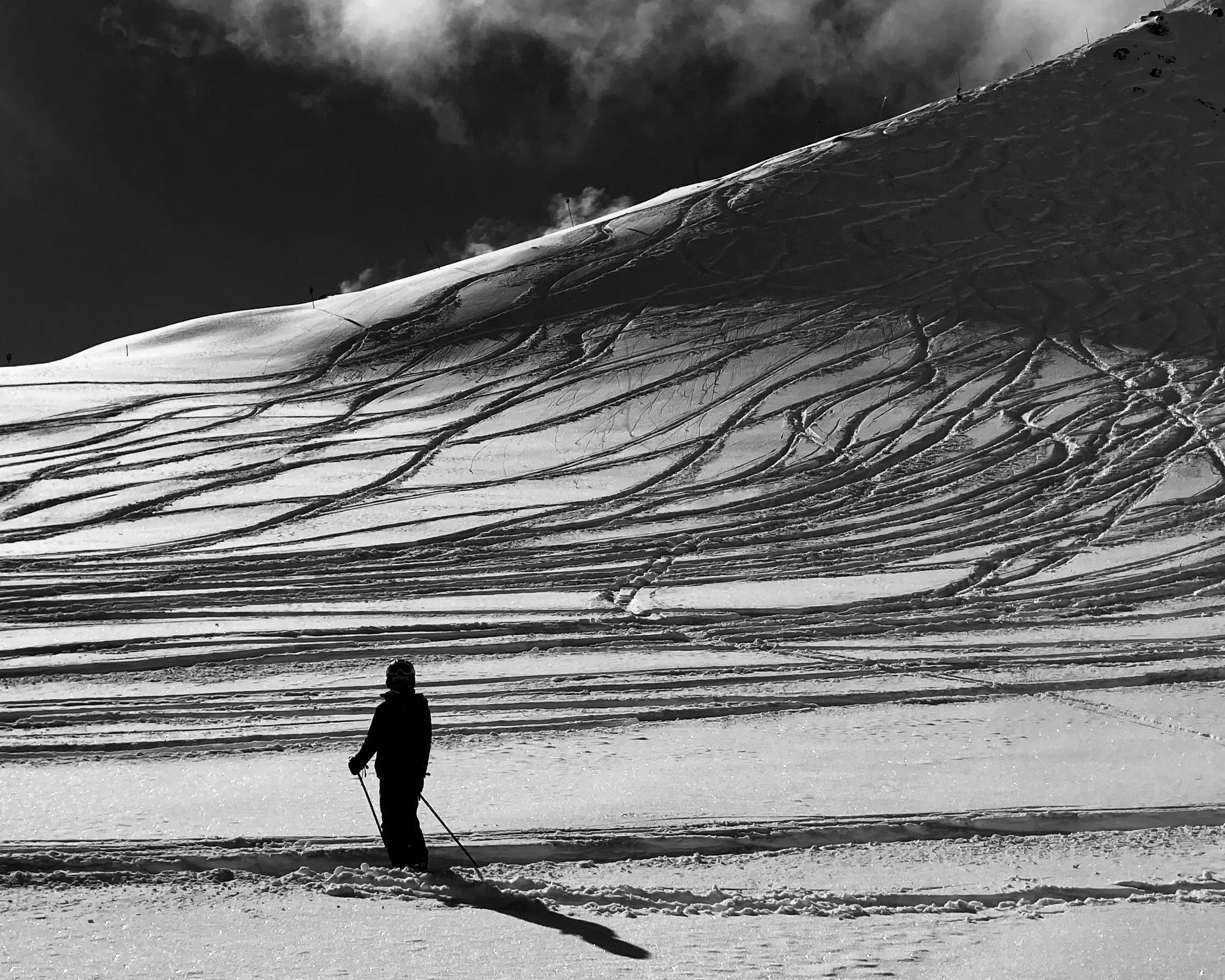
At the lip of Horseshoe Bowl, my eight-year-old student stops moving. She’s a sparrow-sized figure against a corniced ridge at eleven thousand feet, where wind carves the snow into permanent waves and ptarmigan tracks vanish overnight. Below us, a north-facing pitch drops sharply—her first double black.
She’s skied with quiet confidence all week, but this slope shifts the terms of the conversation. She leans forward, a small question mark, and gravity answers before I do.
She starts well enough, then her hips drift behind her heels. A ski clips a wind-formed mogul. One binding releases, then the other. She tumbles—pink helmet blinking in the white—until a mound of sun-softened snow interrupts the slide. The mountain stops her eventually, as mountains do. The question is always how, and whether we get a say in it.
By the time I reach her, she’s upright, breathing in short, surprised bursts. Her goggles are crooked; her tears are not.
Another spring, in the Lake Chutes, I watched two twelve-year-olds slip nearly four hundred feet down a forty-degree pitch. The weather had turned abruptly—clouds dropping low, erasing the terrain, converting the familiar into a blank page. Fear spread faster than instruction. One boy slid first. The other stepped forward to help, and the lip gave way beneath both.
What saved them wasn’t luck. It was technique—imperfect, improvised, enough. Elbows, knees, shoulders: small points of friction interrupting gravity’s plan. They had practiced self-arrest before. Not gracefully, but deliberately. By the time the slope relented, they were upright and waving.
The difference between those falls—my young skier caught by the mountain, the boys catching themselves—is the difference between luck and agency. Skiers talk a great deal about control, though the artistry of skiing lies in letting go.
Self-arrest is not glamorous. It’s procedural. You accept that you can’t prevent every slide, so you learn how to inhabit the slide: soften, angle, dig, interrupt. You won’t stop it entirely; that isn’t the job. The job is to reshape its trajectory before the trees appear.
Versions of this exist off snow. A job collapses. A relationship implodes. A diagnosis redraws the perimeter of a life. People imagine resilience as refusal. More often, it’s timing—knowing when to meet momentum, when to oppose it, and how to slow it by degrees.
My student gathers her equipment, breath steadier now, and clicks in again. I tell her what many instructors never say aloud: fall better. I don’t tell her how to prevent another slide, but to meet it with intention.
She drops in. She falls again. This time she digs in—an elbow, a knee—and stops herself halfway down. A small, deliberate interruption. No tears.
At the bottom, we look back at Horseshoe Bowl curving upward like a parenthesis—holding what just happened without defining it. The terrain hasn’t changed. She has.
“Fall better” sounds like ski jargon, but it’s something else entirely. It’s what remains after strength and nerve ebb with age, after the confidence of good conditions becomes a rarity. It’s the ability to place a small wedge of agency between yourself and whatever is accelerating beneath you. Not mastery—just influence.
Self-arrest, in practice, is almost never dramatic. It’s incremental: a shift of weight, a differently placed arm, the refusal to go rigid at the wrong moment. Children learn it on snow; adults relearn it everywhere else. A promotion evaporates. A relationship implodes. Real estate gives way. The instinct is to brace or deny the fall. But the quieter, steadier instinct—the one that comes with practice—is to make enough contact with gravity to soften the outcome by degrees.
From the chairlift, the bowl already looks less severe. Her fall has contracted into the mountain’s larger grammar, one clause among thousands. By tomorrow, it will be a chapter; in a week, a footnote. But her body will archive the lesson: a template for how to meet a sudden drop with attention rather than abandon.