
Anadromous
I wait for the salmon.
—
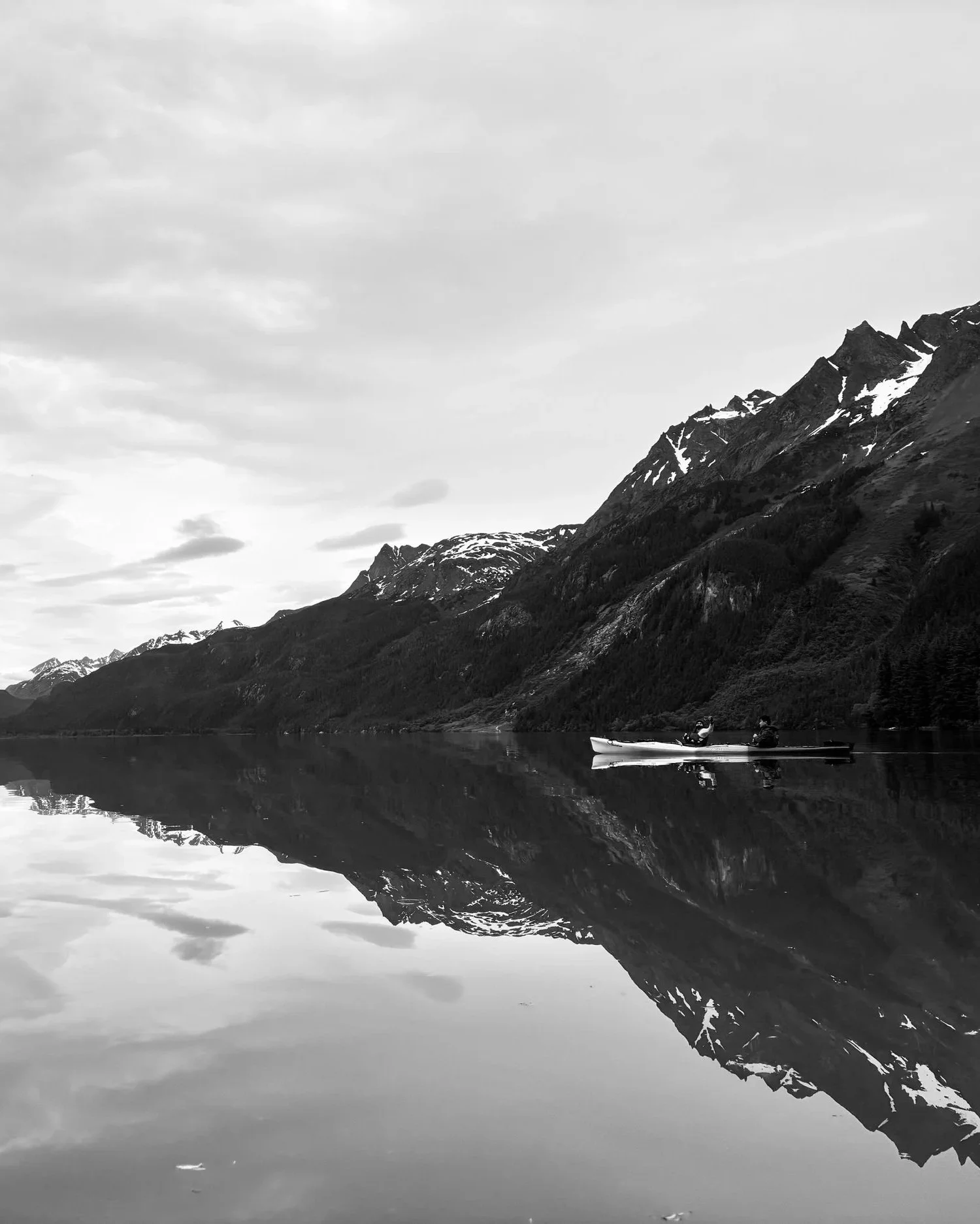
Our kayaks hover along Chilkoot Lake’s western shore in the lee of katabatic winds that race the sockeye up the river. Cushioned between glacial moraine and young peaks curtained with Sitka spruce, the lake curls placid in its bed, three hundred feet deep. An early June warm spell loosens more snow, swelling the lake and shifting the shoreline daily.
The opaque coverlet of sedimentary turquoise thickening with glacial silt stretches from sawtooth mountain to mountain, except for where its southernmost end frays into the Chilkoot River. A mated pair of bald eagles, whom some guides call Uncle Sam and Martha, perch in the sitka spruces which stand like gates above the place where the current grabs the lake water and begins to run. The river barely makes it half a mile before surrendering to the saltwater of the Lutak Inlet and the Lynn Canal just beyond.
These waterways carved from coastal mountains trace the lifecycle of the sockeye salmon. Once they leave the cradled waters of their birth, they are swallowed into the North Pacific. Their adult years are spent swimming through the same ports where cruise ships call at Sitka, Glacier Bay, Ketchikan, and Wrangell—creatures of the open ocean.
The same ocean delivers another lifecycle. Our weekly ration of cruise ships tender ashore passengers crowned with Glacier Bay baseball caps and garlanded with binoculars. These floating cities charge around the Inside Passage like modern-day gold rushers. Except, unlike their ancestors, the gold that floats these ships has already been laid up. Fortunes already made are now being expended in the hopes of spawning a less dense currency than bullion: wildlife, selfies, and adventure.
We pick them up at the dock. We stand there, beneath the Alaska State flag, our little sign advertising sea kayak alongside all the other excursion contractors’ little signs: cycling, rafting, bald eagle preserve.
The 90s van bounces off the state park. It’s ancient leather seats smell like my childhood field trips. Meanwhile, I act as an ambassador to elsewhere. My cargo are my audience, the ultimate apex consumer nature has set upon to devour this final frontier. But I masquerade as more, peddling the mystique of guide. I plod along in lightly scuffed Xtratufs and tell the the tourists how the bears will soon gather at the fish weir. I gesture to the narrow opening in the fence, which stretches from bank to bank like a comb jammed into an unruly snarl of long dark hair, and joke about a vending machine for salmon—like I’ve seen it all a hundred times before.
“They cut back the brush at the forest’s edge so you can better see the bears coming,” I say, trying out another guide’s facts in my mouth like a salmonberry that’s not quite ripe. Who are they, anyway? “We saw one from the van yesterday. Watching us watch it from the side of the road…”
For now, no representative from Fish & Game posts up in the middle of the weir, swathed in rubber to gaze through the fish-sized opening, counting the Sisyphean salmon. The sign where the run’s tally will eventually be inscribed twice a day in red dry erase marker stands at zero. It’s been that way since I arrived.
For now, the salmon and bears are ghosts of the lake’s future. I worry that that the cruise ship people are the ghosts of mine.
Every day, we paddle along the western shore to gape at the empty spawning beds. The still waters hide in their pocket of gravel and moss, tucked behind pale green curtains of old man’s beard.
Even where there aren’t performances scheduled, this theater in the round opens to the public for tours about its storied history—hundreds of years of drama comprising the cultural largesse of an ecosystem, an economy, a people. Protected between the streams that deliver the cold, oxygen-rich water the salmon seek, the gravel waits like boards to be trodden upon by the fish selected by nature from life’s audition to give us the performance of their deaths.
Sometimes, a mature bald eagle darts overhead with a cotton-colored dolly varden in its talons, a rag doll torn from the river. The fish will flicker in the grey sky like a diamond until the trees swallow the spectacle from sight. Other times, mottled juveniles flash cinnamon and orange on the trees above the beaver dams.
I spiel like a priest preaching an ecological gospel of what’s to come. Like the guests, I too have never seen the salmon run, but I proselytize it with the zeal of one who knows.
“In a few weeks, the females will rake their redds with their tails and slip their eggs inside.”
My audience nods with feigned interest before gazing toward the cascades thundering down the far shore. Their feet go to sleep inside the cockpits, and they wonder what they might find in the town’s gift shops, and whether bubble-netting humpbacks will churn the waters to foam for them when they sail tomorrow.
Waiting. Always waiting.
Day by day, the weather brightens. Sunshine comes to Southeast Alaska like an old friend who never married or had children and so sweeps through the neighborhood with no regard for routine and no idea how long they’ll stay.
Evermore expectancy gathers along the lake's edge along with small cloud-like clusters of black cottonwood fluff. Buffleheads and common mergansers hatch their ducklings and hide them from the eagles in the brush. If our group swings too close to one of their nests, the terrorized downy family will rush from their cover out into the water, immediately summoning the eagles from their lofty perches. The birds will swoop down and the ducks will dive. Some will come up to the safety of their mothers. Others into the mouths of their enemies. Others still will not come up at all, drowned in an attempt to get away.
Last year's sockeye fry, who crept from their dead mothers’ redds beneath the ice back in February, flicker silver beneath the surface. They will spend a year growing and dodging the shadows of eagles and kayak hulls in their littoral cradle before heading out to sea.
The generation before them, meanwhile, circles somewhere beyond the mouth of the Lynn Canal. Out of sight, and silver-backed in their Pacific prime.
The sockeye’s journey home is one-way. The reverse way of the cruise ships whose passengers travel here once in their lifetime. Our guests go home and tell everyone they saw Alaska like Alaska is a play the magnitude of Hamlet; the same five universal acts, a classic produced in a myriad of creative ways.
But in truth, they see this place more the way the salmon, pelagic fish who dwell in the sea’s uppermost waters, see the Pacific Ocean. They swim through the layer of the enormity that is most conducive to their getting back to where they need to be when the grand adventure is over. The immensity of this land, its verticality and proto-historic reach, cannot be comprehended. But it takes time being here to know that. I’m not sure that I’ve been here long enough to know it, let alone see it.
Anadromy itself is not too different from our idea of retirement. The moment the sockeye reenter freshwater, they stop feeding and subsist entirely on their zooplankton 401Ks, energy stored from years in the ocean. As they struggle upstream for their beds, their bodies begin to dissolve. Time catches what the fisherman’s net does not. Fins fray. Flesh wastes away. Eyes cloud. They quite literally fall apart while still moving. ("Zombie fish," the locals call them).
They spawn once.
Then they die.
By the Fourth of July, the body count creeps toward one hundred. Sometimes, I think I see a few bubbles ruffle the surface of the spawning beds. My new fisherman friends tell me they’re catching nothing but dolly.
“Soon,” I promise the guests, “the salmon will be so abundant, the bears can be picky about the parts they consume: eggs, brains, the fatty hump behind the head—the most calorie-dense. Heads will be torn off, and the carcass tossed into the woods becomes food for ravens, eagles, weasels, insects, and microbes. The forest itself will close the chain, metabolizing the salmon’s nutrient delivery system: marine enrichment will end up in the ferns, berry bushes, and sitkas.”
For now, the bears have swallowed all the dandelions, and the salmon nowhere to be found, so the juveniles are magnetized to town. They lope hungry through the parking lot and stare at the cruise ships, salivating at the tonnage of trash. They leave little cairns of tar-black scat splattered along the Lutak Road. When the town puts down yellow paint lines to refresh the road, the workers paint right over the scat.
On July 16, a lone figure emerges from the Fish and Game truck and crouches on the weir, dressed in fishing rubbers as fine rain mists around them.
Their head bows towards the current.They are counting.
2,609 …
Weir count, July 18: 18,972.
The first of the large pulses has arrived—6,173 came up just this morning alone. They amass in the inlet then wait for the exact right temperature and tidal conditions to make their rush up the river.
Sunset pink streaks like broad, gestural brush strokes twist in the shallows and leap at the river mouth. They make an impressionist painting in the mouths of drainages.
“A hospice and a nursery,” one guest muses. “And these are the lucky ones.”
After all those years dodging commercial trawlers at sea, they must escape the subsistence fishermen’s long, lethal lines into which a salmon swims in but not out. Their bodies held in suspended animation, trapped with the realization, perhaps, of one of the violent deaths that will soon find them. If they try to reverse and get away, the nets pull at their gills, ripping them of their watery breath. If they are pulled up, the gutting knife waits on deck. If the fisherman dozes on his phone, and they’re left to long, harbor seals appear, and devour them like cookies pulled from the oven, still cooling on the sheet.
Everything is against them. Everything wants them dead. Eagles, bears, loons, humans, ducks, gods—but, most of all, themselves.
And these are the lucky ones.
The Southeast Alaska State Fair begins. Fireweed’s exhilarated pink darkens to ruby purple along the beaches, and Fish & Game’s tally climbs to just under 30,000. The fish arrive like the wildflowers, in heats. They appear suddenly on their own schedules, like cruise ships of various sizes, docking and flooding the place all at once; 2,000 appear, then 200, then 500, then 1,500. Then nothing. A day off. The restaurants close, the eagles digest, and the town sighs quiet. Then another 1,800. They splash their way upstream and vanish into the lake. They are absorbed. Depending on the year, this is the beginning of the end of the run.
The jubilant eagles’ high-pitched popping and piping wraps through the woods. Where they concentrate, six or more, the scent of fish thickens. Since the run began in earnest, we haven’t seen a single bear on any of our tours. The fishing guides say they haven’t really been seeing them either. It’s the eagles who cluster on the banks, hungrily eyeing their catch.
“We’ve seen more glaciers than bears,” moaned one couple.
“How disappointing,” I agreed.
The Fish & Game people count on, unmolested by bears. They are the attractions photographed by the cruise people out the windows of our white vans. They keep their hoods up, even when it’s not raining.
It’s not that I’ve been lying about the bears, but only that this year’s production is being staged with a different casting. I am glad for the bears to remain ghosts. I do not need pictures of them. I’d rather they stay alive catching their salmon and napping in sedge grasses someplace where no one counts their salmon.
The cruise ship people pull anchor and sail on to Glacier Bay or Icy Straight or Hoonah—the next performance of Alaska that is and isn’t Alaska, but like the salmon runs, keep this place humming from generation to generation. Ecosystems here braid like the Chilkat River’s channels across the broad valley or the lives of strangers who come from near and far to witness some idea of wilderness.
Maybe they’ll get their pictures of bears elsewhere, but for most of the guests, the bears will remain ghosts. Soon, the season will stop, and daylight will disappear and the cruise ships, for a time, will become ghosts too. My past, rather than my future. Among the many lesson of the salmon is that there are innumerable ways to produce Hamlet, infinite ways to go home, spawn, and die.
More salmon will come. Some will be caught at the last minute. Snatched, a few thrashes of a tail from home. But a few will make it. They’ll tuck into the beds nature has so graciously made for them, point into the drainage currents, and ensure another generation will wake this winter, under the ice, long after the rest of us have gone home.
A Few Interior Landscapes
I keep going to the Yukon.
―
33 Mile
The roadhouse just seven miles shy of the Canadian border up the Haines Highway flies both flags—US and Canadian. A brown bear stumbles in a ditch just down the road, skinny and dazed. He or she is likely looking for dandelions, but all they are already gone.
It’s Fourth of July Eve, and a pig carcass lolls unattended on the lawn. I don’t want to know how they got it. 33 Mile’s Fourth celebration is a local favorite because, well, the pork roast. Besides, the Haines police don’t bother coming this far up the road to shut down the fireworks.
The place is hewn from large timbers. They’re playing 50s tunes on what could be an invisible jukebox. The condiments on linoleum tables look almost as old, and the portions are bigger than anything you’d see in Haines proper. Everyone says 33 Mile has the best burgers this side of Juneau, our closest McDonalds.
A skinny girl (who hasn’t bathed longer than I have) strolls in right past me in Xtratufs. A long knife swings on her belt. She orders soup, and the server seems to know her. She repeatedly calls the girl “honey” as they chitchat. Weather. Bears. Fireworks. More bears. That one in the ditch has been looking at folks funny, like he’s about to charge. They reckon he won’t last the month.
Finally, I catch a side-eye. Honey goes and takes a seat, and I step forward to order. The server sighs when I ask about veggie burgers.
“Yes, we have them, if that’s what you mean.”
Whitehorse
“You sure go to the Yukon a lot.”
My new friends say this to me like it’s a character judgement. Like it’s a referendum on what I think about Haines, and how it’s going here. Maybe it is.
Why do I keep spending so much gas money driving up and out of the fjord at the back of the Lynn Canal after I traveled so far to get to Alaska? It’s not just for Real Canadian Superstore in Whitehorse, or the bakery in Haines Junction, or even the sustainable shop downtown, with its endless shelves of delightful soaps and laundry powders. Is it?
One does not have to go very far up the Haines Highway for the mistiness of the fjord to drift off on the tides. How fast the sea becomes a postcard swallowed by Yukon’s vast network of mountains and rivers.
The other side of the pass, the Yukon Territory (after a kiss of BC), just feels more like Colorado than Southeast. Soaring cathedrals of hard rock, but with more greens, blues, and violets. Skies are bluer here. The silvery-gray shimmer of the coastal rainforest dispelled. Fireweed soars triumphant along the roadways, magenta arrows pointing the way to Kluane, to autumn, even though summer has just begun.
Like home, too, the rock here is strong: giant bones that can contain the enormity of the world they hold up. Caves rattle with eons and mammoth bones. But unlike home, the sponginess of the permafrost gives way to bogginess that swallows your Tufs with a sigh of Labrador tea. Back in Colorado, there is no sponginess: only the arid grind of stone and bone, occasionally veiled with a resolute crunch of dried-out pine needles.
I camp near the hot springs—another reason to come to Whitehorse. The people in Haines complain that’s it’s boujee since the remodel, but I appreciate the polished floors, multiple saunas, and vegan smoothies.
There are five more hours of daylight to go and it’s already bedtime. This too, is different. There is even more light here than in Haines. Yukon's southernmost border starts at the 60th parallel north, which is nearly 19 degrees farther north than Colorado's absolute northernmost point. Home, but norther.
I sleep deeply for four hours. The sun wakes me like a parent telling me I’ve overslept, ogling at the foot of the bed, its tangerine glow through the black spruce boughs, prying open my eyes at 2 AM.
Million Dollar Falls
And then there it was, the sound of the river.
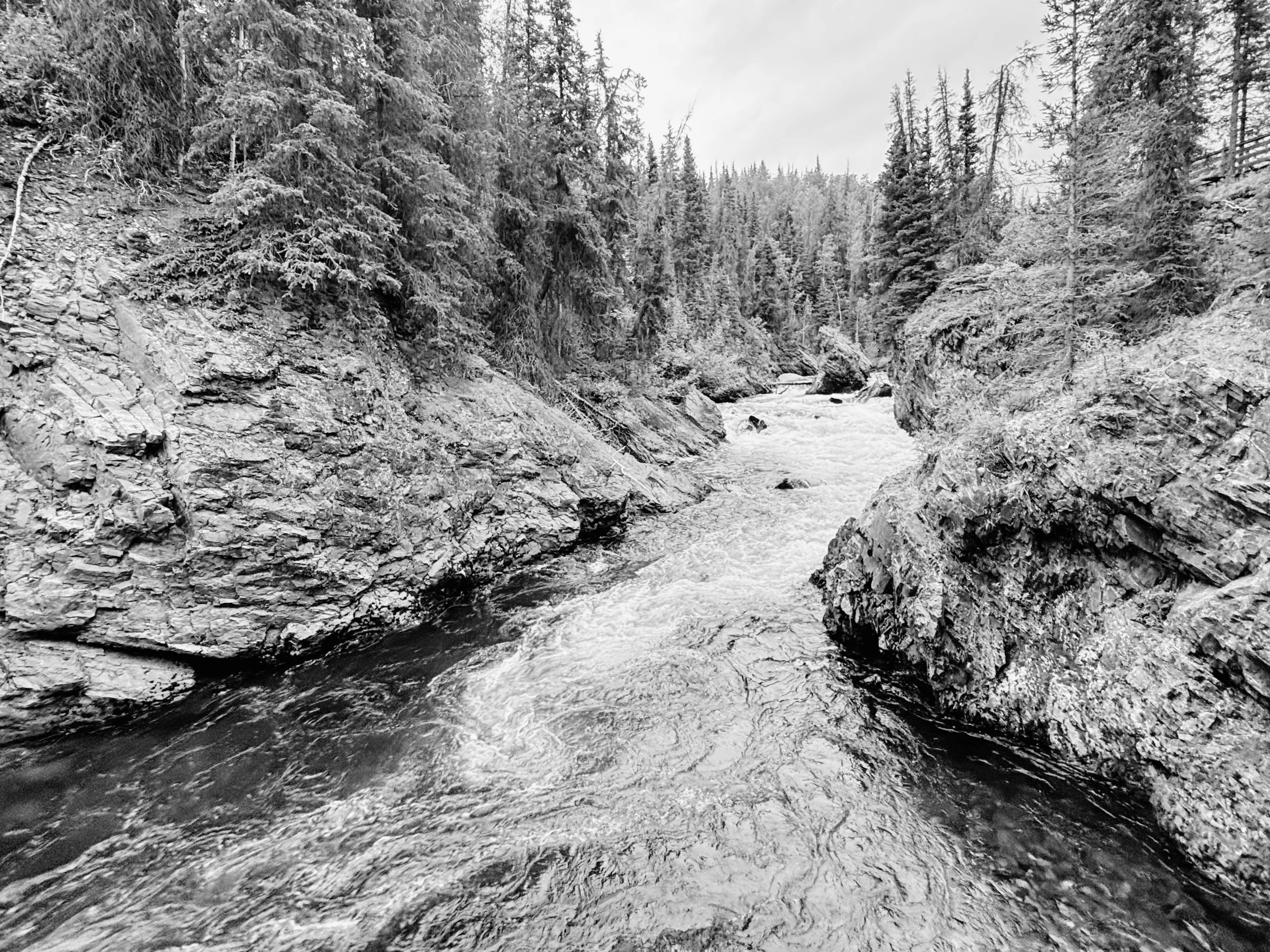
Neither the Chilkoot, which trickles its pewter around the weir with its as yet unrealized promise of salmon. Nor the Chilkat, big and braided while it milks its way down to the inlet. This is the Takhanne boring in my ears. It’s an earnest rush of a big snowmelt, bounding into the earth beneath me. Below the sixty-foot drop, wave trains crash and seethe before giving way on the dark brown banks blanketed by pine.
I light the fire starter I made from torn up shards of a Starlink box and the melted wax from a saint’s votive excavated from one of Haines’ endless free piles. The wax snatches the flame like Sasha snatches a snack, and bursts into righteousness.
I feed the baby fire with the kindling I stole from the ski hut in Haines Pass. Colorful crotchet oven mitts dangle above its door like Tibetan prayer flags. The hut is swept and stocked with dry food and firewood. Its plywood walls and door are tattooed in notes and drawings from people who’d stayed there before: Yukoners, Alaskans, hikers, skiers.
“Keep on birding in the free world.”
“Haines Pass Baby!”
Since I drove up here from home in April, Haines Pass has all gone green and gray with rain: the white a memory. Come again in six months and those words left by those skiers will be another bridge: winter’s long recoil. Bear spray at my hip, Sasha and I wander. But we are very much alone.
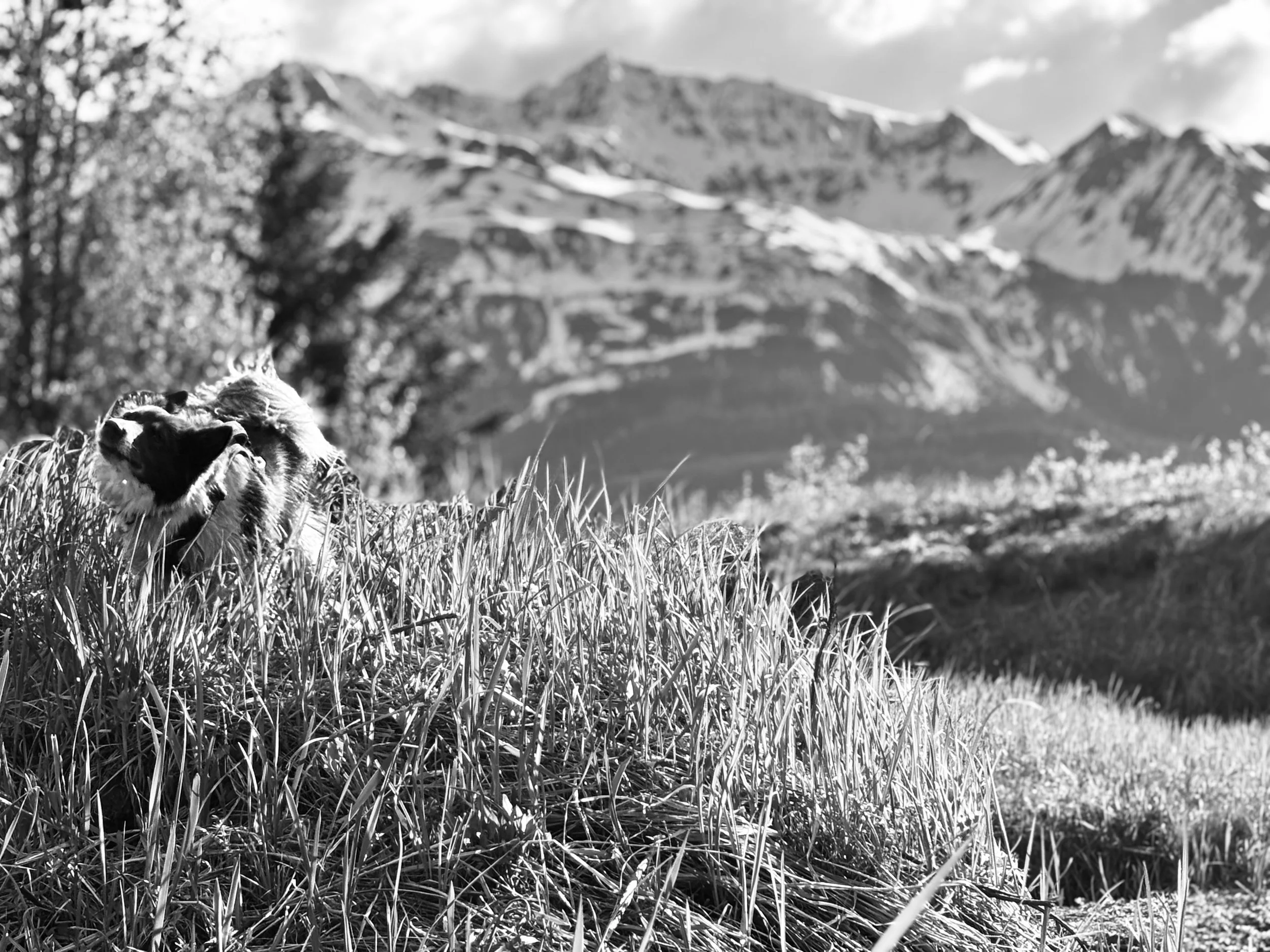
Now the water. And the waterfall. Insisting on erasing the sounds of my pasts—one in each ear. Sasha circles our site with joy. She knows what a campground is now. This sheepdog who requires routine to regulate her hypervigilance takes comfort in this newly forming idea of mutable home. The sound of the truckbed camper rising. The clank of kibble striking metal dinner bowl. I delight in spending the night away from our little dry cabin back in Haines, already crowded like a sunny patch of forest floor with new community.
The rain comes in hard before the darkness. My little fire persists, which leaves me feeling triumphant, like a guide capable of keeping a flame alive in a hurricane. Even Sasha radiates in the satisfaction of being warm and dry while the world around us absorbs the cold deflected by our heat.
The rain here is not Haines rain. It is not feathery rainforest rain. This is the rain that blows in on the wind and will pass shortly, returning the sun, mountain rain. It falls in fat drops that go splat on the rocks. Each splat leaves a wet thumbprint. Wet plopping to the earth with purpose.
This rain is familiar.
“You sure go to the Yukon a lot.”
The Yukon, the interior’s beginning at the end of the Inside Passage, is like homecoming without being anywhere near home.
Tagish Lake
I cannot see either end of Tagish Lake, whose unusual wishbone shape spans the border of the Yukon Territory and northern BC. While Alaskans speak of their oceanways as lower bodies, here, in the nearby interior, laconic nomenclature lives above the waist. Tagish’s long, blue branches are called arms, and they wrap around either side of the Canadians’ borders, 74 miles long.
I camp on the Yukon side. Sasha offleash sniffs the bones of what the signs tell me are what’s left of the Venus Silver Mine. The abandoned machinery of a long-dead era now rots like a caribous carcass on the grey rock beach. The story, to a Coloradan, is a familiar one. Claims staked early at the turn of the last century by men from elsewhere who came in hard, purged other peoples’ money, and established a boomtown—named after themselves.
In elementary school, while delicately skirting the stories of what happened to the Buffalo by choosing to focus instead on the mystery of the Anasazi, all Coloradan children are taught the history of our “Silver State.” Silver was our gold rush before skiing. But when the Panic of 1893 crashed silver prices, mines across our mountains instantly shut, and their villages and camps dissolved into ghost towns.
A Canadian with a mutt comes down. She’s new to Whitehorse, recently relocated there from Toronto after a divorce. The dogs play as she squats on the beach squinting through binoculars for mountain goats after rinsing her frying pan in the emerald and aquamarine lake. Snow patches still cling on the hills ringing the shores. The woman spots two mountain goats cleaving to a rib of ridge, and hands me the binoculars.
“See them? There’s two!” she exclaims.
I find them quick, like motes in the eye: just barely visible to the right of a tear-shaped patch of winter. But I didn’t come all this way to the world of whales and brown bears to see alpine animals who clog the side of our highways back home.
“Yeah, wow,” I reply. “There they are.”
Kluane Lake
Kluane Lake nestles in between mountains of brown and green and grey that rise from the vastness and settle beneath clouds. Fireweed borders the roads with its striking magenta. The one burst of color striking out to say I AM HERE TOO. Notice me! Yukon grandeur made even grander by the smallest flower: a border to the borderlands beauty.
The woman who minds the campground has blue veins that run down her neck like river lines on a topo map. She tells me, “a mama and her two cubs have been coming through. Once a day, but they cause no trouble. It’s the black bears that you have to watch out for—they’re curious. The grizzlies mind their own.”
The lake stretches like a secret. Not the U-shaped wishbone of Tagish so much as a liquid mirror in whose reflection are buried the secrets of northern places that bring people like me here. The Aurora. The caribou migrating in such numbers that “the mountain appeared to be moving.” Kluane has been wishing well to it all.
So much of the Yukon feels this way. Even as RVs cut through, cruise ships of two, usually retirees, that cut the land. They are swallowed by the landscape, which they then try right back to swallow up in turn. The cruise ships that dock in the fjords are less subtle. They lash out at the Coast and Chilkat mountains, floating mountains that block our view of the town. But if they did not come, neither would I. Interior and coastal, tourists and seasonal worker. Local and stranger. Lovers and ex. Brown bears and blacks; everybody has a point of comparison, of contrast, means of expressing curiosity or minding your own.
Why do you keep coming to the Yukon?
Because the air here is cleaner than Haines because it’s not heavy with the water. The air back home is not even the air back home right now. After our terrible drought of a winter, home, Colorado, is on fire.
I cry over my morning coffee as I finish The Sun Is A Compass, and the book ends with the author giving birth. Must all female adventure stories end this way? Epic hikes and treks or paddles whose terminuses are husbands and handmade cabins and babies who go on helicopter rides for their first backcountry trips?
Where are these women? I want to know. I think of the RV retirees and the woman with the river lines on her cheeks and want to scream. The majority of women I meet in this line of work—the guides and scientists and park rangers—are mostly in permafrost relationships. Spongey inbetweens. Melting. Fragile. Glacial remnants.
No one writes about that, though. The stories that get printed and sold in the smalltown Alaskan bookshops sell the narrative of the adventuring couple. It’s a new have it all fantasy for the outdoorsy millennial or gen z’er. Men, of course, have been doing this since the Odyssey. Since the Old Testament, or whatever.
They go out into the big scary nature alone, have revelations and write books, and get shit named after them. Peak baggers. Ocean crossers. Mythmakers. They go alone and come home to a new understand of self and a woman waiting whom they would have treated like shit before they left and probably will again once the sheen of glorious return has worn off.
But women must trek across the mountains or paddle around a continent into the arms of a man and birth a child. Then, she must take them with her back to the woods to truly be wild, free, complete. Bless these Madonnas of the Forest, for I am not one of them.
So far, none of the women I’ve encountered out here are. I’ve met all these women out in the Yukon, camping alone. I do not see men solo camping. Or groups of male friends. Couples, yes. Families, yes. But women—we venture out here on our won in droves. For so long, we’ve been told this tale of men leading women into the wilderness to keep them safe. But maybe, it’s the other way around. Most men won’t go anywhere alone. Not truly alone. Alone with the world watching them break a record or do a badass thing, yes. But that’s not the same thing as a woman who goes just to go, or maybe even get away from these men.
The aloneness as vast as this lake hiding between mountains seduces woman away from man quois man, even if we don’t or won’t speak of it. Mama bears roam without fathers. The trope is always mamas and her cubs. It’s evoked to remind us to be fierce in protecting our own. Do the big adventure with or without the mate, but don’t forget to take care of everyone when it’s all said and done.
Take care to mind your own. Eventually the yearlings go. Mama remains. Out there, fishing and scavenging for berries all on her own again.
Dyea
Tomorrow I will close the Golden Triangle and board the Hubbard, which will take me back to home for now, or Haines.
Four enormous cruise ships are docked in Skagway today: 12,800 souls. A gold rush for modern times. Concentrated human activity that breeds commerce. A dirt road out of the t-shirt shops winds down, down, down and away to the head of a trail that killed the cruise ship people’s ancestors. A graveyard for those who failed to get anything named after them except a cemetery that’s actually named for the thing that killed them. Slide Cemetery houses the bones of 19th century prospectors trying to get up the White Pass when the locals, natives, told them don’t go. Even most skiers know that avalanches are the mountain’s way of wiping the slate clean.
In the shops, they keep asking if I am local. I don’t even know what that means anymore. I don’t know where I live or where most of my mail is ending up right now. I’m unwashed, so I must look like a guide—is that what she meant? Or just that I’m not like a cruise ship person, so I must serve them. Black bear or brown.
Why do I keep coming to the Yukon?
Because, here, the dandelion aren’t quite done. Because there are women who roam free as bears who delight in an abundance of daylight and fish. Because wild iris bloom in the flats. Exquisite, tiny purple fingers reaching for the sun.
The Greenness of Green
Summer comes to Southeast.
―
And then, Southeast Alaska was green beyond all green.
Tennis-ball green. Green like the glow of bioluminescence trailing a kayak blade in the Florida Keys. Honeydew highlighter green. The kind of green Pantone announces as “color of the year.” To a girl with eyes grown in the rocky palette Colorado’s interiors, it is an extraterrestrial green, an impossible, invisible color only seen by multi-eyed insects.
After weeks of grizzle skies flocked with mist and rain, summer's sudden saturation startles. The sun crowns the fjord in Klondike gold and, with it, comes a regional heat advisory, though the temperature barely tops 65. Locals rake the beaches for ingredients for "beach green burritos." Along the Chilkat, they're harvesting spruce tips for beer. The neon-green shoots grow heavy as they ripen, pulling the boughs downward.
A young couple plays with their infant in the intertidal zone. The mud shimmers and ravens circle for fish the tide forgot. The boy sheds his clothes, throws back his head, and screams.
"He was born in winter," they explain, almost sheepishly. "Today's the first time he's ever seen the sun."
A woman with snow-streaked hair follows her elated dog along the beach, pants rolled to expose calves the color of cod. Here, comments about the weather carry the weight of intimate conversation rather than pleasantries. Last summer, they say, there were only three days without rain. So much sun, so early in the season, feels almost overwhelming.
"The ache that always lives in my bones," she tells me, "it's finally gone."
Life in Alaska has a short window in which to get everything done: be born, grow fat, find a mate, raise young, and prepare for winter. It is a meticulously choreographed performance in which all who hurry to the stage know their roles. Nothing hesitates.
The green acts as a scrim to the grand reveals: the brown bears, who I learn are serial monogamists. The oldest female bear recorded in Alaska lived to 39; the oldest male, 38. If I were a brown bear, I'd already be dead.
The only bear we've seen on our lake tours so far is a small black one, romping through the Jurassic skunk cabbage that soars its yellow between plunging cascades. Each day, the sun siphons more snow from the mountaintops, and the water rushes thicker, louder.
On the lake's east side, enormous beaver chips confetti the shoreline. They punctuate the green creeping up the mountainside like ivy. The beavers are turning poplars into toothpicks to enlarge and enliven their lodges.
One afternoon, we return from a tour to find a dozen tourists spilled from a bus, telescopic lenses trained on the far bank of the river. A cow moose is shepherding her calf through the shallows. The calf's spindly legs wobble as it picks its way around the eddies while its mother pauses, alert and watchful.
Everyone is watching them: the tourists, the guides, the river itself. Eagles peer down from the Sitka spruce. The forest is like a restless audience, holding its breath.
A few days later, I'm tying up kayaks when a veteran guide comes down to the boat ramp. Unlike the green twenty-somethings, who post up for the season in their beater cars with bandanas tied around their foreheads, he’s year-round and all brown. This soft-spoken Oberon has eyes like a bear in the forest and dons a weathered khaki jacket. He asks if we've been seeing any bears.
I tell him about the little black rambler on the eastern shore.
"Well," Oberon says, glancing toward the river, "they found that baby moose right there on the rocks by the boat ramp yesterday. I reckon that black bear got it. Lots of scat on the road, too. That's a bad sign. Means they're hungry and coming into town."
He pauses.
"But they got the weir in. Sockeye should be here any day now."
No sign of the mother. They cut back the brush to better see the bears coming.
A group of twenty-something guides—the boys shirtless and the girls in bikinis, all of them in Xtratufs—smoke old-fashioned cigarettes on the dock on a sun-spilled day when, for now, no cruise ship is anchored in Haines harbor.
"Smoking is actually good for you because it teaches your lungs to clean themselves," I hear one girl say.
They load cases of beer where they normally load overstimulated tourists into their fourteen-person voyager canoe. The motor roars to life and they bounce toward the back of the lake, slicing through a glassy reflection of mountains collapsed into sky. Their laughter is soon swallowed by the waterfalls.
Like the bears, the otters, the skunk cabbage, and the moose, they are part of summer's great performance. They emerge from the green like the mechanicals in A Midsummer Night's Dream: overconfident Nick Bottom turning the color of a boiled Dungeness crab while refusing sunscreen; Peter Quince directing traffic on the dock; would-be Thisbes in tie-dye overalls; Robin Starveling, the mushrooms already kicking in, convinced she's Moonshine.
Merrily they stumble onward, performing their play within a play. There is something beautiful about it—the recklessness, the costumes, the certainty that summer will last forever. On one of nature's grandest stages, far from the critics of the cities, a riot of green.
Every week, a few Coloradans step off a cruise ship and into the kayaks I lead. The first thing we talk about is the rain.
Back home, it's all brown, they tell me. They look up at the Coastal Mountains layered in spruce and hemlock, their peaks disappearing into low clouds swollen with rain, and say, almost wistfully, "A week of this would solve all our problems."
Fire restrictions are already in place. Reservoirs shrink. The winter snowpack is devoured weeks before it should be, and whole counties hold their breath through another summer.
The moose calf had been born like a prop presented to an audience. Dozens of cruise ship tourists stood along the riverbank photographing its uncertain first steps. By now those images are scattered across phones and social media accounts, tiny souvenirs of a life that lasted less than a week.
Most of those people will never think of it again.
But I find myself wondering about the mother. Do moose mourn? Is she still searching the riverbanks? Or has the forest already folded her loss back into itself?
The salmon are coming, Alaskan Oberon had said.
Summer is short.
Someone Who’s Been There Before
Getting schooled in guiding.
―
Beyond the windows, the Lynn Canal wrinkles beneath a cold southerly wind. White flashes appear between waves the color of jade. A gull. A whitecap. A whale.
It is April. Humpbacks are moving north with their calves, leaving Hawaiian breeding grounds for the nutrient-rich waters of Southeast Alaska. Soon the herring will spawn, turning sheltered coves silver. Eagles, sea lions, bears, and whales will gather for the first of the annual feasts.
Winter, meanwhile, seems unconvinced it is over. Snow from a record-breaking year remains heaped around town. A damp chill drifts off the fjord. Tomorrow I will spend hours immersed in that water.
For now, there is coffee.
The clubhouse offers the comforts of shore life: showers, Wi-Fi, washing machines. A whiteboard blocks the view. Scrawled across it is an ambitious syllabus: incident management, expedition skills, sea survival.
There are four of us in the Grey Heron’s coastal sea kayak guide course. It is scheduled for sixteen days. It will eventually stretch to nineteen.
The Grey Heron is already in the room. Among sea kayakers, he is known as an expedition paddler, coach, and guide. Decades on the water have carried him along remote coastlines from Japan to Norway. He has spent much of his career teaching paddlers how to become guides and guides how to become mariners.
Tall and long-limbed, the sixty-something Brit moves with the economy of someone who has spent much of his life outdoors. He has a habit of pausing before speaking, as if checking conditions. Weather, tide, wildlife, group dynamics—it all appears to occupy the same mental shelf.
In the absence of bears and rough seas, we become the object of observation: a seasoned outfitter from Sitka, a young NOLS graduate already guiding in Alaska, the Wolf whose enthusiasm arrives several seconds before the rest of him, and me, knees still aching from a winter of teaching skiing.
When the Grey Heron paces before the whiteboard, the room takes on the feel of a vessel underway.
"As kayakers, each individual is captain of their own ship," he says. "Through your leadership, they're going to follow you. Seamanship is about knowing what's coming up."
Long before maps, roads, and GPS satellites, traders crossed deserts, pilgrims crossed mountains, and sailors traversed unfamiliar seas by following someone who had already done it. Today’s recreational guiding remains essentially the same arrangement, albeit with lighter equipment and more expensive gear.
A tourist paddles a kayak along a stretch of coastline.
A sea kayak guide reads the same coastline the way a philologist combs a manuscript.
The lessons move quickly from theory to practice.
"Stop! Capsize! Swimmer!"
One by one we tumble from our kayaks and feign hypothermia until the real thing begins to creep in. We tow one another through confused seas, rescue swimmers beneath rain-slick cliffs, descend rock faces in improvised harnesses, and build fires with whatever will burn. The line between exercise and reality proves surprisingly thin.
The Grey Heron's preferred teaching method is disruption. Whenever the group settles into a comfortable rhythm, disaster arrives. A flooded hatch. A shoulder injury. Cold shock. A cardiac arrest. One moment he is paddling quietly among us. The next he is upside down, a sea anchor holding his breath while someone struggles through a rescue.
Every module points toward the same conclusion: weather deteriorates, equipment breaks, people become tired, and assumptions fail. Rarely all at once, but often enough that some scale of catastrophe should be expected as the guide’s constant companion.
Just because people follow you doesn't mean you always lead them well.
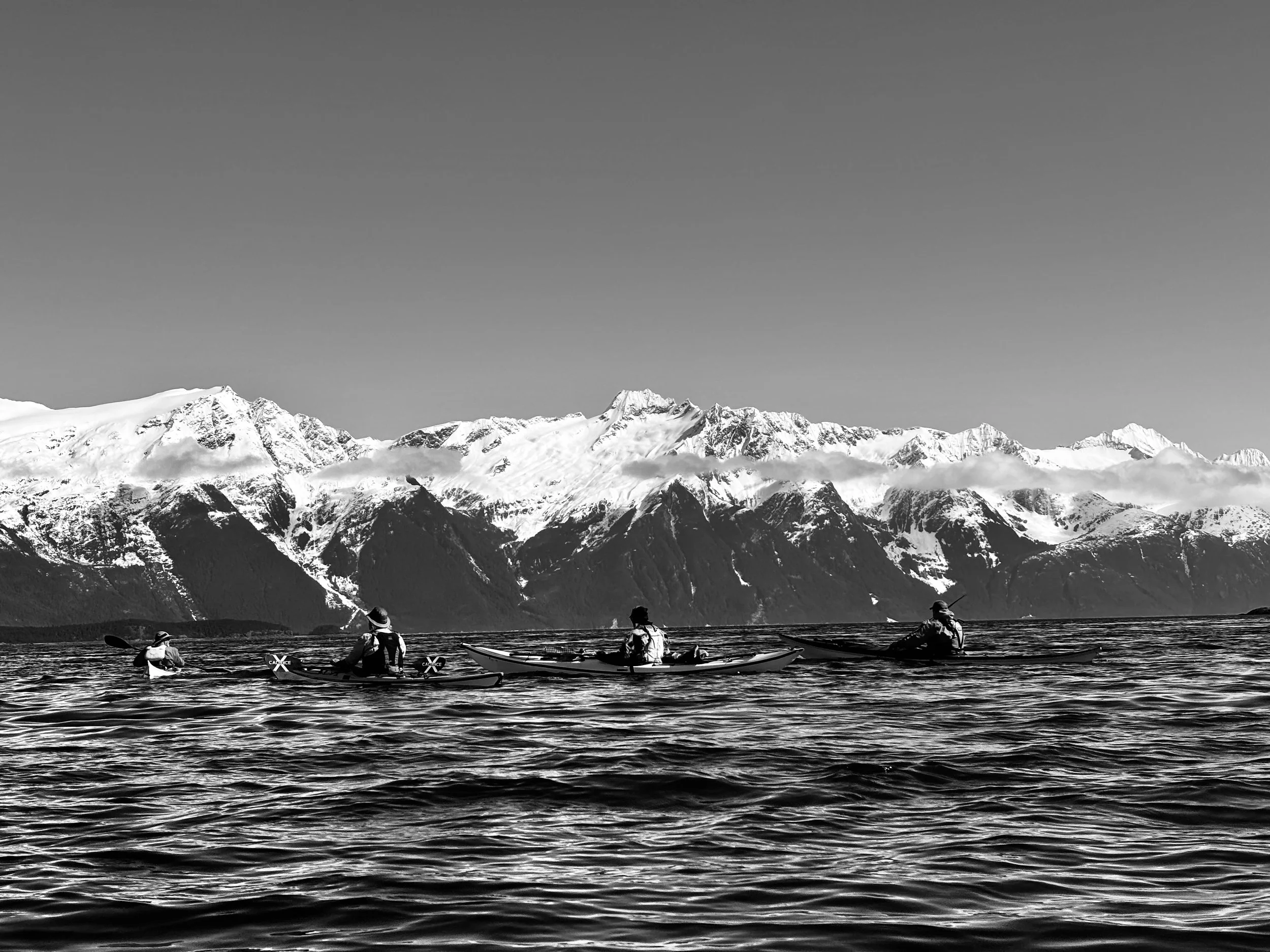
A month later, I find myself leading a group of six experienced river kayakers from Letnikof Cove. Their goal is ambitious: paddle the entire Inside Passage from Seattle to Skagway the following summer. This trip is their forerunner. Our just is to show them tides, crossings, and the practical realities of traveling through bear country.
The strongest paddlers quickly pull ahead. A high-school teacher drops behind.
"My arms are screaming at me right now," he says.
"Push with your feet."
Later, around camp, he recounts my advice.
"'Push with your feet,' she told me. STFU."
The group laughs.
The guests show little interest in rescue scenarios. What concerns them is weather, mileage, and wildlife. They care about making camp on a beach with a short carry and a foreshore of small rocks. They care about the porpoises surfing a ferry wake and the river otter snacking on a fish until an eagle arrives and attempts to steal it.
They care about seeing Alaska.
The previous summer I had traveled this same route under the watchful eye of a local guide. Waterfalls poured from hanging valleys carved by ice. Evening light moved across the Chilkat Range. Humpbacks blew along the deep cliffs before flashing their tails and disappearing beneath our hulls. The place seemed less like Alaska than a rough draft of the planet.
Now I was returning with a pencil. The landscape itself unchanged, but I had begun to read it differently. Freshwater here, lunch beach there, porpoises off this point, bears on that one. My rough draft was acquiring footnotes.
When we reach Juneau, rain falls in sheets. Everything is soaked.
We emerge from the water like seals flushed from a haul-out and gather beside a stranger's fire. Steam rises from wet fleece. Around us, the guests swap stories from our last crossing as though it happened years ago instead of hours.
I smile. Before he left, the Grey Heron offered perhaps the simplest definition of a guide: someone who's been there before.
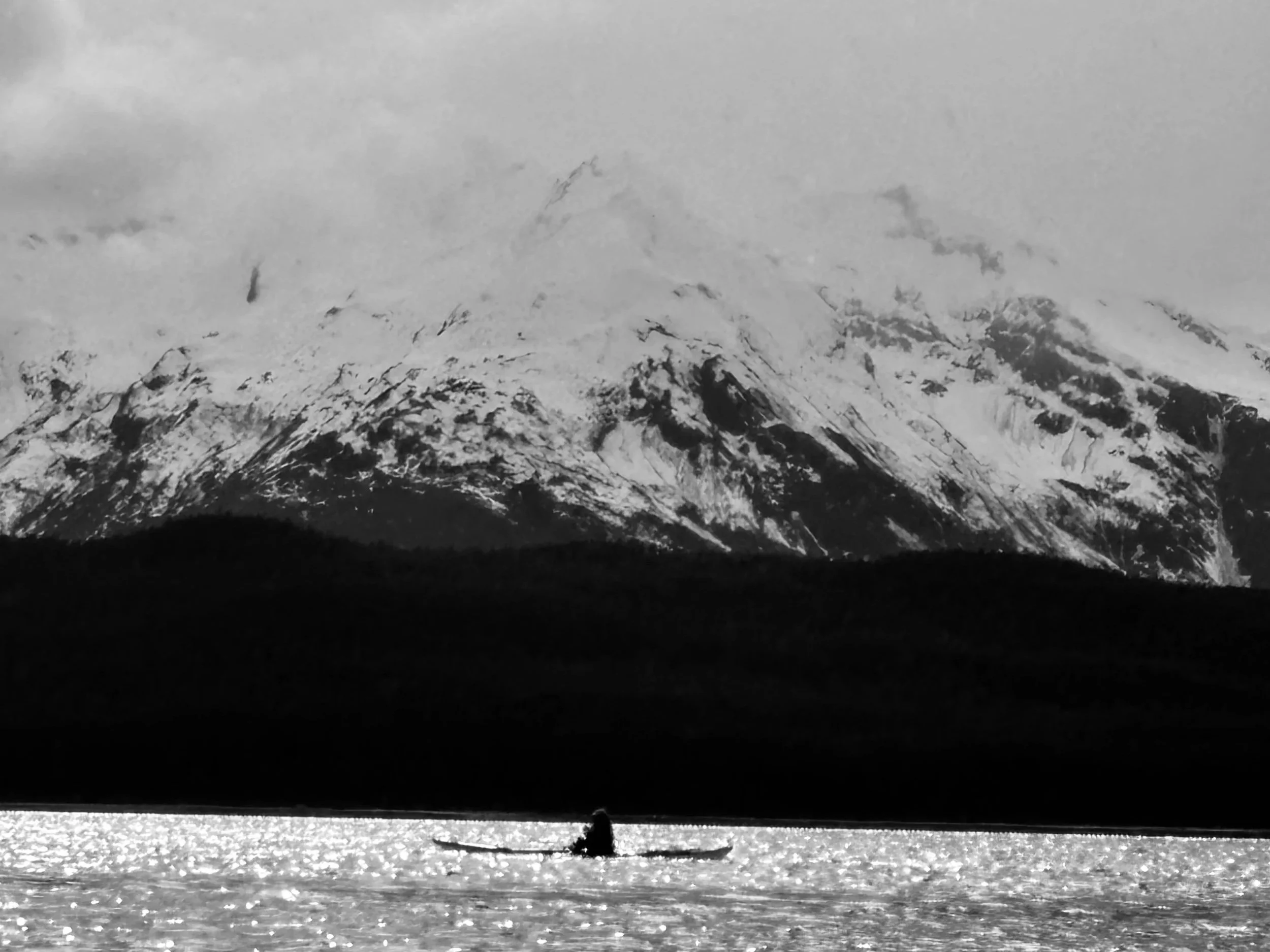
In The Land Before Time
I paddle from Haines to Juneau.
―
The avalanche-swept Chilkats rose above me, and the silver-grey saltwater of Lynn Canal stretched out below—a long exhale from summit to sea. I could feel the transition in my ribs as clearly as the dry bags clattering in the hatches of my loaner NDK Explorer.
It had taken two flights, a five-hour ferry, and months of saving and circling REI clearance racks to reach Haines, Alaska. First came the Southeast Alaska Sea Kayak Symposium; then a five-day expedition along the northernmost corridor of the Inside Passage. I understood immediately why it’s named that—inside. Protected waterways, yes, but also a corridor that pries open whatever you’ve managed to keep sealed. Miles through wilderness, and miles into your stowaway self.
In Southeast Alaska, rain doesn’t fall—it inhabits. It rises from the ground, settles into your bones, and claims you with quiet authority. Forty degrees here is not forty degrees in Colorado. I doubled baselayers, added a vest, swapped gloves. I accepted dampness as the price of admission into a domain ruled by whales and grizzlies.
On the morning of May 6, the journey stopped being weather forecasts intersecting lines on a chart. We left our luggage onshore and paddled off—just me, my seventy-six-year-old paddling partner, the Wolf, and our two unfussy, unflappable guides. The Wolf is compact and deliberate, the kind of paddler who wastes no motion. He rolls without drama, comes up blinking and expressionless, and settles back into a steady cadence that seems older than he is. Age shows mostly in the way he pauses before lifting his hull onto his truck. Once he’s in the boat, it’s gone. Sea kayaking suits him: a discipline where economy outperforms strength and longevity is earned stroke by stroke.
That first day was a reminder of what the body remembers when asked gently: the slip of the blade in cold water; the way engagement from the feet spares the shoulder later. Rain held as we moved past ululating scoters, sea lions rising like pylons from the dark, and pocket beaches arranged as if for a postcard. We pitched our tents on Shikoshi Island, devoured burritos, and collapsed by nine under a sky that never fully darkened.
While the guides scrubbed microscopic hints of food from pans down the beach—bear country etiquette—I climbed onto a rock, bear spray at my hip. Far enough to feel alone; close enough to still be found. The stillness was immense. Unexpectedly, a thought surfaced: I wish my mom could see this. The tears followed with no fanfare. Grief can feel dormant for years, then rise cold and quick as tidewater. The landscape was large enough to hold it; I let it.
The Chilkats are younger than the Rockies where I grew up and now winter. Lower, yes, but geologically restless—glaciers still softening their flanks, moraines drawing straight lines down to the sea. No roads, no lifts, just tectonics and time.
“That’s the Davidson Glacier,” the local guide said, pointing to a blue-brown cradle of ice high above. “In Muir’s time, it calved right into the water.”
As the sun slid behind peaks, a strange memory visited: an old VCR tape, an animated ridge line. The Land Before Time. I hadn’t thought of it in decades, but in that moment the echo was unmistakable—mother loss, the ache of separation, the long pursuit of a new valley. The film had carved something into me, a glacial striation I didn’t know I carried.
The next morning, a black triangle flitted at the surface. “Orcas,” our lead announced, already scanning. “Moving north. Do you see?” I did not. “There. Sometimes I swear people think I’m full of shit.”
Wind came up. Then died. Then returned. When my fingers throbbed with cold or when peeing through four layers felt like a complicated moral exercise, I whispered my private mantra: You chose this. You gave your time and money to be here.
But as the days wore on and the landscape wore me into it—like rivulets braiding down a mountainside—I wondered if I chose anything at all. Or if choice is only a polite name for current and countercurrent, a slack tide flipping direction without warning.
When the wind eased just enough for the guides to greenlight our crossing, I imagined every failure point: capsizing in the cold, soaking my tent and sleeping bag, blowing my angle and drifting toward the sea-lion rocks. You chose this, I repeated. But the water had its own ideas. We reached mainland, exhausted and relieved. The Wolf collapsed on the beach, still sealed into his PFD like a child who’d fallen asleep in a snowsuit.
We would need to make up at around twenty-five nautical miles the next day. While we ate tortellini, the lead looked out toward the channel and said, almost offhandedly, “I see sun on the horizon.” I took that into my tent like a borrowed talisman.
This summer I’ll guide not in Alaska but in Maine. Still, that trip handed me a horizon wide enough to hear the quiet part of myself say: This is why. Not because an inner adventurer needs indulging, but because something in me recognizes the utility of maps, bearings, crossings. Watching the guides hang tarps, call out bear-fence placements, decipher wind with a glance, I wondered which kind of guide I’ll become. Whether I’ll be good. Whether I’ll enjoy it.
When I was young, I wanted to be an “explorer.” The adults laughed, partly because I was a girl and it was the 90s, partly because modern life insists there’s nothing left to explore. But the explorers I loved—Frodo, Littlefoot—weren’t charting territory. They were leaving the familiar because home had changed shape beneath them.
The realization surfaced gently, like the mother humpback and calf we encountered on our third day. The mother exhaled first—tall, resonant. The calf followed, a smaller punctuation. They moved alongside us, unconcerned. A quorum of gulls marked the bait ball beneath. They knew we were there. They simply didn’t adjust themselves around our presence.
Maybe I am not seeking the thrill of new terrain but the permission to feel something primordial that has always been at the waterline—grief, wonder, memory—held long enough to come up for air.
The primordial is not ancient or remote; it’s as ordinary as dropping the skeg and turning downwind. In my boat, I am Littlefoot—small, unsure, moving through immensity anyway. Or like the fire our local guide attempted on our last night in Berner’s Bay—rain-soaked wood, no kindling, no chance. She kept at it. Then, the Wolf remembered the cracked cutting board in his hatch. We fed it to the flame. Finally, a spark held.
Many times the earth beneath me has shifted—divorce, death, breakups, pandemic. Sharp-tooths abound. But the “Great Valley” is not a destination; it’s a clearing, a pause, a space where grief exhales without demanding resolution.
Back in Juneau, our re-entry to time coincided with Mother’s Day. A holiday I’ve long treated like a bruise—best ignored. Brunches, flowers, the forced sentimentality of it all. But that day, moving through gift shops and trailheads dotted with mothers and daughters, I didn’t brace against anything. I just moved among them. I chose to be here, and found I could.
Maybe that’s what the Inside Passage teaches best. Not grandeur or grit, but access—to the remote places outside us, and the more remote ones within. Five days in the Alaskan backcountry loosened something that had been calcified in me for years. The grief didn’t vanish. It simply found room.
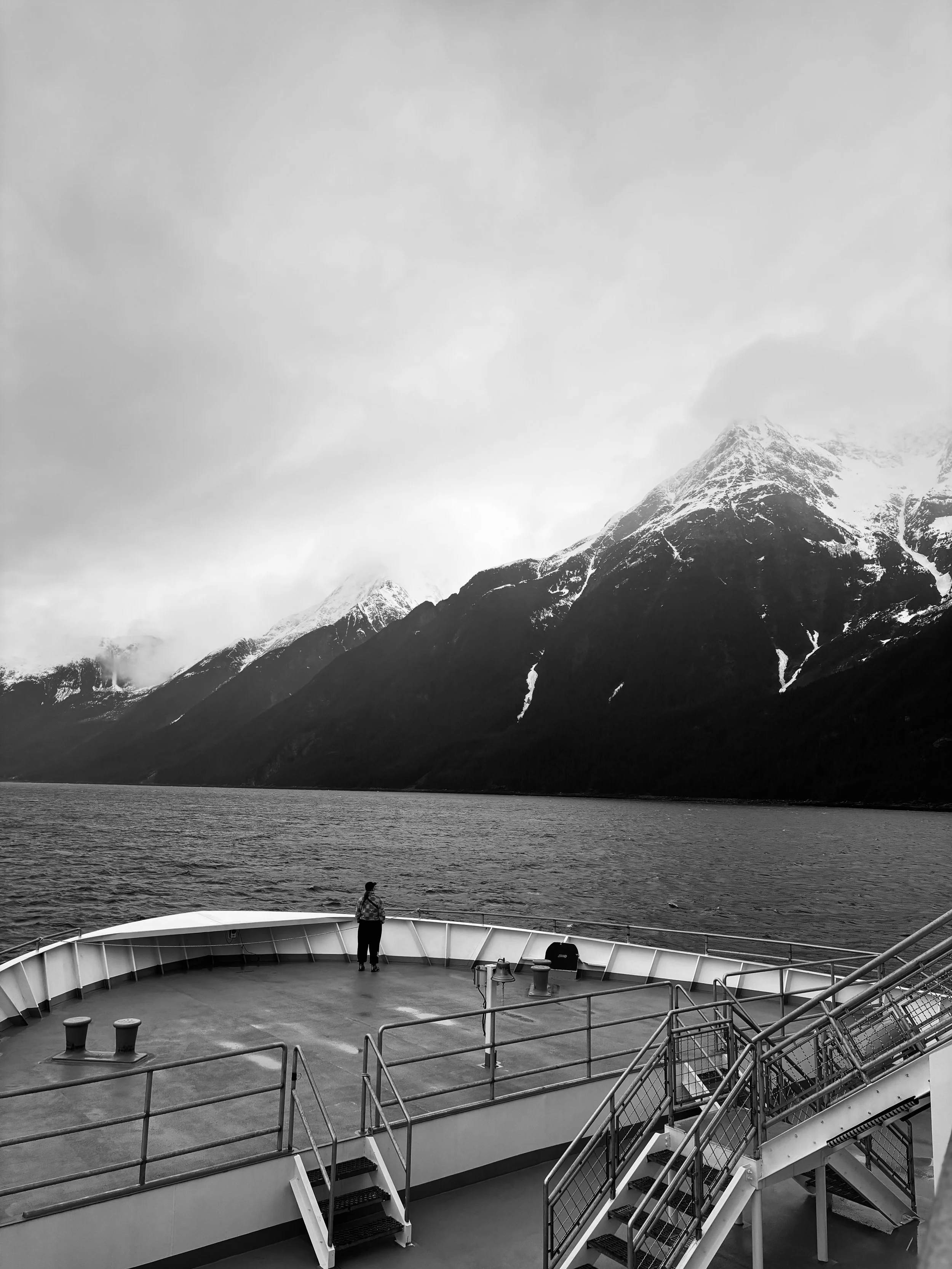
Southeast
Poems composed in Haines.
―
Poems composed in Haines.
Juneau
Rainforest welcome:
skunk cabbage brightens wet trails,
fog stitches the woods.
Marine Highway
Fjord currents ferry
skiers northbound for Skagway;
I will paddle back.
Haines
Hammer museum,
people exist between scars
of avalanches.
XtraTuf
Brown boots everywhere—
locals wear them like logic,
the tall ones only.
The Maul
Bear spray at my hip—
a constant, like a cell phone
with no reception.
Distillery
Whisky tastes of sea;
Alaskans drink like weather—
deep, sudden, stormy.