
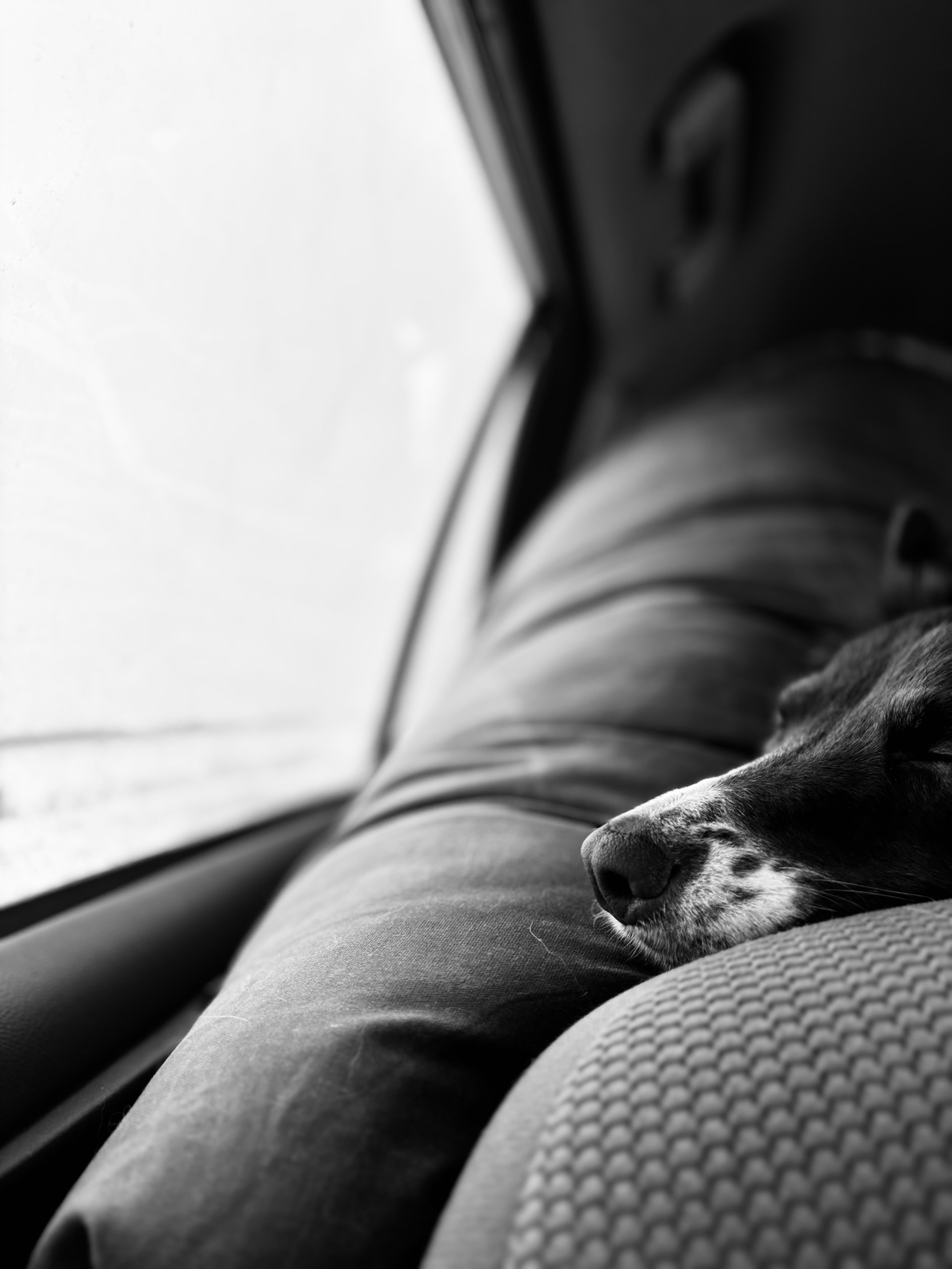
28 hr (1,873.3 mi) via I-80 E
My life in a box
at seventy miles an hour—
winter home recedes.
Poems composed on the drive from Colorado to New York:
Mile 1
My life in a box
at seventy miles an hour—
winter home recedes.
Mile 74
Road signs like old friends,
markers of seasonal life—
one journey, two homes.
Mile 562
Flatness, everywhere.
Time itself has leveled out—
must be Nebraska.
Mile 1487
Another podcast.
“Ohio,” GPS laughs—
nine hours to go.
Mile 1776
Road steams with insects;
even headlights feel soggy—
“welcome back, East Coast.”
In The Land Before Time
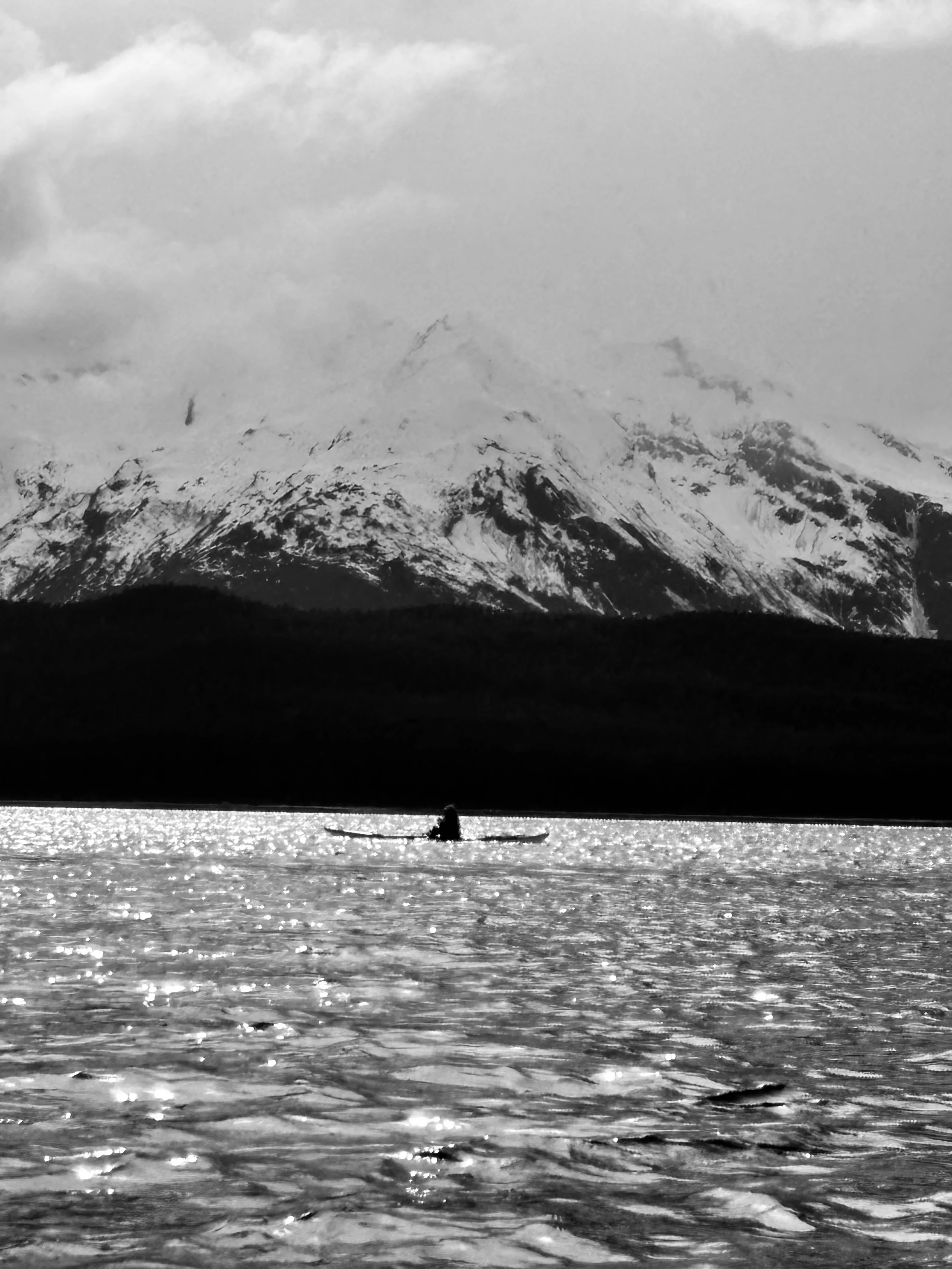
The avalanche-swept Chilkats rose above me, and the silver-grey saltwater of Lynn Canal stretched out below—a long exhale from summit to sea.
The avalanche-swept Chilkats rose above me, and the silver-grey saltwater of Lynn Canal stretched out below—a long exhale from summit to sea. I could feel the transition in my ribs as clearly as the dry bags clattering in the hatches of my loaner NDK Explorer.
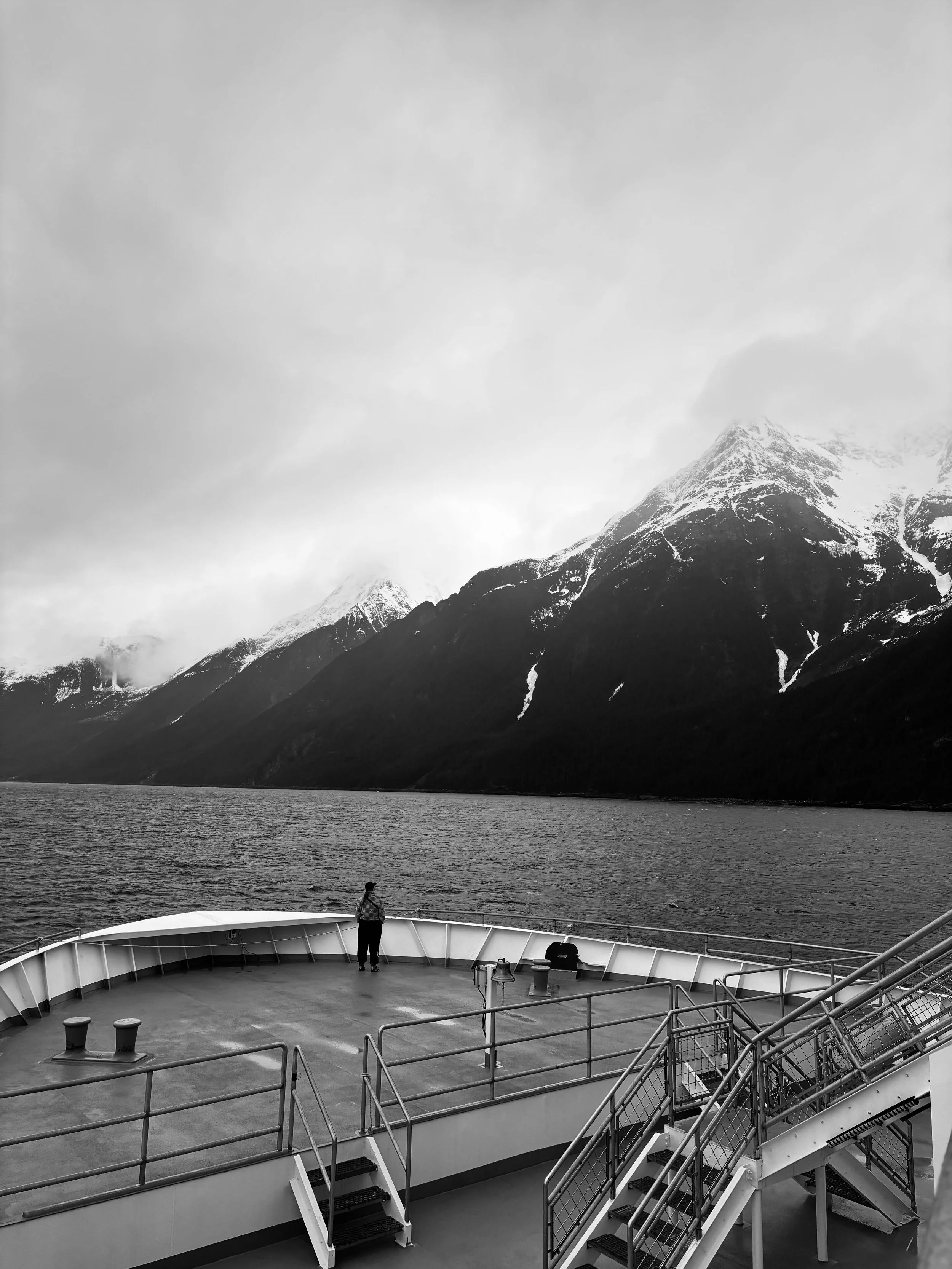
It had taken two flights, a five-hour ferry, and months of saving and circling REI clearance racks to reach Haines, Alaska. First came the Southeast Alaska Sea Kayak Symposium; then a five-day expedition along the northernmost corridor of the Inside Passage. I understood immediately why it’s named that—inside. Protected waterways, yes, but also a corridor that pries open whatever you’ve managed to keep sealed. Miles through wilderness, and miles into your stowaway self.
In Southeast Alaska, rain doesn’t fall—it inhabits. It rises from the ground, settles into your bones, and claims you with quiet authority. Forty degrees here is not forty degrees in Colorado. I doubled baselayers, added a vest, swapped gloves. I accepted dampness as the price of admission into a domain ruled by whales and grizzlies.
On the morning of May 6, the journey stopped being weather forecasts intersecting lines on a chart. We left our luggage onshore and paddled off—just me, my seventy-six-year-old paddling partner, the Wolf, and our two unfussy, unflappable guides. The Wolf is compact and deliberate, the kind of paddler who wastes no motion. He rolls without drama, comes up blinking and expressionless, and settles back into a steady cadence that seems older than he is. Age shows mostly in the way he pauses before lifting his hull onto his truck. Once he’s in the boat, it’s gone. Sea kayaking suits him: a discipline where economy outperforms strength and longevity is earned stroke by stroke.
That first day was a reminder of what the body remembers when asked gently: the slip of the blade in cold water; the way engagement from the feet spares the shoulder later. Rain held as we moved past ululating scoters, sea lions rising like pylons from the dark, and pocket beaches arranged as if for a postcard. We pitched our tents on Shikoshi Island, devoured burritos, and collapsed by nine under a sky that never fully darkened.
While the guides scrubbed microscopic hints of food from pans down the beach—bear country etiquette—I climbed onto a rock, bear spray at my hip. Far enough to feel alone; close enough to still be found. The stillness was immense. Unexpectedly, a thought surfaced: I wish my mom could see this. The tears followed with no fanfare. Grief can feel dormant for years, then rise cold and quick as tidewater. The landscape was large enough to hold it; I let it.
The Chilkats are younger than the Rockies where I grew up and now winter. Lower, yes, but geologically restless—glaciers still softening their flanks, moraines drawing straight lines down to the sea. No roads, no lifts, just tectonics and time.
“That’s the Davidson Glacier,” the local guide said, pointing to a blue-brown cradle of ice high above. “In Muir’s time, it calved right into the water.”
As the sun slid behind peaks, a strange memory visited: an old VCR tape, an animated ridge line. The Land Before Time. I hadn’t thought of it in decades, but in that moment the echo was unmistakable—mother loss, the ache of separation, the long pursuit of a new valley. The film had carved something into me, a glacial striation I didn’t know I carried.
The next morning, a black triangle flitted at the surface. “Orcas,” our lead announced, already scanning. “Moving north. Do you see?” I did not. “There. Sometimes I swear people think I’m full of shit.”
Wind came up. Then died. Then returned. When my fingers throbbed with cold or when peeing through four layers felt like a complicated moral exercise, I whispered my private mantra: You chose this. You gave your time and money to be here.
But as the days wore on and the landscape wore me into it—like rivulets braiding down a mountainside—I wondered if I chose anything at all. Or if choice is only a polite name for current and countercurrent, a slack tide flipping direction without warning.
When the wind eased just enough for the guides to greenlight our crossing, I imagined every failure point: capsizing in the cold, soaking my tent and sleeping bag, blowing my angle and drifting toward the sea-lion rocks. You chose this, I repeated. But the water had its own ideas. We reached mainland, exhausted and relieved. The Wolf collapsed on the beach, still sealed into his PFD like a child who’d fallen asleep in a snowsuit.
We would need to make up at around twenty-five nautical miles the next day. While we ate tortellini, the lead looked out toward the channel and said, almost offhandedly, “I see sun on the horizon.” I took that into my tent like a borrowed talisman.
This summer I’ll guide not in Alaska but in Maine. Still, that trip handed me a horizon wide enough to hear the quiet part of myself say: This is why. Not because an inner adventurer needs indulging, but because something in me recognizes the utility of maps, bearings, crossings. Watching the guides hang tarps, call out bear-fence placements, decipher wind with a glance, I wondered which kind of guide I’ll become. Whether I’ll be good. Whether I’ll enjoy it.
When I was young, I wanted to be an “explorer.” The adults laughed, partly because I was a girl and it was the 90s, partly because modern life insists there’s nothing left to explore. But the explorers I loved—Frodo, Littlefoot—weren’t charting territory. They were leaving the familiar because home had changed shape beneath them.
The realization surfaced gently, like the mother humpback and calf we encountered on our third day. The mother exhaled first—tall, resonant. The calf followed, a smaller punctuation. They moved alongside us, unconcerned. A quorum of gulls marked the bait ball beneath. They knew we were there. They simply didn’t adjust themselves around our presence.
Maybe I am not seeking the thrill of new terrain but the permission to feel something primordial that has always been at the waterline—grief, wonder, memory—held long enough to come up for air.
The primordial is not ancient or remote; it’s as ordinary as dropping the skeg and turning downwind. In my boat, I am Littlefoot—small, unsure, moving through immensity anyway. Or like the fire our local guide attempted on our last night in Berner’s Bay—rain-soaked wood, no kindling, no chance. She kept at it. Then, the Wolf remembered the cracked cutting board in his hatch. We fed it to the flame. Finally, a spark held.
Many times the earth beneath me has shifted—divorce, death, breakups, pandemic. Sharp-tooths abound. But the “Great Valley” is not a destination; it’s a clearing, a pause, a space where grief exhales without demanding resolution.
Back in Juneau, our re-entry to time coincided with Mother’s Day. A holiday I’ve long treated like a bruise—best ignored. Brunches, flowers, the forced sentimentality of it all. But that day, moving through gift shops and trailheads dotted with mothers and daughters, I didn’t brace against anything. I just moved among them. I chose to be here, and found I could.
Maybe that’s what the Inside Passage teaches best. Not grandeur or grit, but access—to the remote places outside us, and the more remote ones within. Five days in the Alaskan backcountry loosened something that had been calcified in me for years. The grief didn’t vanish. It simply found room.
Southeast
Rainforest welcome:
skunk cabbage brightens wet trails,
fog stitches the woods.
Juneau
Rainforest welcome:
skunk cabbage brightens wet trails,
fog stitches the woods.
Marine Highway
Fjord currents ferry
skiers northbound for Skagway;
I will paddle back.
Symposium
Truck with boats pulls in—
Hera finds me on the pier,
paws parting the rain.
Haines
Hammer museum,
people exist between scars
of avalanches.
XtraTuffs
Brown boots everywhere—
locals wear them like logic,
the tall ones only.
The Maul
Bear spray at my hip—
a constant, like a cell phone
with no reception.
Distillery
Whisky tastes of sea;
Alaskans drink like weather—
deep, sudden, stormy.
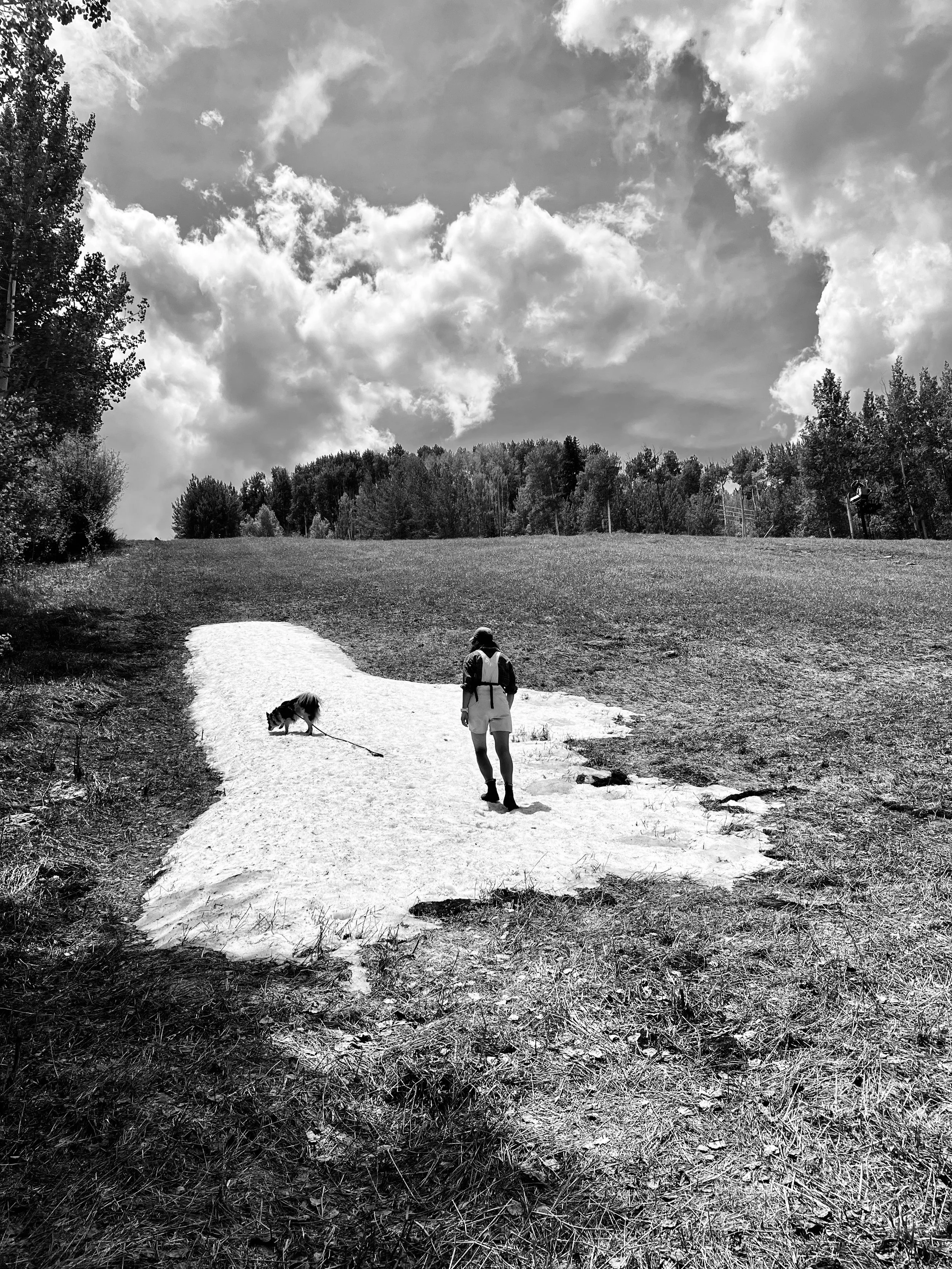
Mud Season
Ski school is closed.
Ski school is closed:
Closing Day
Tourists clear out fast.
Now the mountains hum with mud—
just the way we like.
Cheap Dinner
Snow tires still on.
Main Street maître d calls out:
“Half off for locals!”
Scene Change
Rivers rise and run—
an idea caught in between.
The thaw rushes on.

On Finitiation
By April, the sun has developed an agenda. Breckenridge’s lifts keep turning, but it’s mostly for show; chairs pass overhead like empty gondolas in a diorama.
By April, the sun has developed an agenda. Breckenridge’s lifts keep turning, but it’s mostly for show; chairs pass overhead like empty gondolas in a diorama. A film of windblown dust settles over the remaining snowpack, dulling its reflectivity and speeding its retreat. Down in the North Gondola lot, meltwater feels out the terrain with the patience of a surveyor, committing to the lowest routes with increasing confidence. Birdsong resumes its looped soundtrack. The mountain, deprived of school holidays and long weekends, begins its yearly slide toward irrelevance.
Ski school ends the way snow does—grain by grain. The J1s disappear first. Part-timers fold themselves back into their other lives. The rituals loosen: less chatter in the locker room, fewer dad jokes at line-up, a general sense of people backing away from the season without fully turning their backs on it. Someone’s Bluetooth speaker plays rock music at a volume that implies finale. Outside, bulldozers idle next to rows of early-season mountain bikes. Our locker room building will be razed as soon as we vacate. No one is sentimental enough to stop it; no one is immune enough not to notice.
Guests often ask, “What do instructors do in the off-season?” Most of us offer the old punch line about taking the moguls inside for the summer.
The first week of May feels illicit. No uniform, no hot chocolate vouchers, no obligation to pretend enthusiasm for a blue run in flat light. There’s a short-lived pleasure in domestic tasks: laundry, neglected mail, the rediscovery of sandals. Then the silence stops being restorative and becomes simply silence. By June, many instructors have drifted into a low-wattage depression—nothing acute, just a sense that the structure that held the winter in place is no longer load-bearing.
This drift can look like anything: minimum-wage summer jobs, halfhearted travel, or an earnest attempt to “catch up on life,” which typically collapses into scrolling through photos of powder days we already lived. Writing assignments returned to my inbox, and I met them with escalating reluctance. My dog became the only creature with a clear agenda. The off-season had a way of exposing all the seams winter had hidden.
The cognitive dissonance was consistent: without skiing, I felt reduced to the version of myself I’d paused in October, someone who didn’t feel entirely accurate anymore. Two identities rubbing together with just enough friction to blister.
I eventually understood that it wasn’t skiing I missed so much as teaching—its focus, its tempo, the way it stabilizes a day. So I followed that feeling toward water.
Whitewater, at first. Students practicing wet exits in a reservoir the color of tea; then peel-outs, ferries, a few tame rapids. On the Colorado, with a line of novice paddlers bobbing behind me, some internal gear re-engaged. Whatever part of me had belonged to winter recognized the structure: a moving medium, a technical vocabulary, the need to make good decisions in flux. The boundary between seasons, previously so rigid, began to dissolve.
It turned out the off-season wasn’t “off” at all. It was a misnomer—what felt like absence was simply an unclaimed form of the same work.
Ski instructors love to talk about transition—the hardest part of a turn. It’s often called “finitiation,” the moment between the old turn and the new, where direction and pressure reassign themselves and the skier pretends the change is smooth. Most of the time, it isn’t. The body knows it’s a hinge point, a brief negotiation before committing.
The end of the ski season functions the same way. April memorizes meltwater the way December studies snowpack. Nights refreeze; days undo it. Creeks rise and recede in a single afternoon. Water returns to its previous channels, records its edits: a shifted stone, a revised edge, a small rebellion in direction.
Nothing is lost, exactly. It just becomes something else.
This summer, I’ll trade the river’s turbulence for the abstraction of the Maine coast. Longer boat, broader water, fewer immediate hazards but more consequences when they happen. I’ll steer clients around lobster buoys, toast bagels over driftwood, check the winds with the same reverence ski instructors reserve for snow forecasts. The job description doesn’t really change: read the conditions, place the craft where it needs to be, anticipate the forces that want to move you.
Snow is water; water is weather; weather is work.
So, what do ski instructors do in the off-season? We finitiate, in the truest sense of the word. Sometimes awkwardly. Sometimes with fluency. Often with a brief, dull ache of disorientation and a touch of weight gain. We wait for the new medium to reveal itself, then move through it as best we can.
The lift stops. The water keeps going. And eventually, so do we.
The Longest Lap
Easter weekend arrives with its half-priced ski-in/ski-outs. The Front Range’s short attention span has migrated—predictably—to bikes, bouldering pads, and early patio culture.
Easter weekend arrives with its half-priced ski-in/ski-outs. The Front Range’s short attention span has migrated—predictably—to bikes, bouldering pads, and early patio culture. But winter, for once, refuses to exit on schedule.
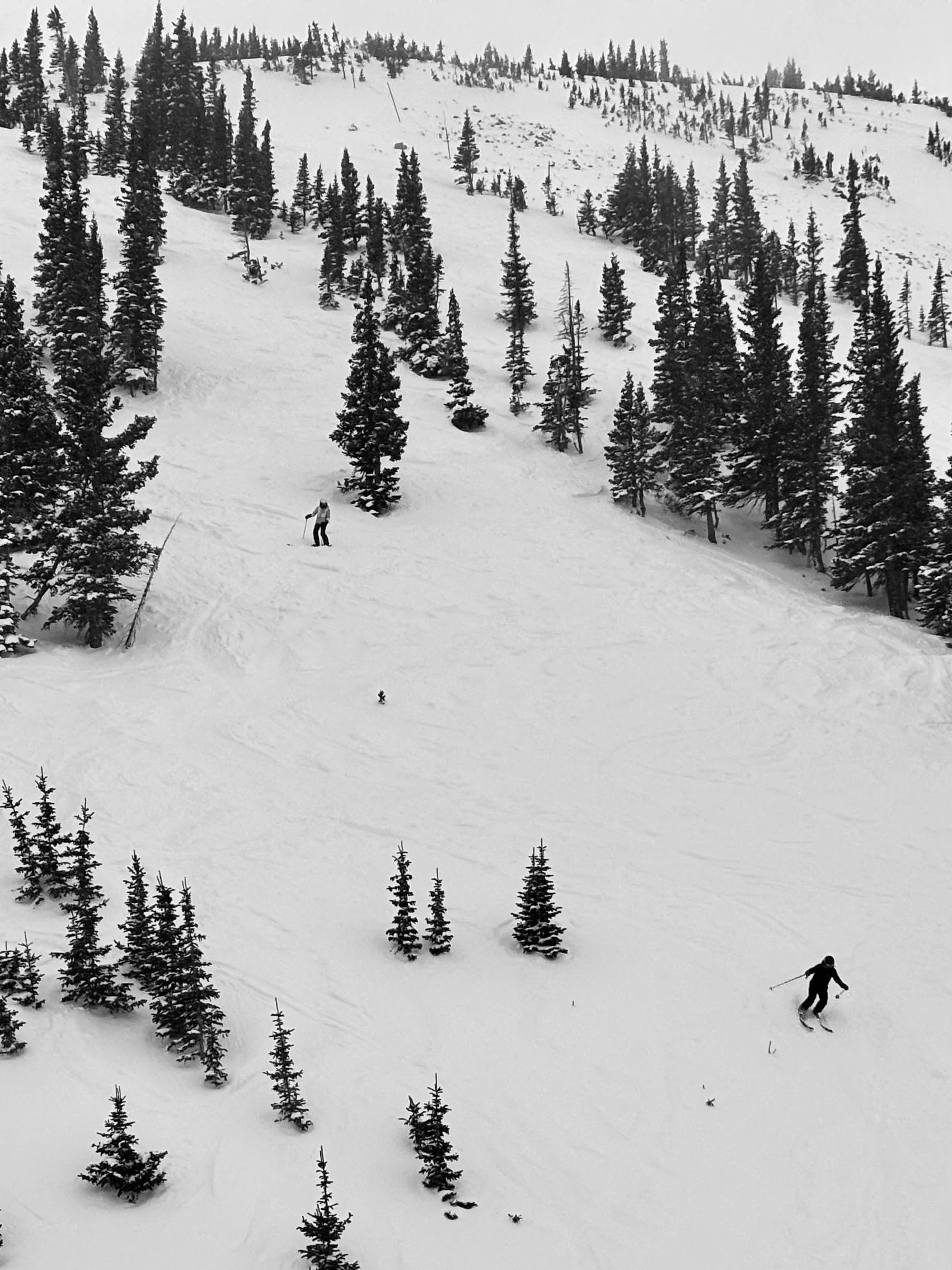
In twenty-four hours, temperatures swing from the fifties to a foot of powder, the kind of late-season storm that briefly restores everyone’s faith. My client and I head toward the T-bar, the most direct route to the soft, untouched alpine. A patroller intercepts us with the neutrality of someone delivering routine bad news.
“Motor’s shot,” he says. “Waiting on a part. Could be a week.”
The translation is obvious: the shortcut is gone. The powder is obtainable—just not conveniently. What should have been a five-minute tow becomes a three-lift commute through the mountain’s receding infrastructure. The snow is heavy. The legs are tired from a winter’s accumulation of miles, not just today’s.
It would be easy to say, Next time. But the calendar doesn’t allow for next times anymore.
Lately I find myself thinking less in “seasons” and more in migrations. Skiers move without calling it that—toward storms, toward work, toward some temporary version of home. Wildlife is more transparent: Beaver Creek closes early to keep its elk undisturbed; in Maine, where I’m headed next, alewives will soon push upstream to spawn. This time of year, everyone is rearranging themselves according to some internal barometer.
For instructors at Peak 8, the locker room has long been a wintering ground—a place to dry boots, stash snacks, and conduct the low-level social rituals that keep the cold months moving. This year, its tenure is over.
“Everything out by end of day,” a supervisor calls down the aisle. One cubby is missing its door; its former occupant removed it, sentimentally or impulsively, to take home. “They’re coming with pickaxes Monday.”
The dismantled locker and the broken T-bar share a logic. We occupy patterns—routes to powder stashes, preferred lines through bumps, a familiar spot to buckle boots—until the mountain reclaims them. Some changes are announced; others simply happen.
My client and I thread our way through mid-March crowds on a mountain that is already half-closed. With all the detours, our lifts multiply. The extra time above snow makes conversation unavoidable. After two seasons of skiing together, I realize we’ve quietly crossed from professional rapport into friendship. At the top of Imperial, we get what we came for: one last descent through the thick remnants of winter on Whale’s Tail and Horseshoe Bowl. The lap is long and inelegant, the kind that deters casual skiers. For those willing to make the detour, solitude rewards the stubborn.
Back in the locker room, I compare notes with another instructor, both of us scraping wet snow from our bases, trying to assess how many rocks we’ve struck.
“Find anything good in the Easter egg hunt?” she asks.
“All the rocks,” I say. “Every single one.”
We laugh, but it’s a placeholder. What follows is not comedy but packing: goggles, gaiters, lesson books, handwarmers, sunscreen. The practical inventory of a season that, in a matter of hours, will be erased by construction equipment.
The comparison to the puffins of Eastern Egg Rock is literal enough to resist metaphor, but the parallel persists. Once their nesting ground disappeared, they stopped returning. Decades later, after a complicated, improbable intervention, they came back. Home, it turned out, was not a fixed location but a pattern that could be relearned.
On my first visit to Midcoast Maine two autumns ago, I boarded the Audubon puffin boat as a tourist with no agenda beyond seeing something small and improbable. I didn’t know then that I’d be working there as a sea-kayak guide, paddling the same waters the puffins reclaim each summer. What felt incidental turned out to be directional.
With the Peak 8 locker room headed for demolition, the symmetry is hard to ignore. One habitat disappears; another emerges before you realize you’ve begun inhabiting it.
Ski season fades; paddling season stirs. The uniform is already in a heap by the door. It shouldn’t feel like an ending, but endings rarely ask permission.
Outside, a western meadowlark settles in an aspen along the Blue River. It’s an understated herald—birds, at least, don’t dramatize transition. Migration isn’t linear. It loops, fragments, and occasionally doubles back. The body learns the pattern first; the mind takes longer to accept that movement, not permanence, is the closest thing to home.
Spring Break
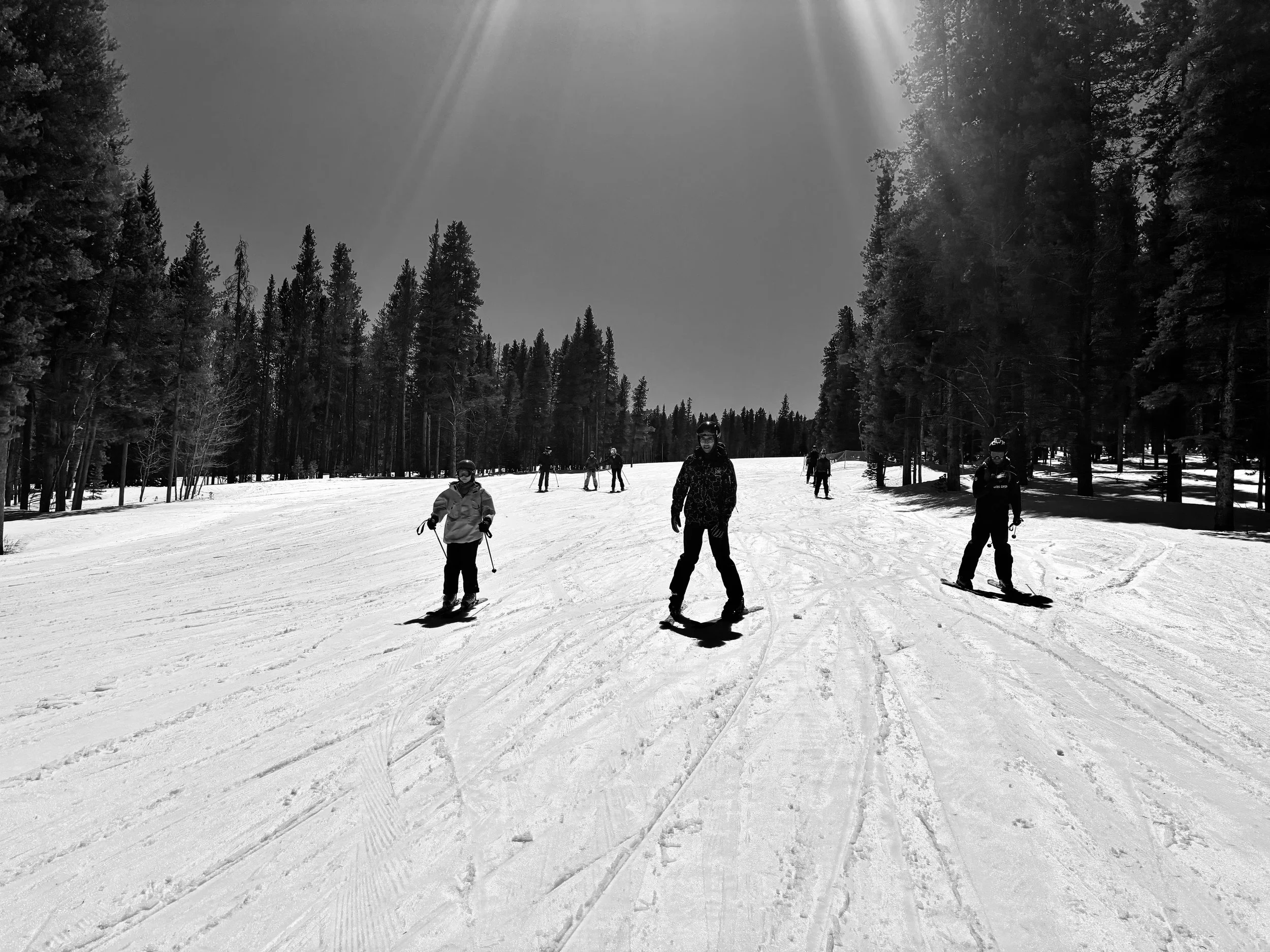
Most of March.
Most of March:
Never-Evers
Magic carpet hums—
never-evers in neon
skitter like pennies.
Texas
Texas Week arrives:
time to ski fast, have some fun—
howdy, altitude.
College Kids
Skiing bikinis—
twenties spill toward the future
like snowmelt downhill.
4:00 To Town
Après hum rises—
music drifting up the slopes
like heat off spring snow.
Ski The Void
For most skiers, visibility mediates reality. It draws the line between a transcendent powder day and a whiteout in which sky and snow fuse into a single, horizonless field.
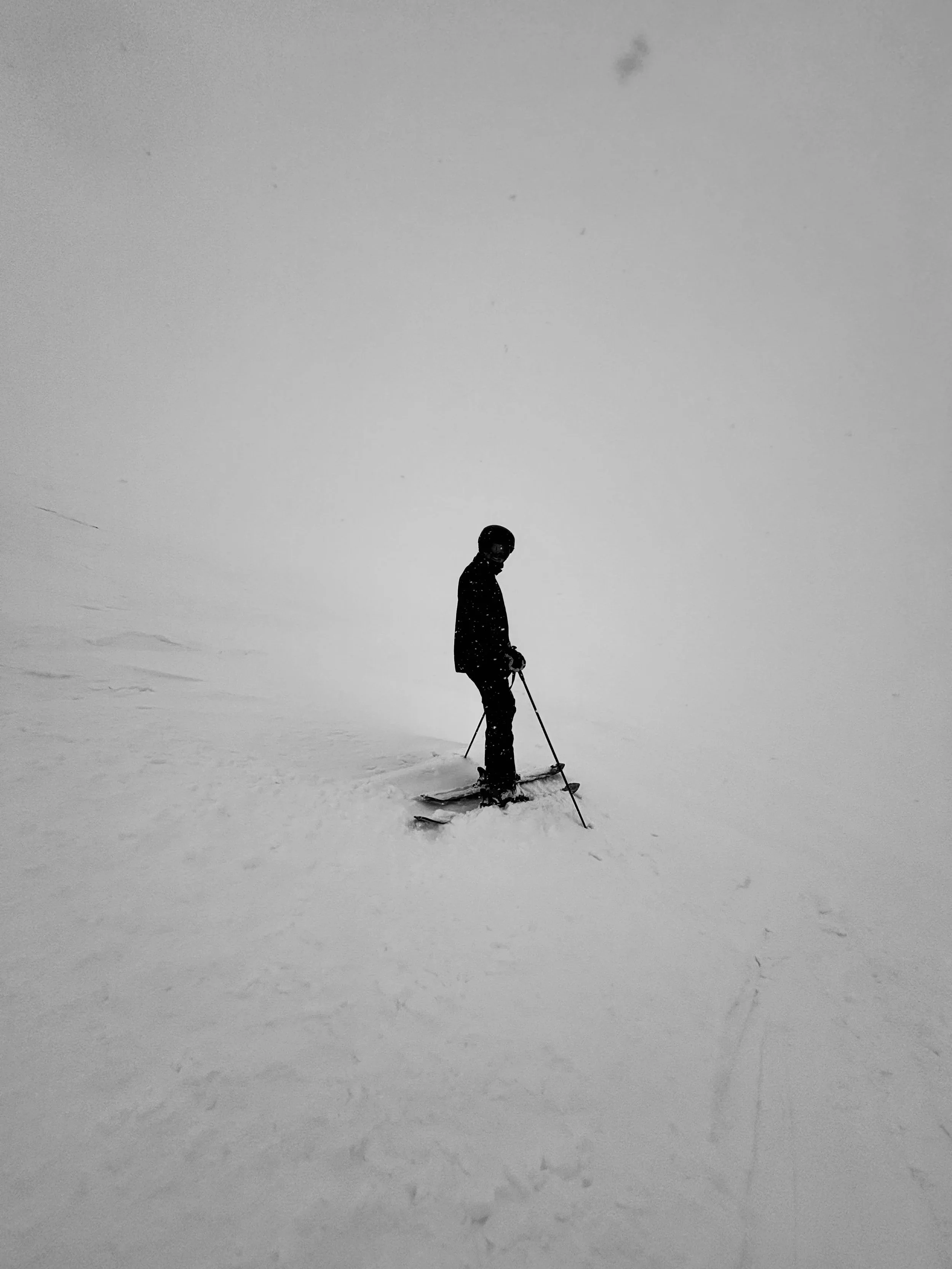
For most skiers, visibility mediates reality. It draws the line between a transcendent powder day and a whiteout in which sky and snow fuse into a single, horizonless field. Above treeline at Breckenridge, this happens often: forty-mile-per-hour winds lift ice crystals into the air, flattening light until even the chairlifts vanish. Perspective buckles. You feel motion while standing still, or stillness while moving. Skiing becomes a form of touch—performed with the feet, interpreted by nerve.
A teenager from Brooklyn had come for the above-treeline expanse, but visibility kept insisting otherwise. After a morning of hiding in the trees, he and I decided to try Imperial Bowl. Whale’s Tail was closed by a patrol rope, so we aimed for George’s Thumb, a face known for its rocks and its indifference to confidence.It was named for the man who first scouted it, George, who attempted to document his discovery and instead photographed his own gloved thumb.
We slid past the gate and stepped into nothing. No slope. No sky. Just a depthless gray. For a moment, I wondered if I’d misjudged the situation: a city kid, a burning-out guide, a vanishing world. But he stood patiently behind me, waiting for my instructions.
“One turn at a time,” I shouted. “Follow me closely.”
I nudged one ski downward, then the other. A single turn became a second, then a third—slow, tentative movements through the blank. Then a rock appeared: not a threat but a reference point. Another followed. We used what we’d usually avoid. Eventually the fence above North Bowl emerged, and the visible world returned.
Behind us, the featureless expanse resumed its silence. The kid yipped with victory.
Whiteouts are rarely described accurately. They’re not metaphors; they’re conditions. Yet skiing them strips away distraction in a way that makes metaphor tempting.
A few days earlier, on the T-Bar, a longtime client and I had talked about religion—not belief so much as the frameworks people use when certainty is scarce. Hegel’s phrase from the Phenomenology, “spirit is a bone,” rose up from memory: Geist locating itself in the physical. In the void of George’s Thumb, the idea shed its academic tone. Spirit wasn’t lofty. It had weight, bindings, and edges. It was a body figuring out where the next turn might land.
Philosophy has many voids. Buddhism’s shunyata—emptiness without nihilism. Existentialism’s lack of inherent meaning. Physics’ vacuum. Literature’s dread and absurdity. But skiing the void is different. It is not conceptual. It is immediate. Everything extraneous falls away. There is only the angle of your skis, the texture underfoot, the willingness to commit to a space you cannot see.
Nietzsche’s well-worn line about the abyss holds that it gazes back. Had he dropped into a whiteout, he might have added that the abyss also clarifies. Not grandly, but practically. It tells you what is actually under you. It strips your attention to its essentials. It edits the adjectives of the world until only verbs in the present tense survive.
We reached the bottom without incident. The boy found his mother; I found the locker room. But the void lingered after visibility returned. The sensation of moving through something that erased you even as you moved within it leaves a faint residue—an awareness that reality is more permeable than it seems.
It doesn’t take renunciation or retreat to recognize this. The mountains provide their own thresholds—spaces where perspective collapses and must be rebuilt turn by turn. You exit the void, but the recalibration lasts longer than the descent.
The void is always there, even when unseen, waiting for the next blizzard. And so, improbably, are we.
Self-Arrest
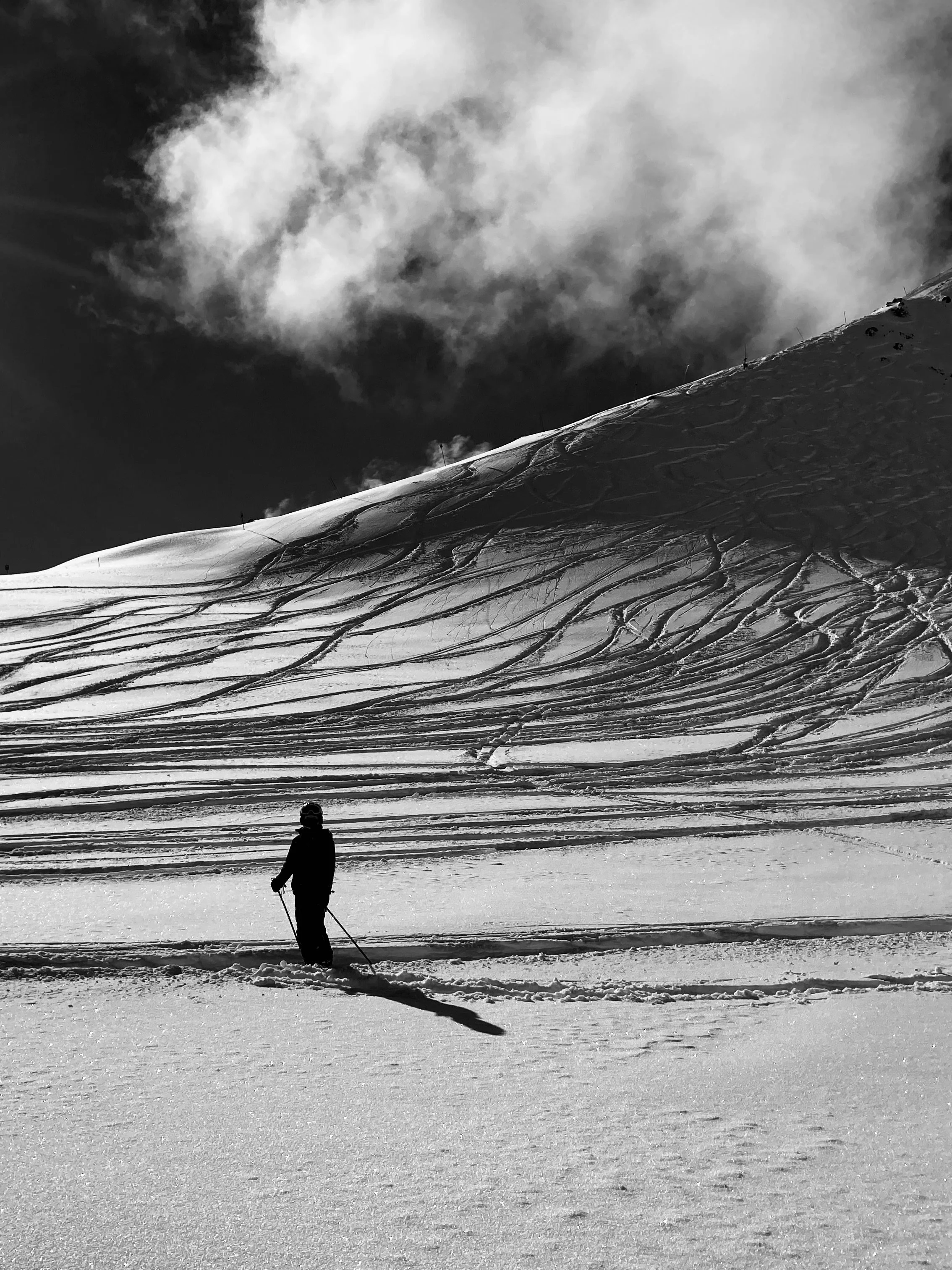
At the lip of Horseshoe Bowl, my eight-year-old student stops moving. She’s a sparrow-sized figure against a corniced ridge at eleven thousand feet.
At the lip of Horseshoe Bowl, my eight-year-old student stops moving. She’s a sparrow-sized figure against a corniced ridge at eleven thousand feet, where wind carves the snow into permanent waves and ptarmigan tracks vanish overnight. Below us, a north-facing pitch drops sharply—her first double black.
She’s skied with quiet confidence all week, but this slope shifts the terms of the conversation. She leans forward, a small question mark, and gravity answers before I do.
She starts well enough, then her hips drift behind her heels. A ski clips a wind-formed mogul. One binding releases, then the other. She tumbles—pink helmet blinking in the white—until a mound of sun-softened snow interrupts the slide. The mountain stops her eventually, as mountains do. The question is always how, and whether we get a say in it.
By the time I reach her, she’s upright, breathing in short, surprised bursts. Her goggles are crooked; her tears are not.
Another spring, in the Lake Chutes, I watched two twelve-year-olds slip nearly four hundred feet down a forty-degree pitch. The weather had turned abruptly—clouds dropping low, erasing the terrain, converting the familiar into a blank page. Fear spread faster than instruction. One boy slid first. The other stepped forward to help, and the lip gave way beneath both.
What saved them wasn’t luck. It was technique—imperfect, improvised, enough. Elbows, knees, shoulders: small points of friction interrupting gravity’s plan. They had practiced self-arrest before. Not gracefully, but deliberately. By the time the slope relented, they were upright and waving.
The difference between those falls—my young skier caught by the mountain, the boys catching themselves—is the difference between luck and agency. Skiers talk a great deal about control, though the artistry of skiing lies in letting go.
Self-arrest is not glamorous. It’s procedural. You accept that you can’t prevent every slide, so you learn how to inhabit the slide: soften, angle, dig, interrupt. You won’t stop it entirely; that isn’t the job. The job is to reshape its trajectory before the trees appear.
Versions of this exist off snow. A job collapses. A relationship implodes. A diagnosis redraws the perimeter of a life. People imagine resilience as refusal. More often, it’s timing—knowing when to meet momentum, when to oppose it, and how to slow it by degrees.
My student gathers her equipment, breath steadier now, and clicks in again. I tell her what many instructors never say aloud: fall better. I don’t tell her how to prevent another slide, but to meet it with intention.
She drops in. She falls again. This time she digs in—an elbow, a knee—and stops herself halfway down. A small, deliberate interruption. No tears.
At the bottom, we look back at Horseshoe Bowl curving upward like a parenthesis—holding what just happened without defining it. The terrain hasn’t changed. She has.
“Fall better” sounds like ski jargon, but it’s something else entirely. It’s what remains after strength and nerve ebb with age, after the confidence of good conditions becomes a rarity. It’s the ability to place a small wedge of agency between yourself and whatever is accelerating beneath you. Not mastery—just influence.
Self-arrest, in practice, is almost never dramatic. It’s incremental: a shift of weight, a differently placed arm, the refusal to go rigid at the wrong moment. Children learn it on snow; adults relearn it everywhere else. A promotion evaporates. A relationship implodes. Real estate gives way. The instinct is to brace or deny the fall. But the quieter, steadier instinct—the one that comes with practice—is to make enough contact with gravity to soften the outcome by degrees.
From the chairlift, the bowl already looks less severe. Her fall has contracted into the mountain’s larger grammar, one clause among thousands. By tomorrow, it will be a chapter; in a week, a footnote. But her body will archive the lesson: a template for how to meet a sudden drop with attention rather than abandon.
Powder Power
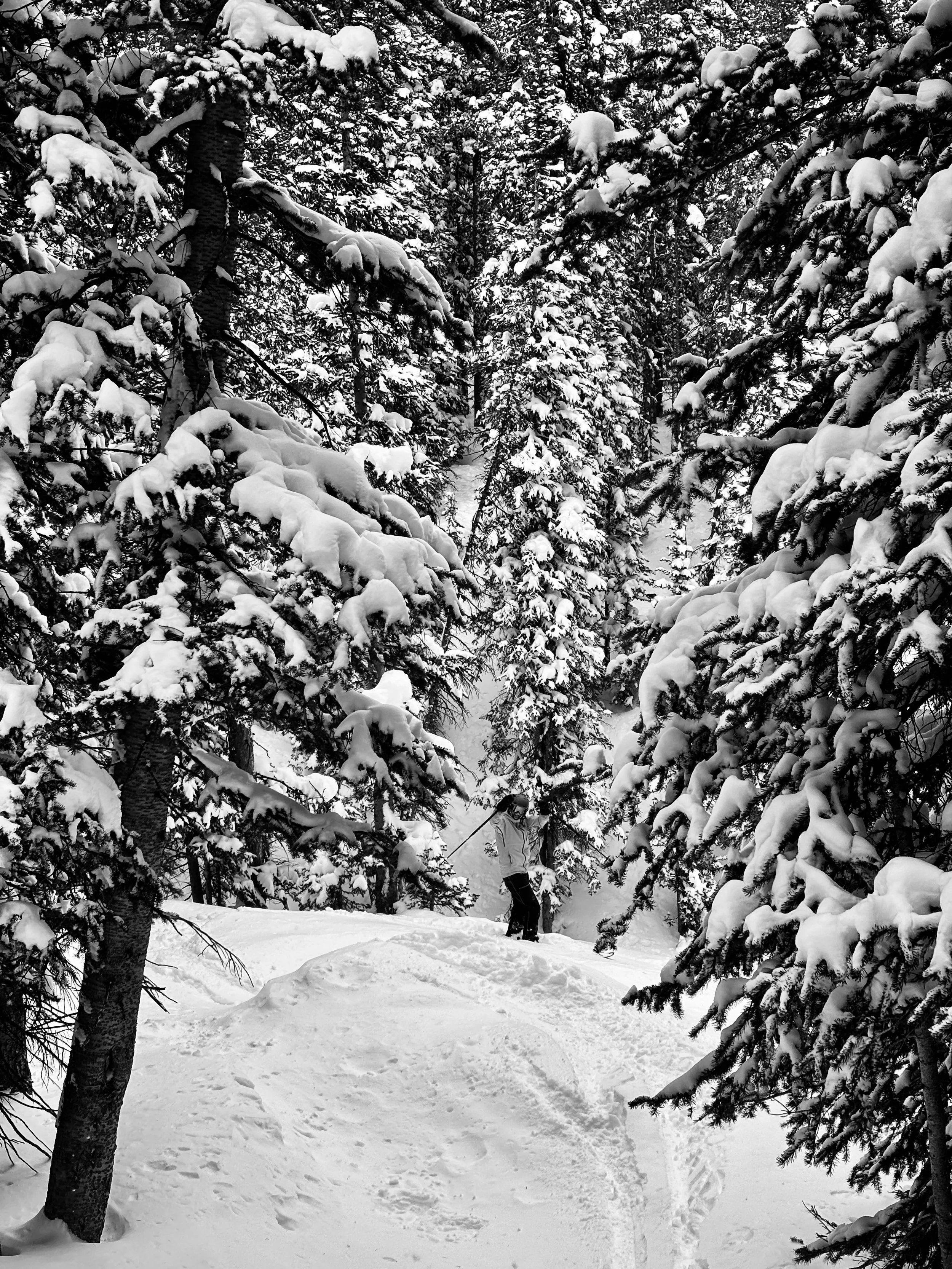
Colorado winters once began in September. Early season storms blew in regular as a mother’s exasperation: flurries at first, then fury overnight.
Colorado winters once began in September. Early season storms blew in regular as a mother’s exasperation: flurries at first, then fury overnight. Bluebird morning afters-glittered with fresh powder.
In my foothills neighborhood, the season’s first snowstorm conclaved its own small ceremony: kids slipping out in sneakers with bald treads to slide around the unplowed asphalt; adults excavating shovels or cursing snowblowers that hadn’t been touched since April. Snowmaking guns, even at the fanciest resorts, sat idle—embarrassing, almost, in the face of winter’s self-sufficiency.
Back then, the peaks kept their whites year-round, veils dropping all the way to the valley floor. We believed winter could take care of herself. And she did. Now she arrives like a transfer student long after the semester has begun—November, if we’re lucky.
Snow holds memory the way the subconscious does: in layers. If you know how to read it, the record is plain.
Early season now stretches across too many cloudless forty-degree days. Whispers circulate—worst December in twenty years—as lessons are canceled, and resorts post strategic crops on social media to catfish the thin cover. In-bounds snowpack grows from the bottom up: fragile facets forming a man-made hoar layer, a kind of rot beneath a cosmetic surface. The “white ribbon of death,” once a joke about the East Coast, is no longer a punchline. Even the ribbon frays.
C., one of my favorite students, arrived as she always does—on time, in her red jacket that flashes against the high-alpine white like a cardinal. This year, the “white” was more aspiration than fact. Roped-off fields of rock barred her favorite lines. She made the best of it until the disappointment began to show. Surveying the sad bumps under E Chair, she sighed as if looking at something spoiled.
“Let it snow, let it snow, let it snow…” she sang, mostly to herself, mostly out of boredom.
But the atmosphere seemed to hear her. A quick shake of flurries answered. On the next lap she tried again; the sky obliged with another faint shimmer. By the following day, the pattern repeated. We decided, unscientifically but happily, that she was communing with the weather. A mythology emerged: part Norse, part Disney. Ullr missing. Elsa calling him back. Their reunion would bring the storm.
We never named the villain.
February has been a string of weak systems, freeze–thaw cycles, and long dry spells that gnaw at an already-thin base. Weak layers fester—a design for failure. South-facing slopes reveal brush and talus. The mountains show their bones.
Then Presidents’ Weekend arrives, and with it, a shift. From Texas—far from our altitude—Elsa must have sung. Three days of heavy squalls follow, warm and wet. For the first time this winter, the stake measures in feet. It is not champagne powder; it drops dense and rimed, wind-loaded into slabs with an attitude. But it is snow. Riders pour into bowls and chutes, churning the thick stuff with a joy that overrides texture. Laughter skims across the ridgelines.
My client, A.B., and I spent the weekend threading tree lines, hunting pockets that the wind hadn’t touched. He’s a San Diego skier with the agility of a chamois—compact, quick, and unbothered by pitch. Over two winters, he’s shifted from guest to friend. On Monday we went looking for what the storm had hidden.
Beneath the still-roped-off Snow White, we found it: a few preserved turns, shaded and crisp, the kind of untouched snow that feels like a promise kept. We lapped it three times. The sound of our turns—soft, cohesive—felt like calligraphy laid gently across the slope. We started calling the pocket “Grandmother’s House,” a small domestic refuge carved into the chaos.
On our last run, another skier dropped in from above, eyeing a jump.
“How’s the landing?” he asked.
“Good,” we called back. “But give us a second—we’re right below it.”
He waited, then sent a front flip, landing low but solid. When he stood, snow dusting his shoulders, he grinned.
“Built it myself,” he said. Then, spotting the logo on my coat: “Don’t tell patrol.”
“We won’t.”
People love powder for the way it frees the body and lightens the mind. But powder is also instruction. A verb, not a noun. And in this instructive sense, the kidnapper in C.’s story isn’t mythic at all. It’s us—our carbon, our appetite, our insistence that winter bend to our timelines and our business models.
Avalanche forecasters read the snowpack like scripture: each storm a sentence, each crust a warning. A buried surface hoar layer is a velvet snare. A warm storm atop cold facets is a house built on marbles. They remind us that snow speaks a language available to anyone willing to listen. And right now, its message is inseparable from the one carried downstream by shrinking rivers.
Maybe we understood this intuitively as children: snowmaking was a sign of failure, not progress. Longer seasons mean more lift tickets, yes—but cost water, energy, and the illusion that the mountain owes us abundance. If we want snowfall to outlive us, stewardship must follow awe.
It doesn’t require grand gestures. Start with stories told on chairlifts, in lessons, in the quiet decisions that shape future winters. Start by admitting that nature will give as long as we stop insisting she give more. That the ribbon of death is not inevitable. That C.’s cardinal jacket should not be the brightest red on the mountain.
And when the dry spells stretch longer—as they will—we must not treat them as prophecy. We must resist the idea that winter is slipping away into artificial domes in New Jersey and Dubai. The mountains are not done. Winter knows how to return once we let her.
Somewhere, a lone cardinal sings.
Let it snow.
29 hr (1,957 miles)via I-76 W and I-70 W
“Stand up every hour,”
the oncologist instructed.
Long way home ahead.
Poems composed on the drive from New York to Colorado:
Orders
“Stand up every hour,”
the oncologist instructed.
Long way home ahead.
Borders
State line, then next one—
recovery marked in miles,
not medical charts.
Indie
Exit Indiana—
His mom’s thumbprints cooling slow;
we stay one hour.
Night Roads
We drive half-asleep—
mercury lights, semi trucks,
lanes of passing ghosts.
Southern Route
Morning in Kansas;
no ruby slippers this time—
tap heels, keep driving.
Love’s
Love’s gas stations boast
small dog parks behind the pumps.
We stop at them all.
Barred Owls
Ski season starts before I can. In Breckenridge, nearly two thousand miles from here, winter wakes abruptly. Snow guns fire and lifts shudder back to life.
Ski season starts before I can. In Breckenridge, nearly two thousand miles from here, winter wakes abruptly. Snow guns fire and lifts shudder back to life. Autumn’s thin membranes of nylon and fleece give way to cobalt Gore-Tex as the ski instructor sheds their off-season patina like a snake to be reborn. Normally I’d be there, slipping into my own routine of cold mornings and beginner lessons. Instead, I’m bracing for an operating table in Albany Med, feeling winter begin without me in both directions: the one I usually chase, and the one gathering quietly under my ribs.
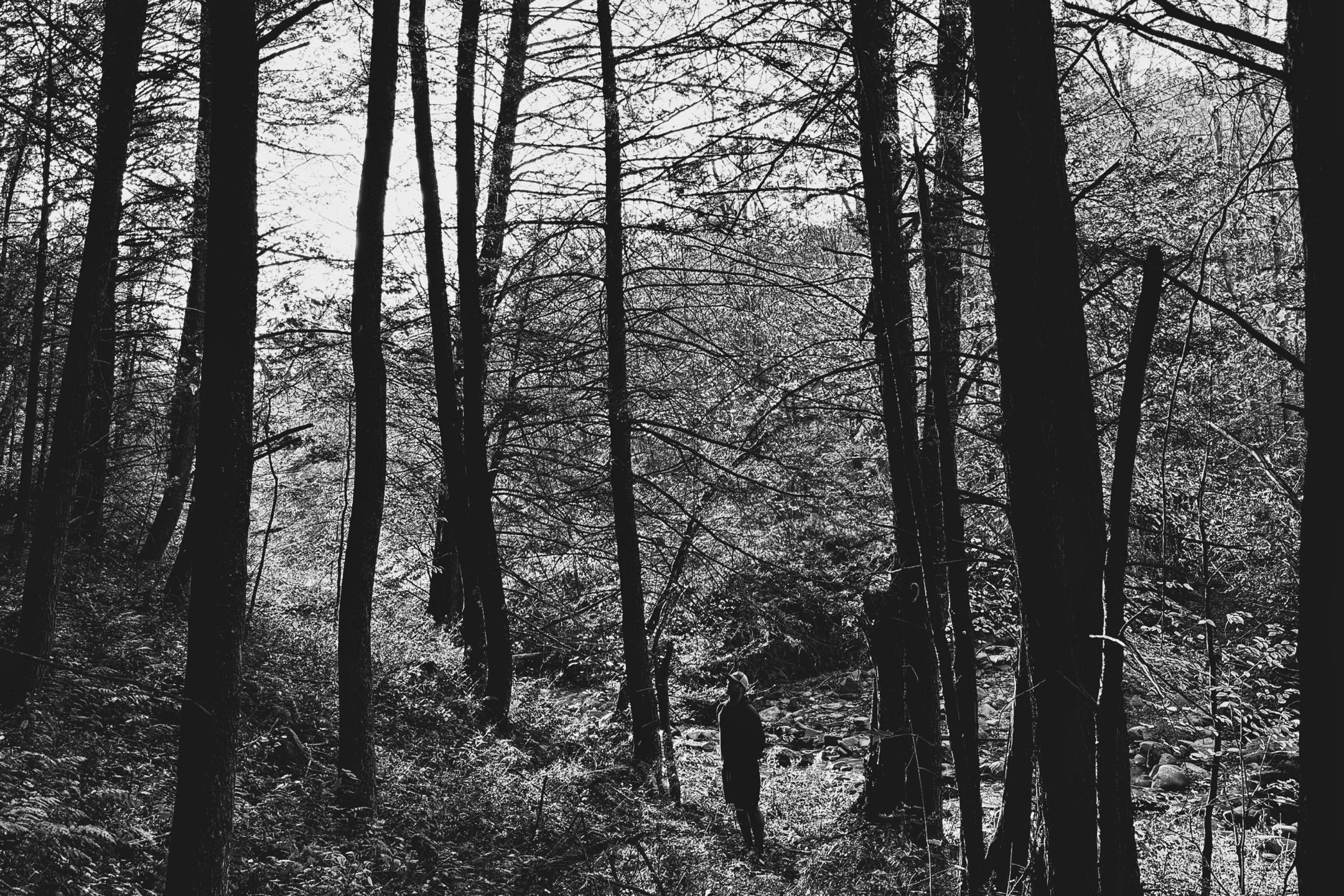
The eastern ridge behind my Catskills home rises in a thicket of bore-stripped ash and resilient hemlock, tangled with the bones of the old Ulster and Delaware Railroad. Stony Clove Creek runs through it—a clear, quick body of water that enlivens the border between my land and two hundred pristine acres held in the state’s Forever Wild trust. A backyard of public commons.
Route 214, New York’s highest highway, arcs north through old forest until it reaches Stony Clove Notch, the narrow seam Dutch settlers forced between Hunter and Plateau. I’m never sure which came first, the clove or the creek. The colonists arrived in the 1650s and immediately claimed a tract a thousand times larger than the law allowed. Long before the Dutch—and centuries before the ice climbers—the Mohican and Munsee traveled these rivers into the mountains, following glacial valleys widened and softened over millennia. Their word kill, meaning stream, still marks the map.
Catskill winters don’t arrive so much as assemble themselves. From my covered porch, I watch the season suggest its intent: the first frost failing to fell the last asters, leaves trembling into the gutters from major to minor key, geese staging at Colgate Lake. By November, the Airbnbs empty out and the valley settles. When the human noise lifts, barred owls take over—Who cooks for you? Who cooks for you-all? Their calls echo off the ridge like a question directed at no one in particular and at me most of all.
My partner, J., works mostly remote, commuting to Manhattan by Metro-North three times a week. My own uniform hangs 1,600 miles away in a Breckenridge garage, folded next to bone-dry skis and the Blue River’s scent of iron and early snow. When my locker stays empty, messages arrive: Where are you? We miss you. Don’t worry—the snow’s no good anyway. They mean it kindly, but the longing in me answers louder than the reassurance.
The night before my surgery, we haul in the Christmas tree. I insist on dragging it inside myself, shedding pine needles across the floor. J. crouches at the woodstove, trying to talk logistics—parking, timing, what to pack—while my mind refuses to step into the next day. I slip out onto the porch instead, where the owls are already calling, their voices rising from the dark as if rooted in the earth.
What will skiing feel like with a piece of myself gone? What will paddling feel like? I’m not the first to wonder how a body, once altered, relearns its own map. But on that porch, flannel blanket pulled tight, Sasha, our border collie pressing against my leg, I feel the question arrive with a kind of quiet force. The Dutch once hewed the Notch; tomorrow, the doctors will hew me.
Who cooks for you? Who cooks for you-all?
The owls call into starlessness—never seen, only heard. Their cries rise like something unearthed: root-voices pulled from soil. Even their bright, forsythia-wisp beaks evade detection. I pull a red flannel blanket tight against the chill they carry in. I try imitating their call, but I sound like a large dog in pain. Sasha slinks over. Her almond eyes brim with judgment. The owls keep hoo-ing. The Dutch hewed the Notch. Tomorrow, the surgeon will hew me.
I try not to scoff anymore when New Yorkers call these moraines mountains. Nothing here is pointy; oxygen is plentiful; the ocean is hours, not days, away. There is no tundra, no ptarmigan, no elk. And yet: geologic time makes and unmakes what we think of as permanence.
The Catskills are a dissected plateau—Devonian sandstones lifted and carved, sediments shed long ago from the Acadian Mountains when they stood near-Himalayan in scale. Glaciers later combed the edges and left their tidy piles. These mountains are older than the jagged peaks of my childhood—softened, like me now, by years.
Except in one place: the clove, an absence cut so deep it reveals sky. The Dutch later called our clove the Devil’s Notch. Charles Lanman, a nineteenth-century painter, described it as “the loneliest and most awful corner of the world…in single file did we have to pass through it.” And, on the appointed morning, in single file we pass again, J. driving me through the Notch toward Albany Med. I am a passenger in my own Subaru. Sasha snoozes in the back, thinking this is another adventure.
J. takes the big curve too fast. From the dark, an owl sweeps across the road—wings wide, mottled. An amber beak flashes inches from the windshield. For an instant, a deep black eye meets mine. The effect is eddying, as if the mountain briefly looked back.
The sun rises over the interstate. My fear lingers, but its shape changes.
In the OR, the drugs flow and a warm light gathers around me. My body softens like snowmelt. The incision feels abstract, a raft threading narrows. A potentially hazardous organ becomes a crux, then is gone.
Recovery is a slow geography. A topography of new scars runs across my abdomen. I lie like a bobsledder on the sectional’s chaise, able to move one way but not another. Time advances single file, Dutch through the Notch. J. skis at Hunter without me. Tasks accumulate. Sasha curls at my feet, careful of my new terrain.
One night, dulled by painkillers, I hear a woman on TV say, “We’re all born with two numbers. The dash in between is what you do with your life.” The owls cut through the streaming and answer with their unwavering call.
In the new year, J. drives me toward Woodstock, the opposite direction from the Notch. We go to my favorite bakery. Mr. B.B., retired English teacher and local writer, meets me for grilled cheese—Gruyère, mustard, caramelized onions. After weeks of bland recovery food, it tastes like triumph.
I list my losses: the middle school team I won’t coach, the women’s group I won’t lead, the private clients entrusted to others. The owls echo in my head. Who cooks for you?
Mr. B.B. knows melancholy’s timbre. He has taught generations of it.
“Your loss is real,” he says. “But your life outside isn’t over. There are skiers you haven’t met yet. And in the meantime—write. Also, want to split an éclair?”
Over the next weeks, my scars resolve into dashes. Ice drips from the eaves and melts before the plow can push it toward the southern side of the house, where the kayaks sleep. Before dawn, while the owls still call, I rise first. Coffee. Words. At first they fall like stray flurries; then in a small storm. Writing opens a narrow passage I’d forgotten was there. In the ink-dark edge of morning, the blank page feels like Claimjumper’s first corduroy, the run I used to take before work. Speed, silence, a moment alone. The same recognition of myself moves through my hands now instead of my feet.
Then one morning, the owls are silent. The next day too. Their absence drapes the ridge in a watchful stillness.
J. and I feed the Christmas tree to the woodstove branch by branch. I begin walking Sasha around frozen Colgate Lake. I can lift laundry again. Venus rises later each day; Orion still hangs low over the Notch.
My doctor clears me to head west.